
Branded mobile app: features to compare | Scrile
Compare branded mobile app features, delivery models, costs, and ownership trade-offs to decide when a custom fitness app is worth building.

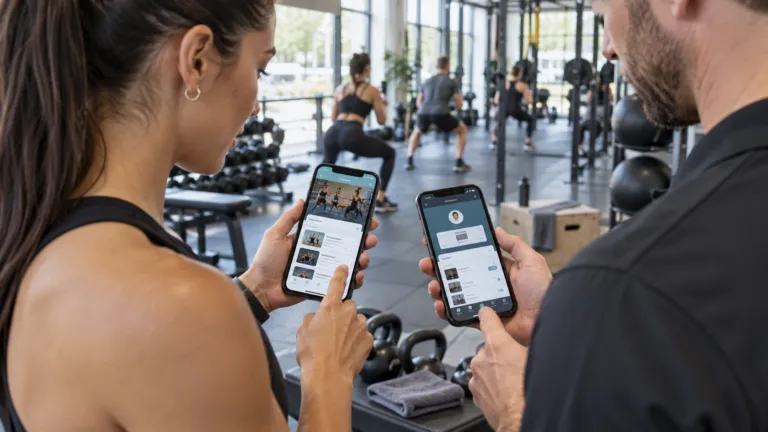
Fitness professionals comparing membership app screens during a gym class
Quick answer
A branded mobile app gives a fitness business a direct channel for booking, payments, content, and member communication. It is worth considering when customers return frequently and mobile convenience can remove friction from that habit. Compare operational workflows and ownership first; colors and an app-store icon are the easy part.
When does a branded mobile app make business sense?
Build an app when frequent customer actions are already proven and a phone-native experience can make them materially easier. A responsive website remains the better first step when demand, retention, or the operating model is still uncertain.
The costly mistake is commissioning an app because competitors have one. Start with behavior instead: what will a member repeatedly open it to do? For a gym, that may be reserving a class, joining a waitlist, checking a pass, watching a session, or messaging a coach. If the only answer is “read about us,” the browser has already won the argument.
| Solution | Best fit | Main limitation |
|---|---|---|
| Responsive web | Discovery, occasional purchases, and early validation | Weaker re-engagement and fewer device-native options |
| Web wrapper or template | Standard content, booking, and simple membership flows | Limited differentiation and dependence on the provider’s roadmap |
| Custom branded app | Frequent transactions, distinctive workflows, or deeper integration | Higher release, maintenance, and governance responsibility |
The threshold is operational, not fashionable. Confirm that staff can maintain schedules, content, support, and customer records across channels. Founders still validating an offer should usually begin with fitness app development around the smallest complete member journey, then add native delivery when usage justifies it. The practical implication: approve an app only after naming the recurring action, its business outcome, and the system that will fulfill it.

Consider a studio whose members book the same morning classes every week. An app can reduce the journey to opening, selecting, and confirming, while a notification can bring a member back when a waitlist place becomes available. By contrast, a personal trainer selling a few high-value packages may gain little from an install requirement; a fast mobile site and direct messaging could serve the same job. Map frequency before choosing technology: repeated weekly behavior supports an app case, while rare behavior usually supports the web.
Which features should a fitness scheduling app include?
Prioritize the complete member transaction: accurate availability, booking, payment, access, reminders, and support. Content and community features matter only when they reinforce that journey rather than becoming decorative tabs.
A useful fitness scheduling app starts with one source of truth for classes, trainers, capacity, cancellations, and waitlists. The fitness booking app should show live eligibility, apply passes or membership rules correctly, and return an unambiguous confirmation. Payments need receipts, renewal and failure handling, refunds, and a clear route to staff support. A polished checkout attached to a confused back office merely produces complaints more elegantly.
- Schedule and booking: capacity, waitlists, recurring sessions, cancellations, and time zones.
- Payments and membership: passes, subscriptions, purchase history, entitlement checks, and recovery from failed payments.
- Engagement: permission-based push notifications, deep links to the relevant action, video, and private messages.
- Customer profile: preferences, waivers, attendance, purchases, consent, and support history.
- Operations: role-based administration, moderation, analytics events, integrations, and auditable changes.
Test every feature as a workflow crossing customer, coach, administrator, and payment systems. This matters for teams combining classes with premium media or content creator management: creator permissions, subscriber access, payouts, and moderation cannot be improvised after launch. The next action is to write acceptance tests for the ten member tasks that produce revenue or prevent churn.

How should you compare pricing, ownership, and app operations?
Compare total operating responsibility, not just setup price. The decisive questions are who owns the store listings, customer data, analytics history, payment relationships, source code or configuration, release process, and exit path.
A quoted fee can hide the parts that determine long-term leverage: vendor charges, store accounts, payment processing, integration work, content operations, customer support, compliance reviews, testing, and updates after operating-system changes. Ask vendors to separate fixed costs, usage-linked costs, pass-through charges, and optional development. Then document what happens if you change suppliers.
Use a break-even model tied to behavior you can measure. Hypothetical assumptions: the app costs $24,000 over its first year, contributes $8 in monthly gross profit per active adopter, and creates no other savings. The required average is 250 active adopters because $24,000 ÷ ($8 × 12) = 250. Replace every assumption with your own retention, margin, support, and maintenance data; downloads are not a financial outcome.
Ownership also changes marketing economics. An app cannot rescue weak acquisition, so pair the product decision with gym SEO and a deliberate installation campaign. Track acquisition source, activation, first booking, repeat booking, paid conversion, notification consent, refund, and cancellation across web and app. The implication is simple: reject any proposal that cannot preserve analytics continuity or export the records needed to operate elsewhere.
How should the app fit the wider digital platform?
Treat the app as one interface to a shared business platform, not as a separate product. Identity, membership, content access, conversations, payments, and analytics should remain consistent across mobile web, native apps, and administration.
Fragmentation appears quickly when the website sells one plan, the app recognizes another, and staff reconcile both by spreadsheet. Define a canonical user account and entitlement model before designing screens. Decide which channel owns checkout, how purchases unlock content elsewhere, how notification preferences synchronize, and what support agents can see. The same discipline applies when adding a customer community platform: membership status and moderation decisions must travel with the customer.
This is also where white-label and custom diverge. White-label delivery can accelerate a standard launch; custom work becomes rational when the differentiating journey, business rules, integrations, or governance cannot fit a template. Branding means more than colors. It includes your domain, policies, pricing, navigation, communication rules, release authority, and the continuity of customer relationships.
Plan the ecosystem in this order: shared data and permissions, revenue-critical workflows, mobile experience, then secondary engagement features. A branded app should make a functioning business loop easier to repeat. If it creates another isolated database, it has delivered an icon and an administrative hobby.

For a business combining workouts, premium video, and coach access, one membership might unlock scheduled sessions, gated recordings, private messages, and occasional live events. The member should not need to understand which backend supplies each feature. Administrators, however, need explicit roles, moderation queues, payment status, and a consistent support record. Before procurement, draw this service blueprint from purchase to renewal and cancellation. Any unexplained handoff is either an integration requirement or future manual work wearing a small disguise.
Build the channel around the business you want to own
Scrile Connect provides a white-label foundation for branded subscription and monetization businesses, with an owned domain, memberships, pay-per-view content, tips, private messages, livestreams, video calls, flexible payment flows, and administration for users, payouts, earnings, and analytics.
For fitness, coaching, creator, or community businesses, Scrile can pair that foundation with custom features and integrations. The sensible starting point is the service blueprint: identify the recurring member journey, ownership requirements, and revenue rules, then choose the web and mobile experiences that support them.
Frequently asked questions
What is a branded mobile app?
It is an iOS or Android app presented under a business’s identity and designed around its customer workflows, such as booking, membership, content, payments, and communication.
Does a gym need its own mobile app?
Not automatically. An app is most useful when members perform frequent repeat actions and mobile access can improve convenience, retention, or purchasing.
What features matter most in a gym management app?
Start with reliable schedules, bookings, waitlists, membership entitlements, payments, reminders, customer profiles, staff controls, analytics, and support workflows.
Is a responsive website enough instead?
Yes, particularly for discovery, occasional transactions, and early validation. Native delivery becomes more compelling when repeat use, push notifications, device integration, or offline behavior matters.
What is the difference between white-label and custom app development?
White-label products configure an established platform for faster delivery. Custom development provides more control over distinctive workflows, integrations, governance, and user experience, but requires greater investment and maintenance.
Who should own the app-store accounts?
The operating business should understand and preferably control its developer accounts, release permissions, credentials, listings, and transfer process, even when a vendor manages publication.
How do you calculate whether a branded app will pay off?
Estimate total ownership cost, then compare it with attributable gross profit and operating savings from active users. Use retained adopters and completed transactions rather than downloads.
Can one platform support bookings, content, and paid communities?
Yes, provided identity, entitlements, payments, moderation, and analytics are designed as shared services instead of separate channel-specific records.
