
Compare fundraising platforms without losing donations to fees
Compare fundraising platforms by total cost, donor experience, integrations, ownership, and switching risk before choosing your nonprofit’s stack.

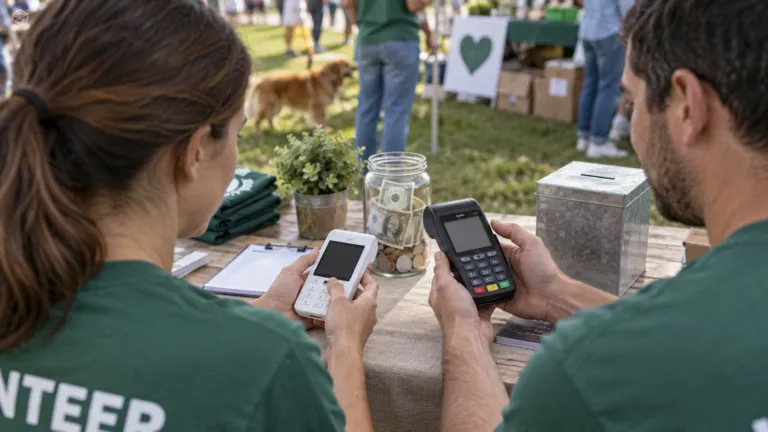
Nonprofit volunteers comparing donation checkout devices at a charity event table
Quick answer
To compare fundraising platforms, calculate total operating cost rather than relying on the headline platform fee. Then test the donation flow, recurring giving, campaign tools, integrations, data access, branding, support, and exit process. A low-cost service suits simple campaigns; growing organizations may save more by paying for automation or owning a branded platform.
Why platform choice affects more than processing fees
A fundraising platform determines how easily people can give, how much revenue reaches the organization, and what happens to donor relationships afterward. The wrong choice can save money at checkout while creating extra administration, weak follow-up, or an expensive migration later.
Start with the donor journey, not the pricing page. A visitor must recognize the organization, understand the appeal, select an amount, choose a payment method, and complete the gift without unnecessary doubt or effort. After payment, the organization must record consent, issue an acknowledgement, update its donor records, and trigger suitable follow-up. A nominally free form that breaks this chain is not free; it merely sends the bill to staff time and missed retention.
- Net revenue: platform, payment, subscription, add-on, and implementation costs can affect the amount retained.
- Conversion: mobile usability, payment choices, form length, and trust cues influence whether an intended gift is completed.
- Operations: exports, integrations, receipts, refunds, permissions, and reconciliation determine the manual workload.
- Relationship value: recurring support and useful donor histories make it easier to continue the relationship after one campaign.
- Control: branding, domains, data portability, and account access shape dependence on the vendor.
This is why a nonprofit fundraising plan should define campaign types, donor journeys, reporting duties, and ownership requirements before the software shortlist is built. Otherwise, attractive features become substitutes for decisions the organization has not made. The practical implication is simple: document the operating model first, then eliminate platforms that cannot support it.

Which type of fundraising platform fits your operating model?
Popular solutions fall into a few operating models: tip-supported services, subscription software, transaction-priced tools, and custom branded platforms. None is universally cheapest because each places cost, configuration work, donor prompts, and ownership in a different part of the system.
| Model | Best fit | Main advantage | Question to test |
|---|---|---|---|
| Tip-supported hosted service | Small teams launching standard campaigns | Low direct software cost | How are donors asked to cover costs, and can prompts be changed? |
| Subscription software | Organizations with steady campaign volume | Predictable access to packaged tools | Which integrations, support levels, or features require a higher plan? |
| Transaction-priced platform | Variable or seasonal fundraising | Cost can track donation volume | What is the full charge after payment processing and add-ons? |
| Custom branded platform | Operators with distinct workflows or ownership goals | Greater control over brand, data, and roadmap | Does the expected control justify build, maintenance, and compliance responsibility? |
For a straightforward appeal, test whether a hosted service covers campaign pages, receipts, exports, refunds, and the payment methods donors actually use. For an established program, examine recurring gifts, supporter records, permissions, automation, and integration depth. Founders building a differentiated fundraising business should also evaluate a white label crowdfunding platform or custom solution, because another provider's branding and fixed workflow may constrain the product being sold.
Fundraising software reviews are useful for discovering recurring complaints, but ratings combine organizations with different volumes, skills, and expectations. Turn every review theme into a testable requirement rather than treating popularity as proof of fit. The next action is to shortlist one option from each relevant model and run the same campaign scenario through all of them.

How to compare fundraising platforms by total cost and capability
Compare fundraising platforms with a weighted scorecard and a cost model based on your own donation volume. Keep fees, donor experience, operations, integrations, control, and switching risk separate so a strong score in one category cannot conceal a release-blocking weakness in another.
- Set pass-or-fail requirements for payment methods, recurring gifts, receipts, accessibility, data exports, permissions, and applicable compliance needs.
- Estimate total cost from subscriptions, platform and payment charges, paid integrations, implementation, support, and recurring staff work.
- Complete test donations on mobile and desktop, including a failed payment, refund, recurring-gift change, and acknowledgement.
- Verify integrations by tracing one donor record into the systems used for finance, communications, and relationship management.
- Review contract exit terms, export completeness, domain control, payment portability, and the work required to switch.
Worked example: assume an organization collects $50,000 through 1,000 gifts in a year. An illustrative 1% platform charge equals $500 before payment processing, subscriptions, add-ons, or labor. If a second option has no platform charge but requires 40 hours of manual reconciliation, the decision depends on the organization's internal cost for those hours. The calculation is not a vendor quote; it shows why “zero platform fee” and “lowest total cost” are different claims.
Next, define the reports needed to manage the program. Useful fundraising analytics should connect campaigns, completed gifts, recurring status, refunds, and supporter activity rather than producing an impressive total with no operational explanation. Reject any candidate that fails a mandatory test, then score the survivors. This prevents price from compensating for a capability the organization cannot operate without.

When should you use a service, and when should you build your own fundraising site?
Use an established service when standard workflows, rapid launch, and limited internal administration matter most. Consider a custom branded platform when fundraising is central to the business model, the supporter relationship extends beyond checkout, or control over branding, data, and product direction is strategically important.
Building does not eliminate costs; it changes which costs you control. An owned platform still needs payment infrastructure, security, maintenance, support procedures, and responsible data handling. The case becomes credible when fixed templates or shallow integrations repeatedly force manual work, when vendor branding weakens the proposition, or when campaign communities and ongoing supporter engagement are part of the product rather than optional extras.
Before choosing to create a fundraising site, write down the capabilities required at launch and those that can wait. Separate essential donation and campaign workflows from speculative features. Confirm who will own product decisions, content moderation, donor support, financial reconciliation, and technical maintenance. Ownership is valuable only when the organization is prepared to exercise it.
For fundraising founders, nonprofits, creators, charities, and community projects that need a branded environment, Scrile Connect – Fundraising Platform is positioned around campaigns, donations, recurring support, supporter communities, paid updates, and ownership of campaign branding and data. Evaluate that fit against the same scorecard used for packaged services, including implementation responsibility and long-term operating cost.
The final decision should state not only which option won, but why, under which assumptions, and what would cause reconsideration. Choose the service if its constraints are acceptable and its total cost remains favorable. Explore a branded build if control and differentiated supporter workflows are sources of value rather than vanity. That distinction keeps the platform decision attached to the fundraising model.

Choose the platform economics you want to operate
A strong platform decision balances donations retained today with the donor experience, staff workload, integration quality, and control required tomorrow. If packaged services cannot support the model without costly compromises, a branded fundraising environment deserves a place in the comparison.
Scrile Connect supports fundraising campaigns, donations, recurring support, paid updates, supporter engagement, and community monetization under a branded platform. Assess it against your requirements, ownership goals, and capacity to operate the experience.
Frequently asked questions
What should I compare when choosing a fundraising platform?
Compare total cost, donation experience, recurring giving, campaign tools, payment methods, integrations, reporting, support, data access, branding, and switching requirements.
Are zero-fee fundraising platforms actually free?
Not necessarily. They may rely on optional donor contributions, while payment processing, premium features, integrations, implementation, or staff work can still create costs.
Which fundraising platform has the lowest fees?
There is no universal winner. The lowest-cost option depends on donation volume, gift size, payment mix, subscriptions, add-ons, donor-covered costs, and administrative labor.
What is the difference between platform fees and payment processing fees?
A platform fee pays for the fundraising service, while a processing fee covers handling the payment. Some providers waive one category but not the other.
What features matter most for recurring donations?
Look for clear recurring enrollment, payment updates, cancellation management, failed-payment handling, donor history, acknowledgements, exports, and reliable internal records.
How should nonprofits use fundraising software reviews?
Use reviews to identify issues worth testing. Do not treat aggregate ratings as proof because reviewers may have different campaign volumes, workflows, budgets, and technical resources.
When is a custom fundraising platform worth considering?
Consider it when fundraising is strategically central and branded ownership, distinct workflows, supporter communities, recurring support, or control of data and roadmap justify the operating responsibility.
How can an organization reduce switching risk?
Verify export completeness, contract terms, domain control, integration dependencies, payment arrangements, consent records, and the process for moving recurring supporters before signing.
