
How text donations work for nonprofits and donors
Learn how text-to-give routes donors from an SMS keyword to payment, what nonprofits must configure, and when a website works better instead.

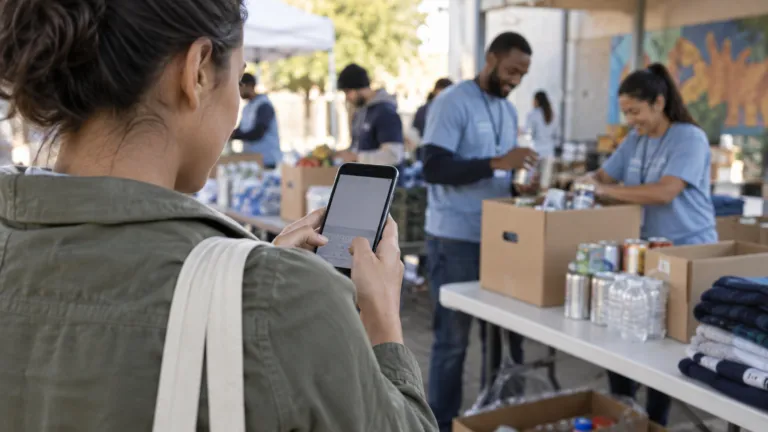
A donor using a phone to make a text donation at a local nonprofit event
Quick answer
How does text to give work? A donor sends a campaign keyword to a designated phone number and receives an automated reply. In the common link-based model, that reply opens a mobile donation page where the donor chooses an amount, enters payment details, and receives confirmation. In a carrier-billed model, a fixed gift may instead appear on the donor's mobile bill. The nonprofit configures the keyword, routing, payment flow, receipts, consent, and reporting.
How does text to give work from message to donation?
Text-to-give turns a public fundraising prompt into a mobile action. The text usually starts the journey; it does not necessarily complete the payment. Donors should therefore know whether they are authorizing a carrier-billed gift or opening a secure web form.
In the link-based model, a supporter texts a keyword such as RELIEF to a number shown at an event, in a video, or on printed material. An automated reply provides a campaign-specific link. The donor opens it, selects an amount, enters payment details, submits the gift, and receives a receipt or confirmation. This is often called an SMS donation even though the financial transaction occurs on the web. The message removes the need to remember or type a long address at the moment of interest.
- Donor: send the advertised keyword to the correct number.
- Messaging system: match the keyword and return the configured response.
- Donation platform: open the intended campaign form and collect the gift.
- Payment processor: authorize the payment and report its status.
- Nonprofit: issue the appropriate acknowledgement and record the supporter relationship.
Carrier-billed giving follows a different route: the mobile operator adds a predefined amount to the phone bill and later transfers eligible funds. Availability, gift values, settlement, and donor data can be more constrained. The practical implication is simple: describe the actual payment path rather than promising that every donation is completed “by text.”

What nonprofits must configure behind the keyword
To set up text donations, a nonprofit needs a messaging route, a memorable keyword, an automated reply, a mobile payment destination, confirmation records, and rules for consent and follow-up. Provider selection should start with the required donation model, not the novelty of the number.
| Component | Donor experience | Nonprofit decision |
|---|---|---|
| Number and keyword | Starts the interaction | Dedicated or shared number; collision and typo handling |
| Automated reply | Explains the next action | Message wording, campaign link, disclosures, and help path |
| Donation form | Collects payment and donor details | Fields, suggested gifts, recurring option, and mobile usability |
| Payments and records | Authorizes and reconciles the gift | Processor, receipts, refunds, exports, and campaign attribution |
Before launch, test the complete route on several common phone sizes and with someone who did not help design it. Confirm that uppercase and lowercase entries behave sensibly, incorrect keywords receive useful guidance, the campaign link opens directly, failed payments do not look successful, and duplicate taps do not create confusion. Decide which system owns the donor record and how SMS-origin gifts will appear in fundraising analytics. Without clean attribution, the channel can feel busy while its financial contribution remains obscure.
The next action is to write a one-page acceptance checklist covering message delivery, form loading, payment status, receipt delivery, opt-out handling, and reconciliation. Launch only after one staff member can trace a test gift from the first text to the final record.

Why text-to-give can help donors and nonprofits
Text-to-give works well when it reduces the distance between an emotional prompt and a credible payment page. It is particularly useful in live, broadcast, volunteer-led, and local campaigns where people already have a phone in hand but are unlikely to type a web address.
For donors, the keyword is easy to hear, display, and act on without leaving the moment. For nonprofits, each keyword can route supporters to a specific appeal and distinguish one event or partner from another. The same prompt can appear on stage slides, direct mail, social posts, volunteer cards, and signs. That makes SMS a distribution mechanism rather than a separate fundraising strategy. It strengthens good fundraising ideas for nonprofits when the cause, amount, urgency, and destination are already persuasive.
Worked example, using assumptions rather than a forecast: an event prompt produces 200 valid keyword messages. If 60 recipients open the form and 36 complete an assumed $25 gift, the campaign records $900 from SMS-origin donors. The form completion rate among starters is 36 divided by 60, or 60%. The useful diagnosis is not merely “SMS raised $900.” The 140 people who did not open and the 24 who started but did not finish point to different problems: prompt relevance in the first case, form friction or trust in the second.
Track message, link, form-start, completion, gift, refund, and repeat-support outcomes separately. This makes channel improvement possible and connects mobile acquisition to the wider lessons in fundraising tips rather than treating every incoming text as a donation.

Where SMS donation campaigns lose money or trust
Text-to-give is a poor fit when fees, carrier restrictions, weak mobile forms, incomplete donor data, or consent requirements outweigh the convenience of the first message. The correct decision requires the full operating cost and donor journey, not a comparison of headline platform fees alone.
| Situation | Likely fit | Reason |
|---|---|---|
| Live appeal with a short response window | Strong | A memorable keyword captures immediate intent |
| Audience already clicking email or social links | Conditional | SMS may duplicate an established route |
| Complex campaign needing extensive explanation | Weak as the destination | A text cannot carry the full case for support |
| Long-term supporter program | Useful as an entry point | The website and donor system must sustain the relationship |
Request a written fee map covering messaging, number rental, platform charges, payment processing, refunds, failed payments, carrier deductions where applicable, and settlement rules. Then inspect ownership: can the nonprofit export donor and campaign records, and can it distinguish consent to receive operational confirmations from consent to receive future marketing? Legal requirements vary by jurisdiction, so the organization should obtain appropriate advice rather than copying another campaign's wording.
SMS should earn its place beside, not automatically replace, other nonprofit fundraising platforms. Approve it when the audience context favors an immediate mobile response and the organization can support the resulting donors. Otherwise, direct people to a strong web page and spend the operational budget where it removes more friction.

When a donation website should carry the relationship
A donation website is the better center of gravity when a campaign needs explanation, flexible gifts, recurring support, updates, supporter accounts, or durable ownership of branding and data. SMS can still serve as the short route into that owned experience.
The website should answer the questions a text cannot: who operates the campaign, what the money supports, how progress will be reported, what payment options exist, and how a donor can get help. Before adding an SMS keyword, learn how to create a fundraising page with a clear purpose, credible organization details, restrained form fields, and an unmistakable confirmation state. A good mobile page also supports campaign-specific attribution without forcing every supporter into the same generic form.
For organizations building a broader operation, Scrile Connect – Fundraising Platform is positioned for branded fundraising sites, campaigns, donations, recurring support, paid updates, supporter engagement, and community monetization. Its relevant advantage here is not that it makes messaging magically sufficient. It gives the organization an owned destination where an SMS-acquired donor can understand the campaign, contribute, and remain connected. Teams evaluating branded ownership can also compare the case for a white label crowdfunding platform.
- Make the mobile donation page complete and trustworthy.
- Choose SMS only for contexts where a keyword is easier than a direct link.
- Route each keyword to the correct campaign rather than a generic homepage.
- Measure completed donations and continued support, not message volume alone.
The resulting architecture is deliberately unglamorous: SMS captures attention, the fundraising site completes and explains the transaction, and supporter workflows continue the relationship. Build in that order. A memorable keyword cannot rescue an unconvincing destination.

Build the destination behind the text
Text-to-give can shorten the first step, but the fundraising platform determines whether that moment becomes a trusted donation and a lasting supporter relationship.
Scrile Connect supports branded fundraising campaigns, donations, recurring support, paid updates, and supporter communities under an organization-owned experience. Explore how donation tiers can give different supporters clearer ways to participate.
Frequently asked questions
What is the difference between text-to-give and text-to-donate?
The terms are often used interchangeably. The important distinction is between carrier-billed giving, where a fixed amount may appear on a phone bill, and link-based giving, where the text opens a mobile payment form.
Can someone donate to charity by text without opening a website?
Sometimes. Carrier-billed programs can complete eligible gifts through the mobile account, but many modern campaigns use SMS to send a link to a secure donation page.
How do nonprofits set up text donations?
Choose the donation model and provider, configure a number and keyword, build the mobile form, write automated replies, connect payment and donor records, address consent requirements, and test the complete journey.
Does a donor get charged for sending the text?
Normal messaging or mobile-plan charges may apply depending on the donor's carrier and plan. In carrier-billed giving, the donation itself may also appear on the mobile bill.
Can text-to-give accept recurring donations?
A link-based flow may offer recurring support if the connected fundraising platform provides it. The automated message alone does not create or manage a recurring donation.
What should a nonprofit measure in a text-to-give campaign?
Measure valid messages, link opens, form starts, completed gifts, net funds, refunds, consent status, repeat gifts, and subsequent engagement. Message volume alone is not a donation metric.
Is text-to-give secure?
Security depends on the messaging provider, payment flow, access controls, data handling, and staff processes. Donors should see a recognizable campaign destination and clear payment confirmation.
When should a nonprofit use a website instead of SMS giving?
Use the website as the primary destination when donors need detailed context, flexible payment choices, recurring support, campaign updates, or account features. SMS can remain a convenient route into it.
