
OnlyFans Terms of Service 2026: What Changed for Agencies?
OnlyFans updated its Terms of Service in October 2026, introducing broader grounds for account suspensions, payout holds, and new restrictions on CRM and AI tools. Here’s what changed, what stayed the same, and how agencies can protect their operations and reduce dependence on a single platform.

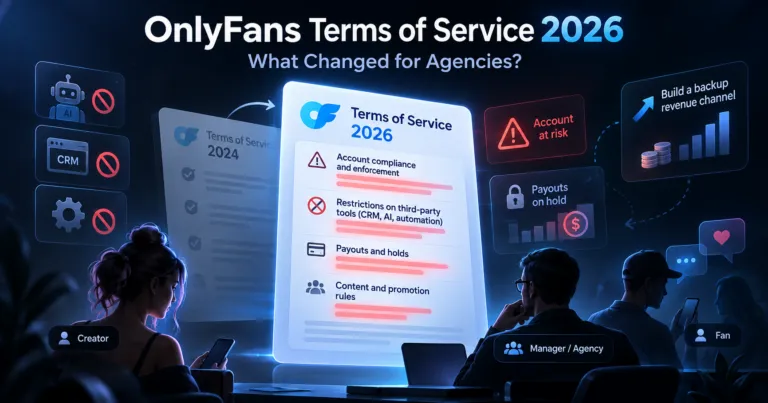
OnlyFans Terms of Service 2026 changes affecting creator agencies
OnlyFans has published updated Terms of Use dated October 2026, with the changes expected to take effect in November. The revised agreement expands the grounds for account restrictions and payout holds, introduces explicit limits on data collection and AI training, and changes how the platform commits to notifying users about future updates.
For established OnlyFans agencies, these changes raise practical questions. Could a suspected policy violation interrupt payouts? Do existing CRM and chat tools comply with the revised rules? And how much of the business should depend on one platform?
We compared the October 2026 Terms of Use against the August 2024 version to identify the actual changes, explain their implications, and outline the steps agency owners should consider.
Quick answer: The updated terms broaden OnlyFans’ enforcement powers and make certain restrictions on data collection and software training more explicit. They do not introduce a general ban on agencies, eliminate the 20% platform fee, or create the ability to suspend accounts without notice for the first time. Agencies should review their tools, document compliance procedures, and consider building a second revenue channel.
OnlyFans Terms of Service 2024 vs. 2026: What Changed?
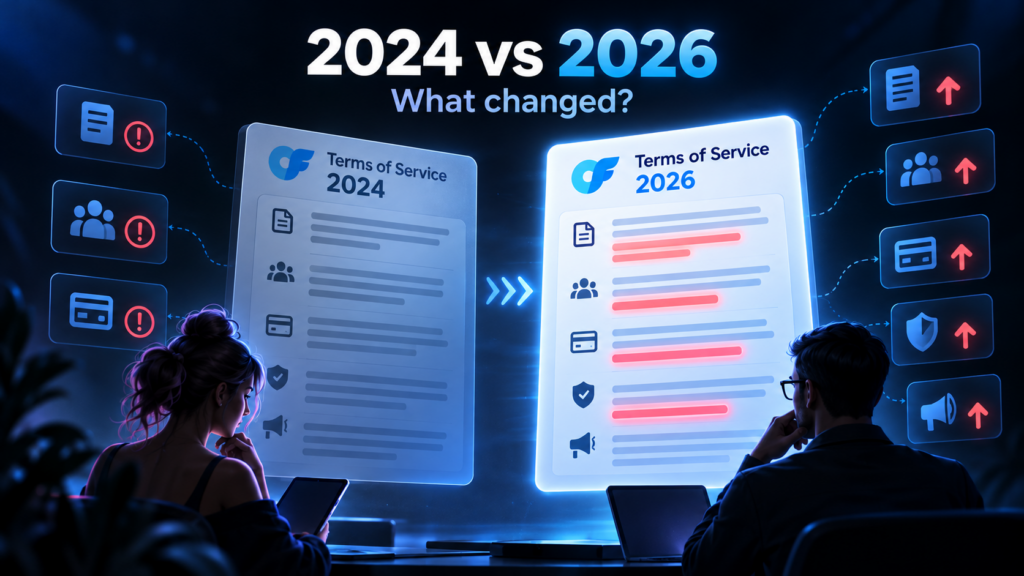
The most significant changes concern account enforcement, information requests, third-party tools, AI, and notification procedures.
| Provision | August 2024 | October 2026 |
|---|---|---|
| Account suspensions and payout holds — 14.b.i | Suspected serious or repeated violations | Suspected violation, without the seriousness or repetition requirement |
| Financial or reputational harm — 14.b.iv | No equivalent standalone ground | Potential loss or reputational harm becomes an additional ground for enforcement |
| Information requests — 14.b.v | No equivalent general enforcement ground | Failure to promptly provide requested information becomes a listed ground |
| Data collection and AI training — 8.g | No equivalent standalone provision in the Terms of Use | Explicit restrictions on data collection, access controls, and software training |
| OnlyFans AI services — 12.e | AI use described primarily for moderation | Platform-provided services may process content, including direct messages, using AI |
| Changes to terms — 4 | Stronger commitment to notify users about other changes | Reasonable efforts to notify users of other material changes |
| Disputing decisions — 14.d | Six months to dispute a decision | Same deadline, with an explicit written-dispute requirement |
| AI-generated content — 19.b | AI disclosure required | Content must also clearly feature the verified creator |
These differences are drawn from the two versions of the Terms of Use. They should not be interpreted as a complete comparison of every OnlyFans policy, including the separate Acceptable Use Policy and Community Guidelines.
When do the new OnlyFans terms take effect?
The published document states Last updated: October 2026 but does not identify an exact effective date. Reports about notices sent to creators indicate that the changes are expected to apply in November 2026.
Agency owners should check their own platform notifications and the currently applicable agreement rather than rely on an assumed effective day.
1. Account Suspensions and Payout Holds: A Lower Threshold
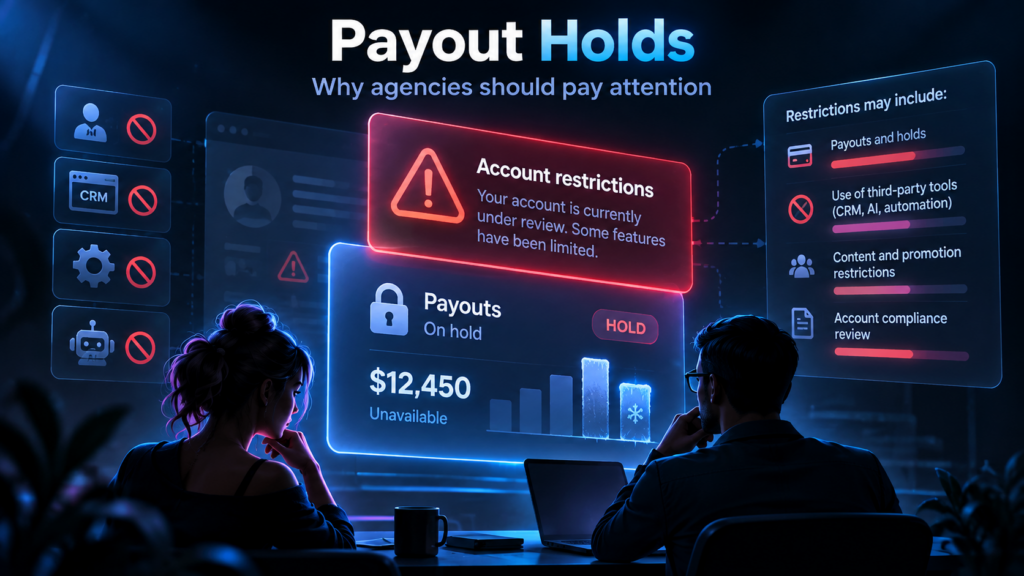
The most important change for agencies appears in Section 14.b.i.
In the August 2024 version, the relevant clause referred to users who had potentially seriously or repeatedly breached the rules.
The October 2026 version removes that qualification. The provision now applies when OnlyFans believes a user has breached, or may have breached, the Terms of Service.
This is a meaningful change in contractual wording.
OnlyFans already had the ability to suspend accounts and temporarily withhold earnings without advance notice. What changed is the threshold for invoking those powers under this particular provision.
Can OnlyFans withhold earnings over a suspected violation?
Section 14.b permits several measures while the platform reviews the relevant circumstances:
- Suspending or deleting an account or content.
- Pausing certain user payments.
- Withholding some or all Creator Earnings.
- Suspending, refunding, or canceling payments.
These measures can be taken before the platform completes its review.
However, a temporary payout hold is not identical to permanent forfeiture. Section 14.c separately describes measures OnlyFans may take after determining that one of the listed grounds applies, including treating part of the Creator Earnings as forfeited.
For an established agency, even a temporary restriction can create financial pressure. Staff salaries, advertising expenses, creator payments, and other operational commitments may continue while income is unavailable.
What agencies should do: Review cash-flow exposure across creator accounts, identify essential expenses, and document how the business would operate during a payment interruption.
2. Two Additional Reasons for Account Restrictions
The revised Section 14.b introduces two further grounds for enforcement.
Potential financial or reputational harm
Section 14.b.iv addresses actions that OnlyFans believes have caused, or are reasonably likely to cause, losses or reputational harm to the platform or its users.
This provision gives the platform another basis for responding to conduct it considers harmful.
It does not provide an exhaustive list of prohibited agency activities. Agency owners should therefore review potentially sensitive marketing, communication, and account-management practices against the applicable policies.
Delayed responses to information requests
Section 14.b.v adds failure to promptly provide necessary requested information as another ground for action.
The updated terms do not establish a universal response deadline.
For agencies managing multiple creators, this makes internal coordination especially important. A verification request may require documents or information that only the creator can provide.
What agencies should do: Assign a compliance contact, establish an escalation process, and maintain secure access to the necessary records and permissions.
3. What the New Rules Mean for OnlyFans CRM and AI Tools
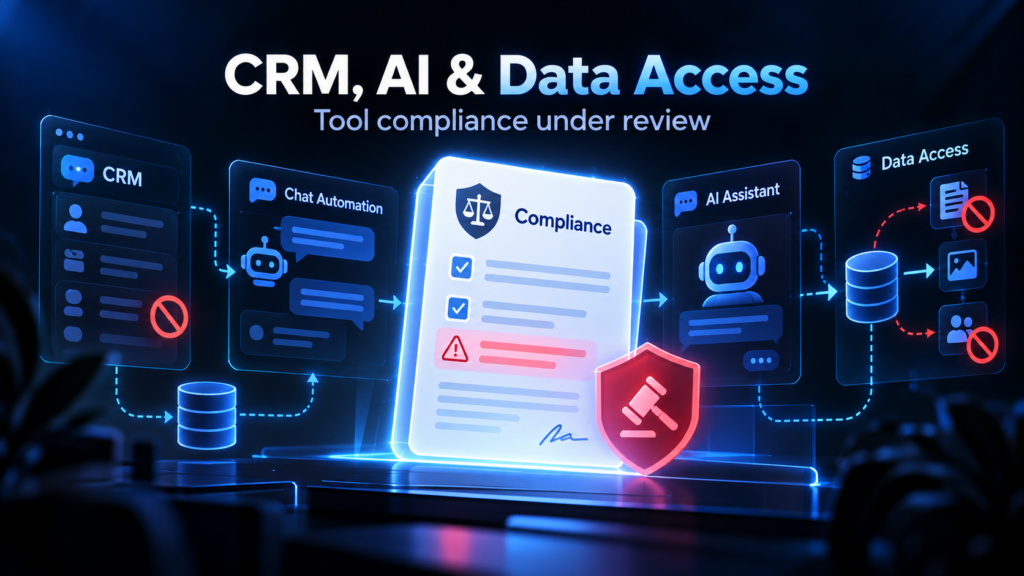
Section 8.g is particularly relevant to agencies using third-party software.
The updated Terms of Use restrict manual and automated tools designed to collect information from Content or Direct Services. They also prohibit circumventing access controls and using those materials to train or enhance software, machine-learning systems, or AI systems.
These provisions raise important questions for CRM platforms, browser extensions, automation software, analytics tools, and AI chat assistants.
Are third-party OnlyFans CRM tools now banned?
The revised Terms of Use do not prohibit all software marketed as CRM by name.
Instead, compliance depends on what the software does, how it accesses information, and which materials it processes.
Consider these examples:
| Agency workflow | Compliance consideration |
|---|---|
| A manager manually replies through the standard OnlyFans interface | The new clause does not establish a general ban on human account management |
| A CRM automatically collects messages, content, or other platform data | May raise concerns under the data collection and access restrictions |
| Software trains or improves an AI model using OnlyFans content | Directly implicates the software-training restriction |
| An AI assistant uses conversation context to suggest a reply | Requires assessment of data access and processing, even if no model training occurs |
One important distinction is between AI inference and model training.
Using existing context to generate a suggested response does not necessarily mean training the underlying model. But that technical distinction alone does not establish compliance with the separate restrictions on collecting or accessing OnlyFans information.
Were automation restrictions new in 2026?
Not entirely.
Earlier OnlyFans policies already restricted certain forms of automated access and data collection. The October 2026 Terms of Use make relevant restrictions explicit in the main agreement and specifically address software and AI training.
Agencies should review both the updated Terms of Use and other applicable policies rather than assume previously used software remains acceptable.
A practical first step is to request technical and compliance documentation from each vendor. Agencies should understand what data a tool accesses, where it is stored, whether it is reused, and whether it contributes to model training.
OnlyFans may also develop its own AI services
Section 12.e adds another noteworthy provision.
OnlyFans states that it may provide platform services designed to improve Creator Interactions, including systems that process content and direct messages using AI or machine learning.
This expands the potential services described in the agreement beyond the platform’s previously stated AI moderation functions.
It does not prove that OnlyFans has launched a competing agency CRM or intends to prohibit every third-party provider. It does, however, give agencies another reason to understand which operational processes depend directly on external software and platform access.
For a broader overview of existing agency software, see our guide to OnlyFans management tools.
4. Changes to Notifications and Dispute Procedures
Two less visible revisions also deserve attention.
OnlyFans now makes a weaker notification commitment
In August 2024, the Terms of Use generally provided for notification of other changes before they took effect, giving users an opportunity to delete their accounts.
The October 2026 wording instead commits OnlyFans to making reasonable efforts to notify users of other material changes.
Exceptions allowing certain modifications without advance notice already existed in the older agreement. The new wording therefore changes the strength of the notification commitment rather than creating an entirely new power.
Agencies should regularly review policy updates and platform notices, especially when introducing new tools or management practices.
Disputes must be made in writing
Section 14.d continues to provide a six-month period for disputing certain platform decisions following notification.
The updated text explicitly requires disputes to be made in writing.
The terms also distinguish between the Complaints Policy for earnings forfeiture and the Appeals Policy for certain account and content decisions.
For agencies, the practical implication is straightforward: preserve written notices, supporting documentation, correspondence, and records of submitted disputes.
The six-month contractual dispute period should not be confused with other deadlines for bringing legal claims, which are addressed elsewhere in the agreement and may be affected by applicable law.
5. What Hasn’t Changed in the OnlyFans Rules?
Several important responsibilities and risks existed before October 2026. Understanding them prevents the update from being overstated.
Creators remain responsible for agency activity. Section 8.b already made creators responsible for account operations when third parties helped manage their profiles. Hiring an agency does not transfer that responsibility away from the creator.
Suspensions without advance notice were already possible. OnlyFans already reserved this right under specified circumstances. The new agreement broadens certain grounds for exercising it.
The standard platform fee remains 20%. Section 10.b continues to establish the platform’s 20% fee on Creator Interactions.
The six-month dispute period is not new. The updated wording adds an explicit written requirement, but the underlying timeframe existed in 2024.
AI-content disclosure was already required. The 2026 version additionally requires AI-generated, altered, or enhanced content to clearly feature the verified creator. Agencies using AI content should review both requirements.
These distinctions matter because the appropriate response is a targeted compliance review, not an assumption that the entire OnlyFans business model has changed.
6. What OnlyFans Agencies Should Do Now
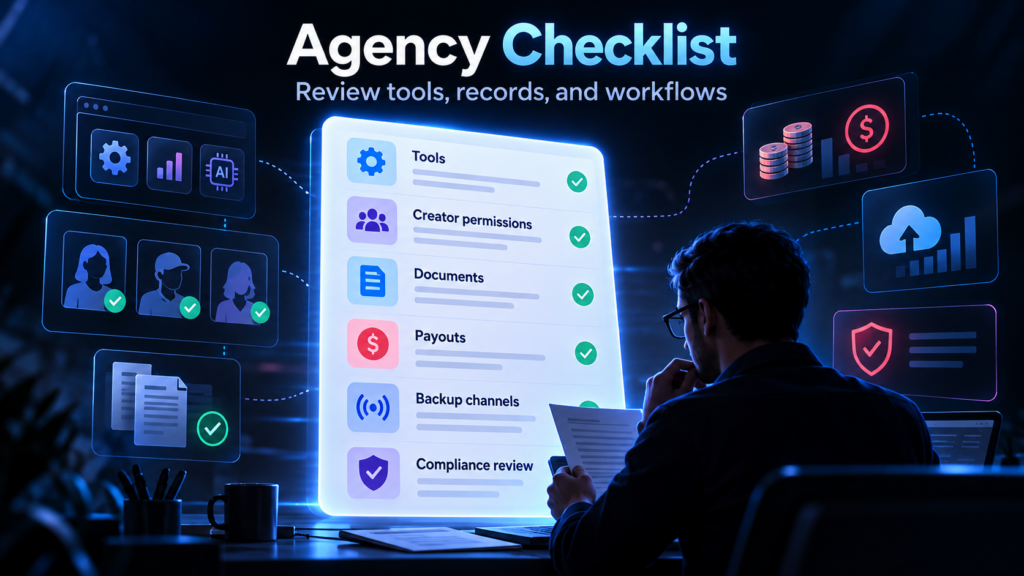
The updated agreement does not mean agencies need to abandon OnlyFans. It provides a reason to review processes, reduce avoidable risks, and prepare alternatives before a payment or account disruption occurs.
Agency compliance checklist
- Audit CRM and AI tools. Document each tool’s access method, data collection, storage, and model-training practices.
- Review creator permissions. Make sure agreements clearly define account access, responsibilities, and permitted activities.
- Prepare verification records. Maintain appropriate identity, consent, and content documentation in a secure and accessible system.
- Assign a compliance contact. Monitor platform notices and coordinate responses to requests.
- Review payout exposure. Assess financial obligations and cash reserves if withdrawals are delayed.
- Develop independent audience channels. Build newsletters, social communities, and websites where users can voluntarily subscribe or register.
- Test a second monetization channel. Validate payments, content delivery, customer support, and conversion rates before relying on the channel for significant revenue.
Can agencies move OnlyFans subscribers to another website?
Not automatically.
Existing OnlyFans subscriptions cannot simply be transferred to a separate platform. Fans must choose to register and establish new payment arrangements.
Agencies also should not assume they can extract OnlyFans user data for external marketing. Any collection or reuse of contact information needs to comply with applicable platform rules, privacy laws, and consent requirements.
A more sustainable approach is to develop independent acquisition channels through permitted promotional methods.
The goal is to create additional opportunities for fans to discover and support creators, rather than promise a frictionless migration of an existing subscriber base.
7. Why a Second Revenue Channel Makes Sense for Established Agencies
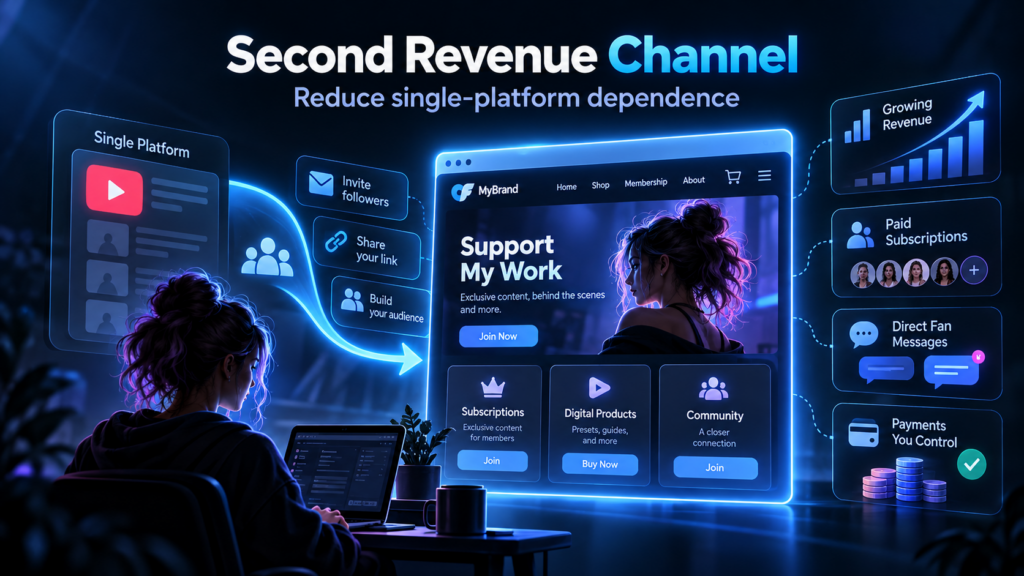
OnlyFans can remain a profitable sales channel even as its policies evolve.
The underlying business question is whether the agency should depend on that channel for every subscription, paid message, customer interaction, and payout.
When a single platform controls all those functions, changes to its rules can affect multiple parts of an agency’s operations simultaneously.
A second branded website offers a different arrangement. Agencies can develop independent offers, acquire customers through their own marketing, and configure payments through supported providers.
This does not remove the need for compliance. Independent websites still require suitable payment processing, identity and age verification where applicable, content moderation, customer support, and data protection.
Nor does a second website guarantee that existing OnlyFans subscribers will purchase again.
The commercial value comes from building another functioning revenue stream over time—not from expecting an immediate migration.
8. How Scrile Connect Helps Agencies Build a Second Platform
Scrile Connect for Agencies is white-label software for launching a separate branded creator platform.
It is not a CRM that extracts OnlyFans messages or bypasses OnlyFans restrictions. Instead, agencies use it to operate a website with its own creator profiles, paying members, content library, and monetization features.
Scrile Connect supports multiple creators and agency management workflows, including:
- Paid subscriptions and premium content.
- Direct messages and paid offers.
- Content publishing and media management.
- Roles for managers and other team members.
- Revenue reporting and supported payment integrations.
Agencies can use their own branding and domain while managing the platform through a centralized administration interface.
Scrile charges a fixed software fee rather than taking a percentage of creator payments. Its platform commission is 0%, although subscription fees, payment processing charges, and other operating expenses still apply.
This makes Scrile Connect an option for agencies developing a separate business channel alongside OnlyFans rather than replacing their existing operations overnight.
Explore Scrile Connect for Agencies
Comparing the costs of OnlyFans and an independent platform
OnlyFans retains its standard 20% commission. A separate website has a different cost structure, including software, payment processing, and operational expenses.
Agencies can use the OnlyFans Fee Calculator to model those costs at different revenue levels. Select the Scrile Connect Pro plan when evaluating a multi-creator agency.
For agencies evaluating alternative payments, Zyrox also offers non-custodial cryptocurrency payment services. Its published pricing advertises 0% Zyrox gateway fees through December 31, 2026. Integration compatibility, network charges, and applicable requirements should be confirmed separately.
The right setup depends on the agency’s business model, audience, operating costs, and payment-processing eligibility.
Frequently Asked Questions
What changed in the OnlyFans Terms of Service in 2026?
The October 2026 revision broadens enforcement grounds, adds explicit restrictions on data collection and software training, updates notification language, and introduces provisions for platform-provided AI services. Several existing rules, including the 20% fee and creator responsibility for third-party managers, remain unchanged.
Can OnlyFans withhold earnings without warning?
Yes, under circumstances described in Section 14.b. The platform already had this ability in 2024, but the 2026 terms broaden certain grounds for applying restrictions. Temporary withholding during a review is distinct from a subsequent decision to forfeit earnings.
Are OnlyFans agencies allowed under the new terms?
The October 2026 Terms of Use do not introduce a general prohibition on agencies. Creators remain responsible for ensuring that account activity, including work performed by third parties, complies with the applicable rules.
Are OnlyFans bots and CRM tools against the rules?
Not every CRM or automation product can be assessed from its category alone. The relevant questions include how it accesses OnlyFans, what data it collects, and whether platform content is used to train or improve software. Agencies should review each tool and all applicable policies.
Did the OnlyFans commission increase in 2026?
No. The October 2026 Terms of Use continue to specify the standard 20% platform fee on Creator Interactions.
Can an OnlyFans agency run its own creator platform?
Yes. An agency can establish a separate creator website, subject to applicable laws, payment-provider requirements, content policies, and its contractual obligations. Existing OnlyFans subscriptions and payment arrangements do not automatically transfer.
Final Takeaway: Keep OnlyFans, but Reduce Dependence on One Platform
The October 2026 Terms of Use expand the circumstances in which OnlyFans can restrict accounts and hold payments. They also put more explicit restrictions on certain data collection and software-training practices.
For agency owners, the appropriate response is a combination of compliance and business planning.
Review the tools used by your team, improve processes for handling platform requests, and understand how an interruption could affect cash flow. At the same time, consider building additional audience acquisition and monetization channels.
OnlyFans can remain part of that strategy. It simply does not have to be the only channel.
Discuss an Independent Agency Platform with Scrile
Sources and methodology
This article is based on a comparison of:
- OnlyFans Terms of Use — October 2026
- OnlyFans Terms of Use — August 2024, archived copy
The analysis covers the Terms of Use, not the entirety of the separate documents incorporated into the OnlyFans Terms of Service. The October 2026 document identifies its last update month but does not itself specify an exact effective day.
Disclaimer: This article is intended for general information and business analysis. It does not constitute legal advice. Specific obligations, remedies, and the enforceability of contractual provisions may depend on applicable laws and individual circumstances.
