
How to Create a Crowdfunding Platform in 2026
Learn how to create a crowdfunding platform from scratch in 2025, including features, costs, and real launch steps. This guide breaks down models, payments, and scaling strategies, and shows how services like Scrile Connect help you launch a fully branded fundraising platform faster without starting from zero.


create a crowdfunding platform
If you’re wondering how to create a crowdfunding platform, the process is more practical than it sounds. Start by choosing a model: donation, reward-based, or equity. Then build the essentials: campaign pages, payment flows, and a simple analytics dashboard. If your model involves investments, you’ll need KYC and AML compliance. Don’t aim for a perfect product at launch. A focused MVP with a few real campaigns is enough to test demand and start growing.
Most people see crowdfunding as a campaign. The smarter ones see it as infrastructure. When you create a crowdfunding platform, you’re not raising money once, you’re building the system that takes a cut every time someone else does.
Look at Kickstarter. It has helped creators raise over $8 billion since launch. GoFundMe processes millions of donations every year. Neither owns the ideas. They own the flow of money. That’s the real game.
The standard model is simple: around 5% platform commission plus payment processing fees. On a large campaign, that’s serious revenue.
So instead of launching one campaign, many founders now think bigger and build the platform itself. What used to require a full custom development team is now much more accessible, with ready-made frameworks and white-label solutions that allow you to launch faster without rebuilding everything from scratch.
Why People Build Their Own Crowdfunding Platforms
The decision to build a crowdfunding platform usually has nothing to do with creative freedom. It comes down to control over money flow and long-term revenue.
Take Kickstarter as a benchmark. The platform charges around 5% on successful campaigns. On top of that, payment providers like Stripe take another 3–5%. In practice, that brings total fees close to 8%.
Here’s what that looks like in numbers:
Campaign revenue: $500,000
Platform fee (5%): $25,000
Payment processing (3%): $15,000
Total fees (~8%): $40,000
That’s not a small operational cost. That’s margin being extracted from every campaign that succeeds. Now imagine running ten similar campaigns a year. You’re looking at $400,000 moving to someone else’s platform instead of staying in your ecosystem.
Owning the platform changes the equation. You decide the fee structure, control user data, and keep the upside. This is why niche crowdfunding projects are gaining traction. Charity portals focused on specific causes, local fundraising hubs, or creator-led communities are all moving toward platform ownership. The idea is simple: don’t just participate in fundraising, own the infrastructure behind it.
Choosing the Right Crowdfunding Model
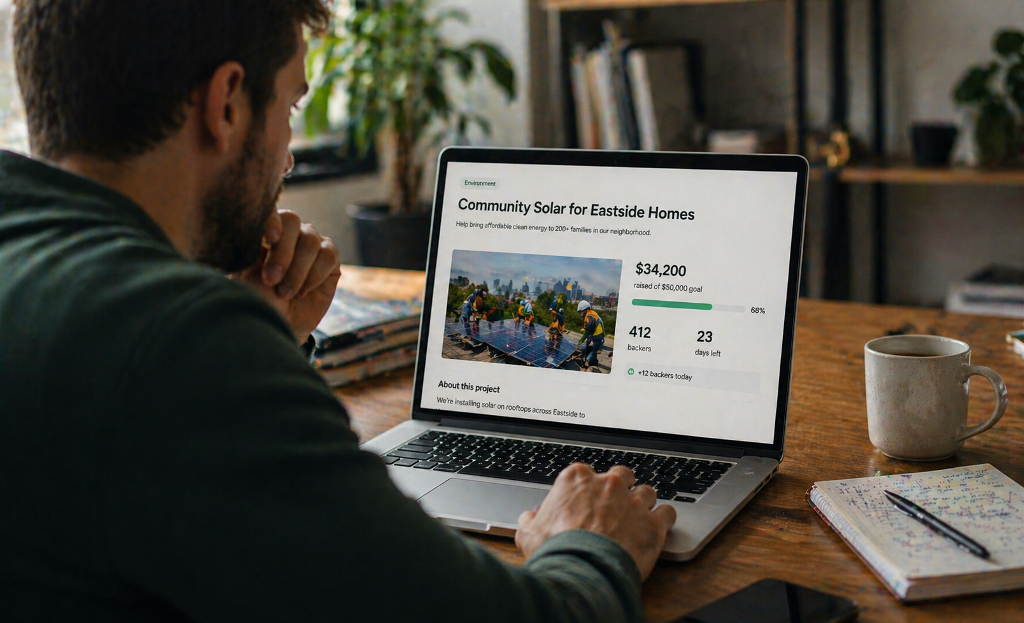
Before you create a crowdfunding platform, you need to answer a simple question: why would someone give money here in the first place?
Different platforms solve that in completely different ways.
- Donation-based (GoFundMe)
This is the simplest version. People give because they care. No rewards, no returns. It works for charities, medical fundraisers, local causes. The tricky part is trust. If the story doesn’t feel real, conversions drop fast. - Reward-based (Kickstarter)
Here it’s closer to shopping than donating. People back a project and expect something in return. Early access, limited editions, perks. That’s why this model works so well for gadgets, indie games, creative launches. You’re basically testing demand before production. - Equity-based (SeedInvest)
Now it gets serious. Users are not supporters anymore, they’re investors. They expect returns, not updates. This brings bigger checks, but also legal weight. You don’t just launch this casually. - Subscription / hybrid (Patreon-style)
This model doesn’t spike, it accumulates. Instead of chasing one big campaign, you build steady monthly support. Creators, communities, long-term projects all lean this way.
There’s no “best” model. It depends on what people expect when they click that “fund” button.
Core Features You Can’t Skip

Once you move from idea to execution, the question shifts from “should I build this” to how to build a crowdfunding website that people actually use. Most failed platforms don’t break because of design. They fail because the core mechanics feel unfinished or confusing.
Campaign & User Experience Layer
This is where conversion happens. If campaign pages don’t work, nothing else matters.
- Campaign pages need structure. A short story, strong visuals, and regular updates. Visitors don’t read everything. They scan, decide, and either click or leave.
- Donation flows must be fast. Ideally one or two steps. Clear amounts, no distractions, no unnecessary fields.
- Rewards or tiers help guide decisions. Even basic options like $10, $50, $100 can noticeably increase the average pledge.
- Comments and updates keep campaigns alive. Backers want to see movement, not silence.
A common pattern across successful platforms is visible progress tracking. Funding bars and countdown timers create urgency. When a campaign is close to its goal or deadline, conversions tend to increase sharply.
Payments, Analytics, and Trust
Once a user decides to contribute, everything shifts to reliability.
- Payments should support split payouts between the platform and campaign owners.
- Multi-currency support helps expand beyond a local audience.
- Fraud protection basics are essential, even at early stages.
You also need visibility into performance. A simple dashboard should track:
- conversion rate
- average pledge size
- traffic sources
Without these metrics, improving the platform becomes guesswork.
On the admin side, the platform also needs tools that regular users never see but owners rely on every day. Campaign approval helps filter low-quality or risky fundraisers before they go live. Moderation tools handle reports, suspicious activity, and misleading content. Payout rules define when money is released, while a donor database and notification system help you keep supporters informed after the first contribution.
Build vs Use Existing Platforms
At some point, every founder hits the same fork in the road. You either plug into an existing ecosystem or figure out how to make a crowdfunding website that you fully control. Both paths work, but they lead to very different outcomes over time.
Here’s a clear comparison:
| Criteria | Own Platform | Kickstarter / GoFundMe |
| Fees | Payment fees + hosting/infra (you control platform commission) | ~8% total (platform + payment fees) |
| Control | Full | Limited |
| Branding | Full | Platform branding |
| Monetization | Flexible | Fixed |
| Setup time | Medium | Instant |
| Compliance burden | On you | Platform handles |
Using an existing service is fast. You can launch a campaign the same day, test an idea, and get early traction without touching code. That speed is the main advantage. But the trade-off shows up later. You don’t control user data, pricing, or long-term relationships with your backers.
Building your own platform takes more effort upfront. There’s development, payments, and compliance to think through. But the upside is structural. You’re not just running campaigns, you’re owning the system behind them. That means flexible monetization, direct access to your audience, and the ability to scale beyond one project. Over time, that difference becomes hard to ignore.
Step-by-Step: How to Start a Crowdfunding Platform

Building a platform like this doesn’t begin with code. It starts with understanding who will use it and why they would trust it with money. Many founders rush into development and skip this part, which is exactly why most platforms stall early.
Phase 1 — MVP Thinking
At this stage, you’re not building a full system. You’re testing a focused idea. Choose a niche where fundraising already happens. Charity campaigns, local initiatives, or creator communities are easier to activate than broad “catch-all” platforms.
Your value proposition has to be clear from the start. Lower fees, better discovery, or a niche audience can be enough. Once that’s defined, your real goal is the first 10 campaigns. Reach out directly, onboard users manually, and adjust fast based on feedback.
Phase 2 — Development & Payments
This is where the technical side comes in, and where people start thinking about how to build a crowdfunding website without overcomplicating things. A simple backend using Node.js or Laravel is enough for an MVP. Hosting on AWS or Vercel works well for early traffic and scaling.
Payment infrastructure needs to be solid. You’ll need split payments between platform and campaign owners, along with basic fraud checks and clear transaction flows.
Phase 3 — Launch & Traction
Once the platform is live, growth becomes the priority. If you’re serious about how to start a crowdfunding platform, you can’t rely on organic discovery alone.
Bring in your first users manually. Help them launch campaigns, guide updates, and keep activity visible. Early traffic usually comes from niche communities, forums, and targeted groups where your audience already exists.
Costs Breakdown (Realistic Numbers)

Before you create a crowdfunding platform, you need a realistic view of costs. Not vague estimates, but actual ranges based on how these systems are built in practice. A basic MVP usually lands between $30,000–$50,000, while a fully custom solution starts at $70,000+ and grows with complexity.
What actually drives that budget becomes clearer when you break it into parts. A crowdfunding platform isn’t one feature. It’s a stack of systems working together:
- Project creation and management: 200–500 hours → $5,000–$25,000
- Payment processing: 100–200 hours → $5,000–$10,000
- User management: 100–200 hours → $3,000–$5,000
- Project discovery and browsing: 150–300 hours → $5,000–$10,000
Even at MVP level, these modules add up fast. You’re not building pages, you’re building workflows.
“Development budgets typically range from $70,000-$150,000 for a full-featured platform, or $30,000-$50,000 for a basic MVP focusing on core functionality.”
InvestGlass
The biggest cost driver isn’t design. It’s how money and users move through the system.
Payments alone introduce complexity. You need secure transactions, split payouts, and refund handling. On top of development costs, processing fees typically take 3–5% per transaction.
User systems grow quietly. Logins turn into profiles, profiles into permissions, and then moderation, notifications, and verification layers appear.
Campaign logic is the heaviest part. Funding goals, progress tracking, deadlines, rewards, and updates all interact in real time.
Cutting corners here saves money early, but creates friction later. Stable infrastructure is what keeps campaigns running and revenue consistent.
Hidden Challenges Most Founders Miss
Most guides explain how to make a crowdfunding website, but very few talk about what actually breaks it after launch. The first issue shows up with payments. Refunds, chargebacks, and disputes are inevitable once real money starts moving. Even a small spike in failed campaigns can turn into operational noise that eats time and trust.
Then comes fraud. Fake campaigns, misleading goals, or copied content appear earlier than most founders expect. Without moderation tools and verification, the platform quickly loses credibility.
Legal risk becomes a real concern if you move into equity-based fundraising. Once users expect returns, you’re no longer running a simple platform. You’re stepping into regulated territory.
The hardest problem, though, is much simpler. No campaigns means no users. Platforms rarely fail because of code. They fail because there’s nothing happening on them. Without a steady flow of active campaigns, growth stalls before it even starts.
Your Own Turnkey Crowdfunding Portal with Scrile Connect
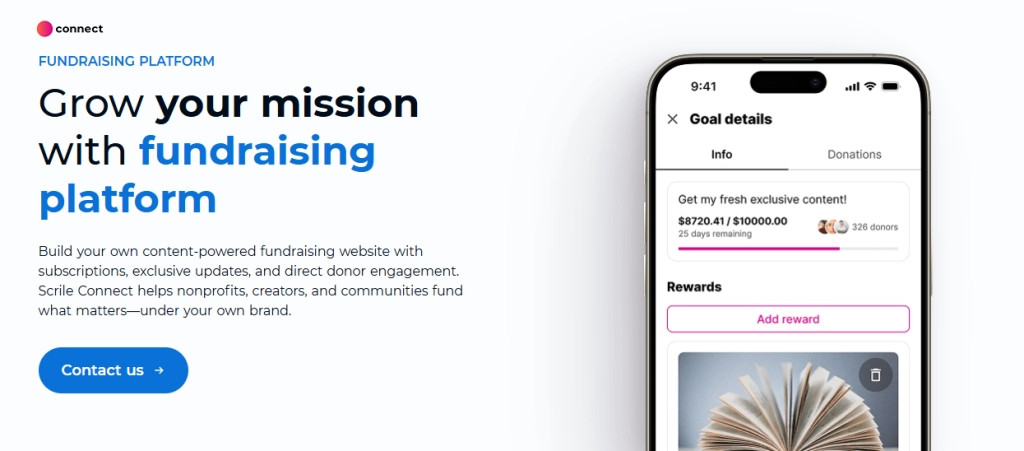
At some point, the question is no longer whether to create a crowdfunding platform, but how to do it without rebuilding everything from scratch. This is where Scrile Connect fits in. It’s not a platform you join. It’s a white-label development service that gives you a system under your own brand.
Instead of assembling everything piece by piece, you start with a working foundation that already includes the core mechanics:
- white-label platform fully branded as your product
- support for subscriptions and one-time donations
- paywalls and paid updates to extend monetization beyond campaigns
- real-time analytics to track performance and user behavior
- scalable architecture that handles growth without constant rebuilding
What matters here is the balance. You avoid the long timeline of a full custom build, but you also avoid the limits of SaaS platforms where everything is predefined. You control pricing, user experience, and data, which turns the platform into an asset, not just a tool.
That difference becomes obvious once campaigns start generating consistent traffic and revenue.
What Model Works for You
At this point, the decision is less about features and more about how your platform is expected to grow. Different models don’t just change user behavior, they change how much control you need over the system.
| Goal | Best Model | Revenue Logic | Complexity | Time to Launch | Control Level | Best Approach |
| Charity / NGOs | Donation | One-time contributions | Low → Medium (with scale) | Fast → Medium | Medium → High | Start simple, then move to branded solution for trust and retention |
| Product launches | Reward | Pre-orders + upsells | Medium | Medium | High | Customizable platform with flexible campaign logic |
| Startups / investments | Equity | Large funding rounds | High (legal heavy) | Slow | High | Fully controlled infrastructure with compliance support |
| Creators / communities | Subscription hybrid | Recurring payments | Medium | Medium | Full | Flexible system with long-term monetization tools |
The interesting part is how these evolve over time. Charity platforms often start simple, but once volume grows, branding, donor retention, and analytics become critical. The same pattern shows up across all models. Early simplicity works, but long-term growth pushes you toward more control.
That’s why many founders don’t stay on basic solutions. They move toward systems they can shape. Not necessarily fully custom from day one, but flexible enough to adapt as the platform gains traction.
Conclusion
Crowdfunding looks like campaigns on the surface, but underneath it’s an infrastructure business. The real value isn’t in one successful fundraiser, it’s in owning the system that powers many of them. When you create a crowdfunding platform, you build an asset that can generate revenue over time, not just once.
Ideas matter, but execution decides everything. The right model, clean payment flow, and active campaigns are what actually drive results.
If you’re ready to move beyond theory and launch your own platform, explore Scrile Connect and contact their team to build a fully branded crowdfunding solution tailored to your goals.
FAQ
How much does it cost to build a crowdfunding platform?
A basic crowdfunding platform with core features like campaigns, payments, and user accounts typically costs between $30,000 and $50,000. A fully custom solution with advanced analytics, moderation, and scaling features can reach $70,000 or more. The final cost depends on complexity and how much automation you need from day one.
How much does it cost to build a custom crowdfunding platform?
Development effort varies by feature set. Project creation and management may take 200–500 hours ($5,000–$25,000), payment processing 100–200 hours ($5,000–$10,000), user management 100–200 hours ($3,000–$5,000), and project discovery 150–300 hours ($5,000–$10,000). These modules together define the total budget.
Can I crowdfund on my own website?
Yes, you can run crowdfunding directly on your own site. You can build it from scratch for full control or use ready-made or white-label solutions to speed things up. Before launching, it’s smart to check legal requirements, especially if you operate across regions.
What is the downside of crowdfunding?
Crowdfunding requires consistent effort to keep campaigns visible and active. It’s not just about launching, but about maintaining momentum through updates, communication, and traffic. Without that, even strong ideas struggle to gain support.
How long does it take to launch a crowdfunding platform?
A basic MVP can be launched in 2–4 months if you focus only on essential features. A more complex platform with integrations, analytics, and scaling capabilities can take 6–12 months.
What payment systems are required?
You need a system that supports secure payments, split payouts, refunds, and basic fraud protection. Most platforms rely on providers that handle card processing and compliance.
Can I run crowdfunding without legal registration?
For simple donation-based campaigns, it may be possible in some regions. For equity or investment-based crowdfunding, legal registration and compliance are usually mandatory.
What niche works best in 2026?
Charity, local fundraising, creator communities, and mission-driven projects tend to perform well. Niches with an existing audience and emotional connection usually grow faster.
How do crowdfunding platforms make money?
Platforms typically earn through transaction fees, payment markups, or premium features. Some also use subscriptions, paid campaign promotion, or additional services for creators.
