
How to Get Cryptocurrency Donations Online
Learn how to get cryptocurrency donations online, from crypto donate buttons to BTC, ETH, and USDT setups. See how Scrile Connect helps build secure, branded donation flows on your website.


how to get cryptocurrency donations
A donor opens a wallet app, scans a QR code, and sends Bitcoin in under a minute. No forms, no card details, no rejected payments because of geography or bank rules. For many donors, that simplicity is no longer exotic — it’s expected. As crypto ownership has grown globally, more organizations and individual creators are learning how to get cryptocurrency donations as a practical part of online fundraising, not an experiment.
Recent industry reports show tens of millions of people now hold digital assets, and nonprofits are steadily adding crypto options alongside traditional payment methods. The motivation is straightforward. Crypto donors value speed, transparency, and control, while organizations benefit from lower fees and global reach. In some cases, crypto gifts are also larger, especially when donors contribute appreciated assets instead of cash.
“In 2024 alone, it is estimated that over $1 billion in crypto was donated to nonprofits.”
Source: The Giving Block — 2025 Annual Report on Crypto Philanthropy
This article breaks the topic down without hype. It explains why donors choose crypto, which technologies are actually used to accept BTC, ETH, and USDT, how donation buttons work in practice, and what secure implementation looks like on a real website. By the end, you’ll have a clear picture of how crypto donations function and when custom solutions make sense.
To get cryptocurrency donations online, you need a clear donate entry point (button/QR), support for the coins donors actually use (BTC, ETH, stablecoins like USDT), and a way to confirm + track gifts (receipts, attribution, reporting) so crypto becomes a repeatable channel—not a one-off experiment.

Why Donors Choose Cryptocurrency Over Traditional Payments
For many donors, crypto is no longer experimental. It’s simply the fastest way to move value online. That shift explains why organizations increasingly ask how to get cryptocurrency donations instead of relying only on cards or bank transfers. The decision usually comes down to speed, control, and cost — not ideology.
Speed, Borderless Giving, and Donor Control
Cryptocurrency works as a global payment layer. A donor can send Bitcoin, Ethereum, or USDT directly from a wallet, without banks, intermediaries, or currency conversion. That matters for international fundraising, where card payments often fail or lose value to fees.
USDT plays a specific role here. Many donors prefer stablecoins because the amount received stays predictable. There’s no volatility window and no need to time the market. For nonprofits and individual fundraisers, this makes budgeting easier and reduces follow-up conversations about price changes.
Other practical reasons donors choose crypto include:
- Fewer failed transactions compared to cross-border cards
- Lower friction for repeat donations
- On-chain confirmation that funds were actually sent
This combination makes crypto especially attractive in regions with strict banking rules or high transfer costs.
Tax Treatment and Asset Appreciation
Another driver is how donors treat crypto as an asset. Someone holding appreciated Bitcoin may prefer to donate part of it rather than convert to cash first. In the US and EU, this logic is widely discussed among crypto holders, even if exact tax outcomes depend on jurisdiction.
Because of this, crypto gifts often come in larger amounts than card donations. Understanding that behavior is central to how to get cryptocurrency donations in a sustainable way — and it naturally leads into how to accept Bitcoin donations and stablecoins on your site.
“Your charitable contribution deduction is generally equal to the fair market value of the virtual currency at the time of the donation if you have held the virtual currency for more than one year.”
Source: IRS — Frequently asked questions on virtual currency transactions (Q35)
Ways to accept cryptocurrency donations online (what you gain / what you lose)
| Method | Setup effort | Donor experience | Reporting & donor data | Control & branding | Best for | Main downside |
|---|---|---|---|---|---|---|
| Plain wallet address + QR | Low | Very fast for crypto-native donors | Weak unless you do it manually (hard to match donors to tx) | High control, but basic UX | Small campaigns, early testing | Attribution + receipts become a spreadsheet job |
| Simple donate widget / “button generator” | Low–Medium | Faster than DIY, still simple | Limited tracking (varies) | Branding usually limited | Quick launch on existing site | Often feels “third-party” and can hurt trust |
| Hosted crypto donation processor | Medium | Smooth checkout + multi-coin support | Often includes receipts + dashboards | Medium (some branding, some limits) | Nonprofits wanting speed + structure | Custodial flow + platform constraints over time |
| Custody/DAF-style acceptance route (donor donates via a third party; you receive fiat/settled funds) | Medium | Familiar for donors who already use the provider | Strong compliance & documentation | Low (you’re inside their rails) | Larger orgs prioritizing compliance simplicity | Less direct relationship + less on-site conversion |
| Custom, integrated donation flow (site-native) | High | Best UX when done right (campaigns, recurring, attribution) | Full analytics + CRM hooks possible | Full control and consistent branding | Scaling fundraising, multi-campaign ops | Requires build/maintenance (but removes lock-in) |
Technologies Used to Receive Crypto Donations

After the decision to accept crypto is made, the real work starts. Tools matter here. The setup you choose defines how much control you keep, how visible donations are, and how much manual work lands on your team later.
Wallet-Based Donations (BTC, ETH, USDT)
The most straightforward option is still the blockchain itself. A public wallet address, shown as text or a QR code, lets supporters send BTC, ETH, or USDT directly. No intermediaries. No approval layers. The transaction appears on-chain within minutes and can be verified by anyone.
For donation use cases, wallet type matters more than many expect. Hot wallets stay online and are practical when donations arrive daily. Cold wallets remain offline and reduce exposure when funds are meant to be held longer. Many organizations split the flow: receiving funds into a hot wallet, then moving balances periodically into cold storage.
Wallet-only setups work well when volumes are manageable and reporting expectations are light. They become harder to run once multiple campaigns, chains, or donor confirmations are involved. At that point, manually reconciling transactions just to receive crypto donations starts eating time.
Payment Processors and Hosted Crypto Tools
Processors add structure. They generate payment requests, support several currencies at once, and often provide automatic receipts. Some also convert crypto to fiat instantly, which simplifies bookkeeping.
The tradeoff is control. Funds typically pass through custodial wallets. Fees apply per transaction or conversion. Custom logic is limited. Over time, workflows begin to follow the processor’s constraints rather than the organization’s needs.
This is usually where friction appears. Branding options are fixed. Donor data access is restricted. Adjusting how you accept cryptocurrency donations becomes harder as campaigns grow.
Both approaches work. The difference lies in scale, flexibility, and how much ownership you want over the donation flow from day one.
Ways to Accept Cryptocurrency Donations Online
| Method | Setup Complexity | Fees | Control Level | Best For |
| Wallet Address | Low | Network fees only | High | Small organizations, individual fundraisers |
| Hosted Crypto Tools | Medium | 1–4% | Medium | Fast launch with minimal setup |
| Custom Integration | High | Custom (depends on infrastructure) | Full | Scaling fundraising and long-term campaigns |
Advantages of Crypto Donations: Fees, Reach, and Resilience
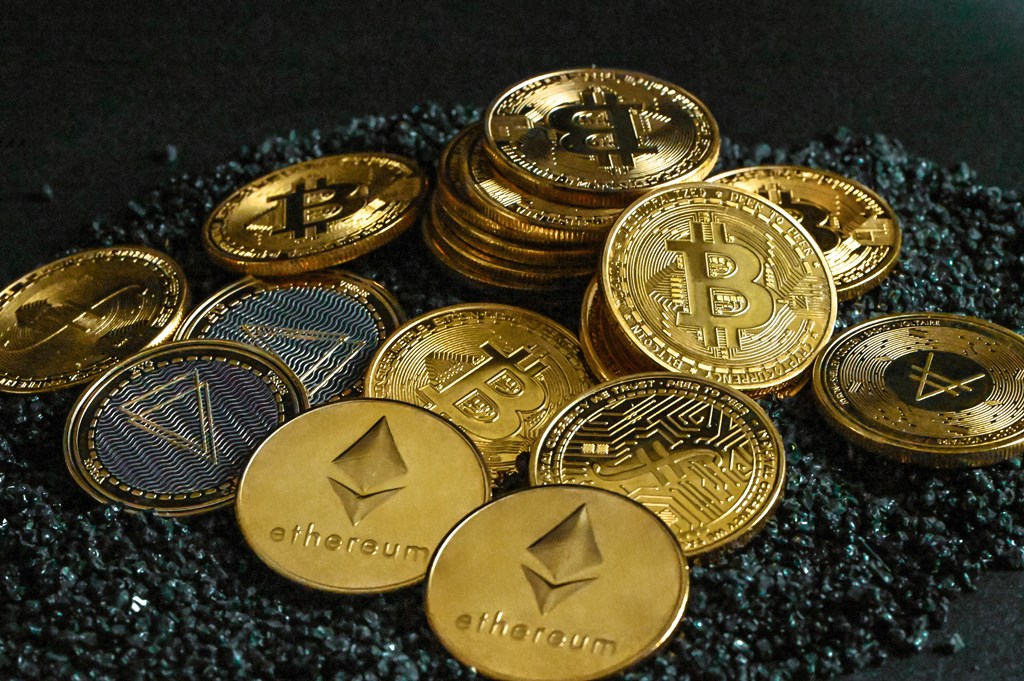
Once organizations understand how to get cryptocurrency donations, the advantages become practical rather than theoretical. These benefits show up quickly in costs, geography, and operational stability.
- Lower transaction fees compared to cards and wires.
Card payments routinely take 2.5–4% once processing and cross-border fees are added. International wire transfers often cost even more and introduce delays. Crypto transfers usually involve a network fee that is visible upfront and, in many cases, significantly lower. For recurring fundraising or large gifts, that difference compounds over time. - Global reach without banking friction.
Crypto moves across borders without currency conversion, correspondent banks, or regional restrictions. Donors in countries with limited card access or unstable banking systems can still contribute instantly. This is one reason nonprofits with international audiences actively learn how to get cryptocurrency donations instead of relying on local payment rails. - Operational resilience during banking downtime.
Bank outages, payment processor disruptions, and regional shutdowns do not stop blockchain networks. Donations continue to arrive even when traditional systems are offline. For campaigns tied to emergencies or time-sensitive causes, that reliability matters. - USDT as a volatility-aware option.
Not every donor wants price swings. USDT gives supporters a familiar dollar-pegged value while still using crypto rails. It often becomes the preferred option for donors who want predictability without banks. - Volatility and treasury handling require discipline.
Crypto prices move. Organizations need clear policies on holding, converting, or hedging assets. Without that planning, gains can turn into losses just as quickly. The advantage is flexibility, but it comes with responsibility.
Used correctly, crypto donations extend reach while reducing friction.
How to Set Up a Crypto Donate Button on Your Website
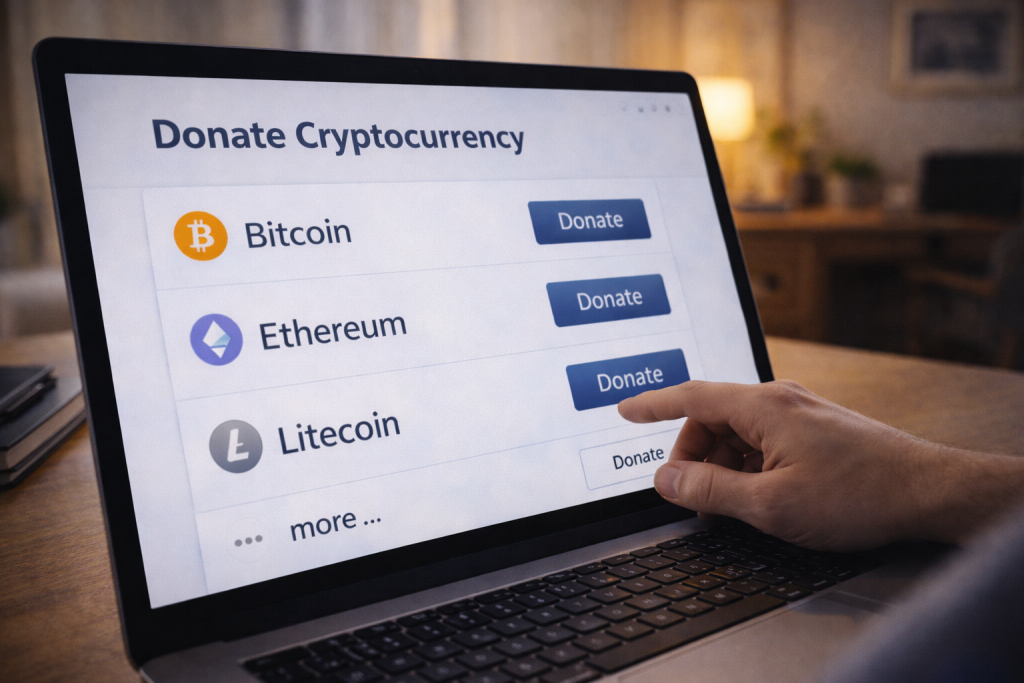
This is the point where theory turns into mechanics. A crypto donate button is not just a visual element. It’s the bridge between a donor’s intent and an on-chain transaction.
What a Crypto Donate Button Actually Does
At a basic level, the flow is simple. A visitor clicks the button, sees a wallet address or payment interface, sends funds, and waits for network confirmation. What happens in between depends on how the button is built.
Some buttons link directly to a wallet address. Others route the donation through a processor that handles the transaction, tracks confirmations, and sometimes issues receipts. A simple crypto donate button works well for small campaigns or personal fundraising pages. It starts to break when you need donor attribution, recurring gifts, or reporting across multiple campaigns.
Wallet-based buttons give you control. Processor-based buttons give you convenience. The tradeoff shows up quickly as volume grows.
There is also a middle-ground option between a raw wallet address and a fully custodial processor. With Zyrox, businesses can accept crypto payments directly to their own wallet while still using a more structured payment flow. For donation websites, that means better control without giving up usability.
Common Setup Options
There are a few practical ways teams approach this:
- Manual wallet address with QR code. You generate a public BTC, ETH, or USDT address and display it on the page. Donors scan, send, and that’s it. This works, but tracking who sent what becomes manual work.
- Hosted widgets and generators. Tools that act as a Bitcoin donate button generator package the address, QR code, and sometimes a simple UI. They reduce setup time but often limit customization and data access.
- Embedded processor buttons. These sit between you and the blockchain. They simplify confirmations and sometimes convert crypto automatically. In exchange, you give up flexibility and accept platform rules.
If your goal is learning how to get crypto donations quickly, a generator or widget is usually enough. If donations are tied to campaigns, analytics, or compliance, the setup needs to go deeper. At that point, the button stops being a shortcut and starts being part of your infrastructure.
Accept Crypto Donations on Your Website With Scrile Connect
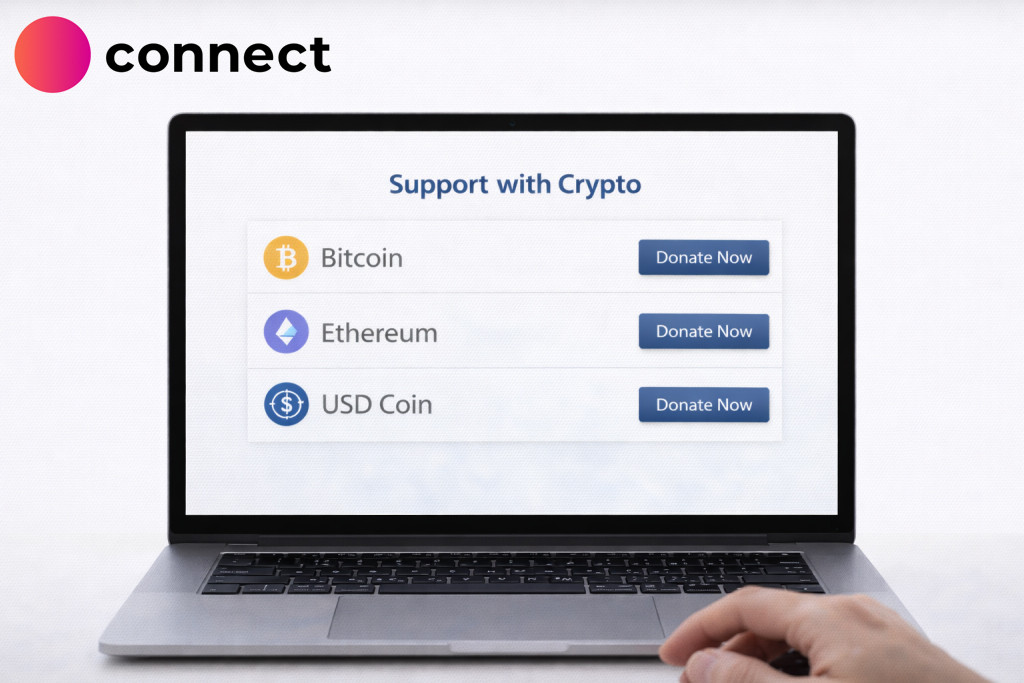
Most teams start with simple crypto tools and hit the same wall. Widgets look out of place on the page. Payment logic is fixed. Reporting is shallow. Once donations become a real channel, those limits start affecting trust, branding, and long-term growth.
Scrile Connect solves this with a custom approach — and it already offers ready integration with Zyrox. This means businesses can launch branded crypto donation flows on their own website and accept crypto payments directly to their wallet, instead of relying entirely on third-party custodial tools.
In practice, this means Scrile Connect can implement:
- Ready integration with Zyrox, so donations can be accepted directly to your wallet with a non-custodial payment flow instead of being locked into a generic hosted processor.
- Crypto donation flows tailored specifically for BTC, ETH, and USDT, instead of one-size-fits-all checkout logic. This matters when donors prefer different assets or network standards.
- Secure wallet handling built around direct-to-wallet settlement, whether donations go straight to treasury wallets or follow a more controlled internal flow.
- Fully branded donation pages and embedded forms that match your site’s design and tone, rather than redirecting donors to third-party interfaces.
- Modular payment logic that supports one-time gifts, recurring contributions, or campaign-specific rules without rewriting the system.
- Integration with user accounts, CRM systems, and internal reporting, so crypto donations don’t live in a separate spreadsheet.
- Analytics hooks that show where donations come from, how donors behave, and which campaigns actually convert.
The goal here isn’t to sell crypto as a gimmick. It’s to make crypto donations behave like first-class infrastructure on your website. When donation flows, branding, and reporting work together, accepting crypto stops feeling experimental and starts feeling reliable.
With Zyrox integrated into Scrile Connect, this infrastructure becomes much more practical: donors get a clean branded experience, while your team keeps control over settlement because funds go directly to your own wallet.
Conclusion
Learning how to get cryptocurrency donations is no longer a niche skill reserved for early adopters. It’s becoming part of long-term fundraising strategy for organizations that want resilience, global reach, and fewer payment bottlenecks. Crypto giving works best when it’s treated as infrastructure — something reliable that runs in the background — rather than a one-off experiment added during a campaign spike.
Simple tools are often enough at the beginning. A wallet address or basic donate button can validate demand and attract first contributors. As volumes grow, expectations change. Donors notice branding gaps, limited payment options, and weak reporting. That’s where custom systems start to make sense, especially for teams planning repeated campaigns or international outreach.
With Scrile Connect and Zyrox, that infrastructure can include a ready non-custodial setup that lets you accept crypto donations directly to your wallet while keeping the donation flow branded and fully integrated into your site.
If crypto donations are becoming central to your funding model, it’s worth building them properly. Reach out to the Scrile Connect team to discuss a custom crypto donation setup designed around your website, your donors, and your long-term goals.
Quick recap (numbers worth remembering):
- Crypto philanthropy hit a new level in 2024: The Giving Block estimates $1B+ in crypto donated to nonprofits in 2024 alone.
- The same report expects ~$2.5B in crypto donations in 2025 (forecast).
- Crypto donations can be meaningfully larger: The Giving Block reports an average crypto donation of $10,978 in 2024.
- Big players see the same pattern: Fidelity Charitable reports $786M in cryptocurrency contributed in 2024 (14x vs 2023).
Takeaway: Start simple to validate demand (address/QR), then upgrade to a tracked, branded flow once crypto becomes a real channel—because attribution, receipts, and analytics are what make crypto donations scalable.
FAQ
Can I accept crypto donations directly to my own wallet?
Yes. A non-custodial setup allows donations to be sent directly to your wallet instead of being held by a third-party processor. With Scrile Connect and Zyrox, this can be built into a branded donation flow on your website.
How to ask for donations in crypto?
Start by making the option visible and normal. Announce crypto donations in your newsletter with a short explanation of why you accept them and which coins you support. In email campaigns, include a direct link or QR code alongside traditional payment options. For major donors, use a personal message that explains the benefits clearly: speed, transparency, and global access. Keep the ask practical, not technical, and always show exactly where to send funds.
How to get free Bitcoin money?
It’s important to separate earning from fundraising. Bitcoin can be earned through GPT platforms that reward users for tasks, exchange referral programs, faucets that distribute very small amounts, mining, crypto airdrops, or staking products that offer indirect exposure. These methods involve time, risk, or learning. They are not donations. Fundraising depends on people choosing to support you, not on generating crypto through platforms.
How to get people to send you crypto?
Make the process obvious. Share your public wallet address clearly on your website and donation pages. Use QR codes to remove friction, especially for mobile users. Embed donate buttons where supporters already interact with your content. Clear placement and simple instructions matter more than technical detail.
If you’re running multiple campaigns, a raw wallet address gets messy fast. We switched once we needed campaign-level tracking.
The friction point wasn’t wallets. it was reporting. Once we had a dashboard and a clean reconciliation routine, the channel became real
We added BTC/ETH and got a few gifts… but the real win came after we fixed attribution + receipts.