
Incident Response Plan for SaaS in 2026: Key Components
An effective incident response plan defines who on the team will do what and how they will communicate with each other and includes a detailed process for detecting, containing, and recovering from incidents. By having detailed incident response playbooks, you will know exactly what to do when reacting to an incident instead of having to react in a panic. This guide will help build an effective response plan so you can implement and maintain it in your daily operations.

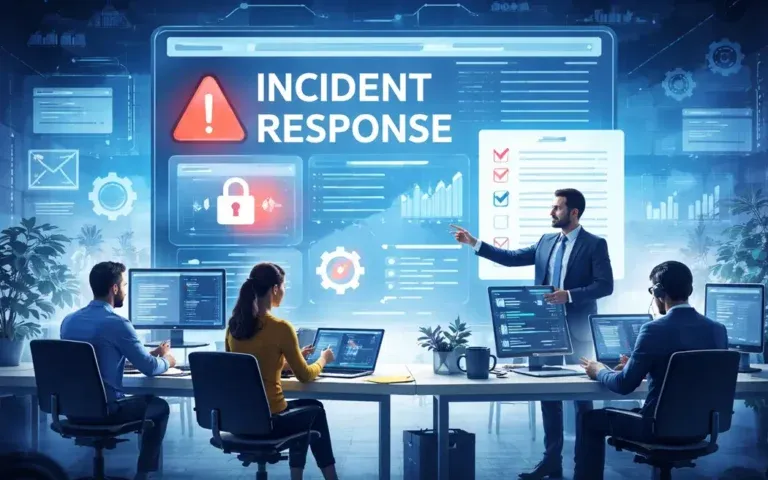
incident response plan
Why SaaS Teams Need an Incident Response Plan Today
Security breaches usually come out of nowhere, whether they’re from a strange login, an exposed API key, or a massive service crash that impacts multiple parts of a company’s infrastructure. Because continuous uptime is vital for users of SaaS offerings, how quickly and effectively the situation is handled during the first few hours after discovering a breach will heavily influence how badly your business will be affected overall. That is why every modern platform needs a clear incident response plan. It helps teams move from confusion to action within minutes. Instead of debating what to do, engineers follow predefined steps. As a result, they can isolate threats faster and reduce downtime.
Most founders think that just having a great infrastructure comes with no risk of an event occurring. This isn’t true. Reality is starkly different. Even a very secure infrastructure can be subject to events you did not anticipate: for example, configuration mistakes, vulnerabilities in the supply chain, and credential leakage. Good security reduces your potential risk. However, it will never remove it totally.
What Is an Incident Response Plan?
If you are wondering what is incident response plan, the short explanation is simple. It is a structured set of procedures that helps a company detect, contain, and recover from cybersecurity incidents.
SaaS companies have common features in their plans:
- Defines what events are security incidents.
- Who is responsible within the dev and security teams to respond to security incidents?
- How to escalate and what severity levels are.
- When and how to communicate with internal teams and customers.
- Playbooks for how to contain and recover from incidents.
- How to do reviews/lessons learned after an incident.
A good security incident response plan is not simply a policy doc stored in some folder but can be used by teams as an operation guide when under pressure. The goal is simple. Reduce response time, limit damage, and restore service quickly.
When companies treat the plan as a real operational tool, they gain something extremely valuable: predictable crisis management.

Incident Response Planning: From Compliance Document to Operational Playbook

Many companies create a response document once and forget about it. The file sits in a compliance folder and only appears during security audits. However, real incident response planning should produce something very different — a practical guide that teams actively use when incidents occur.
In other words, the plan must function as an operational playbook. When engineers detect suspicious activity, they should immediately know what to do next. No long meetings. No confusion about ownership. Just clear actions.
A strong incident response plan usually defines several critical elements. These include response roles, communication channels, containment procedures, and recovery steps. Each component helps teams react faster under pressure.
Policy vs. Operational Response Plan
The difference between a formal document and a working response system becomes obvious during a crisis.
| Aspect | Static compliance document | Operational incident response plan |
| Purpose | Meets audit requirements | Guides real-time response |
| Usage | Rarely opened | Used during incidents |
| Structure | General policy language | Clear step-by-step procedures |
| Updates | Updated occasionally | Improved after every incident |
A living plan evolves with your infrastructure. New integrations, new APIs, and new user flows introduce fresh risks. Therefore, teams must update the plan regularly.
Why Playbooks Matter in SaaS
SaaS platforms move fast. Deployments happen daily, sometimes hourly. Because of this pace, response teams cannot rely on theory. They need clear playbooks for common threats.
Typical examples include the following:
- compromised administrator account
- exposed API credentials
- abnormal traffic spikes
- infrastructure outages
When teams rehearse these scenarios in advance, response becomes faster and far more coordinated. As a result, recovery takes hours instead of days.
“Organizations that develop and test incident response capabilities are better prepared to handle cyber incidents effectively and reduce operational impact.” Cybersecurity & Infrastructure Security Agency (CISA)
Core Components of a Security Incident Response Plan

A solid security incident response plan works like a structured operational manual. It tells your team what to do, who should do it, and how quickly actions must happen. Without these elements, even experienced engineers may lose valuable time deciding on the next step.
A practical plan usually contains several core components. Each one focuses on a different stage of managing incidents.
Incident Identification and Classification
First, teams should define what constitutes security incidents. Not every alert from a system prompts a response. Nonetheless, all suspicious activity should be treated with care.
Examples of common security incidents consist of the following:
- unauthorized logins.
- data access anomalies.
- API keys that may have been compromised.
- intrusions into infrastructure.
- traffic spikes that are not normal.
Most businesses have developed severity levels that specify how fast they need to address an incident and what individuals/teams are included in resolving the incident.
Defined Roles and Responsibilities
The following are the standard roles assigned to participants for disaster response:
- Incident commander: this person is responsible for the overall coordination of the response effort.
- Security analyst: investigates and assesses the threat by gathering evidence and evaluating its impact.
- Infrastructure engineer: isolates the affected systems from the rest of the network.
- Communications lead: informs management and users of the situation.
When you assign and make clear the responsibilities of all members of the response team, you can prevent duplication of effort and reduce confusion during the chaos of an emergency.
Escalation and Communication Protocols
Incidents can escalate rapidly, thus making this a crucial element of the operational plan. The operational plan must specify how incidents progress from minor incidents to critical incidents based on certain established criteria and should also include typical escalation procedures for proper identification of:
- timeframes associated with incident investigation;
- conditions that will require leadership involvement in the incident;
- notification procedures for affected users.
In addition, strong communication protocols provide the means for keeping technical, leadership, and customer support personnel aligned under high-stress conditions.
IRP Cyber Security Lifecycle: The Six Stages of Incident Response
Typically, most security teams utilize a predetermined workflow for processing incidents. In IRP cyber security, incident response progresses through an established chronological approach. Therefore, the team is able to process incidents quickly because they know the rules and do not forget any step along the way.
So rather than reacting randomly, engineers and other responders will approach incidents using an organized procedure from prep through learning. Each stage has a narrowly defined goal of achieving a specific outcome associated with performing a function within that defined, organized sequence.
The Standard Incident Response Lifecycle
| Phase | Main goal | Typical actions |
| Preparation | Ensure readiness before incidents | Monitoring setup, documentation, training |
| Detection | Identify suspicious activity | Alerts, log analysis, anomaly detection |
| Containment | Stop the spread of the threat | Isolate affected servers or accounts |
| Eradication | Remove the root cause | Patch vulnerabilities, delete malware |
| Recovery | Restore systems and services | Rebuild infrastructure, validate security |
| Lessons learned | Improve processes | Incident review, plan updates |
Preparation is often underestimated. Yet this stage determines how effective the response will be later. Teams that prepare well usually detect threats earlier and contain them faster.
Building a Cyber Security Incident Response Plan for SaaS Teams

Designing a reliable cybersecurity incident response plan takes more than writing a document. SaaS teams must build a system that engineers can follow under pressure. When alerts start firing and customers notice disruptions, clarity becomes priceless.
A strong plan answers three critical questions. What happened? Who responds? What actions come next?
Step 1: Classify Incident Severity Levels
Different levels exist for how serious incidents are classified and responded to. Not all alerts require the same response.
Organizations that provide software as a service typically use multiple classifications based on severity.
- Low severity – internal technology issue with minor risk.
- Medium severity – service degradation that has some impact on users.
- High severity – confirmed security event or compromise of credentials.
- Critical severity – compromise of data or significant service outage
This classification allows for teams to quickly prioritize resources based on incident severity.
Step 2: Create Incident Response Playbooks
Create a response playbook that details all of the steps that an engineer should follow to respond to common security incidents. The playbooks will generally include the following use cases for incident response activities:
- account takeover;
- leaked API keys;
- unexpected traffic pattern activity;
- physical intrusion into an organization’s infrastructure;
- database access anomalies.
Having a playbook for each unique incident reduces the number of decisions that an engineer has to make during an incident and reduces the amount of time spent looking for the next step.
Step 3: Establish Communication Channels for Incident Response
Communication around incident response can be disorganized if such channels are not in place before an event occurs. Teams must be aware of where conversation around incident response occurs, as well as how to communicate updates to stakeholders.
Many organizations providing software as a service establish the following:
- an incident response chat channel;
- an emergency video conference call for coordination;
- an internal status dashboard;
- templates for notifying customers.
Effective communication leads to alignment and allows the technical team an opportunity to focus on mitigation and recovery efforts.
Communication Infrastructure in a Cybersecurity Incident Response Plan

When an incident turns bad, technology can’t fix the incident. The teams need to coordinate quickly for making their decisions, keeping each other up to date, and aligning with each other on their recovery actions. Communication is a key element in every part of a cybersecurity incident response plan.
Without having a defined communication structure in place, even well-qualified engineers spend their time waiting on questions to be answered, redoing work by asking the same question multiple times, or waiting for a decision that never comes. Just a few minutes lost due to wasted time on these tasks can quickly add up to hours of downtime.
A solid incident response plan will help eliminate this confusion by clearly defining how teams communicate while recovering from a crisis.
Internal Communication Channels
The first step in an emergency response is to set up dedicated communication channels that activate as soon as an emergency incident occurs. These channels will be separate from usual project communication channels.
Some tools for communicating during an emergency will be:
- Emergency Slack or Teams channels.
- Video coordination calls for incident response leadership.
- Secure messaging applications to provide confidential incident updates.
- Centralized incident dashboards.
By using predefined channels, the team will know exactly where to find and look for information.
Stakeholder and Customer Updates
The technical response to incidents is just part of the overall response. There are also many other stakeholders, partners, and customers who expect timely updates whenever an incident affects services.
A lot of SaaS companies will have created communications templates for the following types of incidents:
- Service outages.
- Suspected security breaches.
- Degraded performance.
- Scheduled maintenance during recovery.
Templates help alleviate pressure on support personnel as well as help you keep users properly informed on your company’s status.
Why Clear Communication Reduces Damage
Efficient coordination facilitates every stage of the response experience by getting engineers to find threats faster, leaders to approve threat containment faster, and customers to receive timely and accurate information.
Effective communication can dramatically reduce recovery time. This can also help sustain the value of a growing platform as it protects revenue and reputation when a security incident occurs.
“An incident response capability is required to effectively identify, contain, and recover from cybersecurity incidents while minimizing damage and recovery time.” National Institute of Standards and Technology (NIST)
Metrics and Continuous Improvement in Incident Response Planning

A strong incident response planning process does not end after recovery. Real growth occurs once the teams have reviewed their performance and determined the results.
Performance data shows how well responses worked and what areas remain missing. If your team does not have some type of metrics, it becomes very difficult for you to know how to improve.
To help identify improvement opportunities, successful SaaS teams measure key incident response metrics after each security event.
Key Incident Response Metrics
By measuring performance over time, teams can evaluate how to decrease the overall amount of time and money lost due to incidents.
Key measurements include the following:
- Mean Time to Detect (MTTD) – How quickly was the incident detected by the team?
- Total Time to Contain – How long did it take to contain the threat?
- Mean Time to Recover (MTTR) – How long did it take to return the site to normal operations after the incident?
- Total Number of Recurring Incidents – How many of the incidents could be repeated, indicating that the incident’s root cause has not been resolved?
By monitoring the mean time to detect incidents, the team can focus its efforts where needed if there is a decrease in mean time to detect but a longer mean time to recover exists.

Example: Impact of Faster Recovery
Let’s look at a simple calculation.
Imagine your SaaS platform generates:
- $10,000 in revenue per hour
An incident causes:
- 3 hours of downtime
Financial impact:
3 × $10,000 = $30,000 loss
Now suppose process improvements reduce downtime to 1 hour.
New loss:
1 × $10,000 = $10,000
The improvement saves $20,000 per incident.
This example shows how operational discipline directly protects revenue.
Continuous Improvement Cycle
Teams should do the following after an incident:
1. Perform a post-incident review.
2. Identify underlying causes of the incident.
3. Update playbooks and documentation.
4. Enhance monitoring or automation.
A living security incident response plan evolves with infrastructure changes and new threats.
Over time, this cycle builds resilience and reduces the impact of future events.
Why Operational Platforms Strengthen Your Cybersecurity Incident Response Plan
Technology does not guarantee resilience; the type of technology your team uses will slow down or accelerate recovery during a crisis. A reliable operational platform enables a team to respond more efficiently because it provides capabilities necessary to coordinate rapidly and communicate effectively during a cybersecurity incidence response plan.
For SaaS teams, using predictable infrastructure and secure collaboration tools significantly reduces the amount of chaos when an incident occurs. Providing transparency in systems to authorized team members will enable a more timely response.
Operational Stability Reduces Risk
Platforms that provide:
- secure real-time communication;
- controlled access management;
- scalable infrastructure;
- reliable uptime performance.
help teams react without fighting technical limitations.
When engineers trust the tools they use daily, they focus on solving the incident instead of troubleshooting communication failures.
Faster Coordination Means Faster Recovery
During a high-severity incident, every minute counts. Teams need instant access to:
- live video discussions for urgent decisions;
- shared dashboards for system monitoring;
- logs and system metrics;
- clear ownership of tasks.
If collaboration tools fail or lack security controls, response time increases. That delay often leads to larger financial and reputational damage.
Practical Example
Consider a SaaS platform experiencing unauthorized access to a production environment. The team must:
- isolate affected systems;
- revoke compromised credentials;
- review logs;
- notify stakeholders.
If communication happens inside a secure, dedicated environment, coordination improves significantly. Actions align quickly, and recovery becomes more structured.
Operational reliability directly strengthens your overall incident response capability. When infrastructure supports quick communication and controlled access, the team handles threats with confidence and precision.
Scrile Meet as Part of Your Operational Security Strategy

A practical cybersecurity incident response plan needs reliable communication infrastructure. Teams cannot respond effectively if their coordination tools are slow, unstable, or insecure. That is where platforms like Scrile Meet fit into the picture.
Scrile Meet provides structured real-time communication for organizations that depend on fast collaboration. During incidents, quick alignment between engineers, security teams, and leadership becomes critical.
Centralizing emergency response in one secure location provides a way for teams to avoid switching back and forth between multiple tools and create one secure location.
How It Supports Incident Response
Scrile Meet supports situational awareness through the following ways:
- Provides secure video rooms for the purpose of coordinating responses for emergencies.
- Established controlled access for those team members that are authorized.
- Provides stable infrastructure to allow for real-time discussions.
- Easy to integrate into existing SaaS workflows.
When a security event occurs, teams activate a dedicated incident room. Everyone joins quickly. Decisions happen transparently. That speed reduces confusion and shortens response time.
If you want your incident response process to move from theory to execution, reliable communication infrastructure is a strong foundation.
Summing Up: How to Choose the Right Incident Response Strategy for Your SaaS Team

Every SaaS business is unique; therefore, there isn’t one perfect formula for developing an incident response plan for every company. Teams will select a strategy that is appropriate for the level of development of their organization, the complexity of their IT infrastructure, and the amount of risk exposure to their company.
Essentially, your answer to the question of what stage of preparation to develop your strategy depends on your company’s current level of growth.
Assess Your Operational Maturity
Before you can develop an incident response program, you need to establish the incident response policies based on a review of your organization’s current policies and procedures. This should involve asking yourself these questions:
- Are our response roles defined?
- Do we have documented playbooks that have been tested?
- Are we using a centralized communication channel for emergencies?
- Do we maintain metrics, such as mean time to respond (MTTR) and mean time to detect (MTTD), for incidents?
If you answered “no” to most of these questions, your top priority will be to create basic foundational processes.
As teams grow and traffic increases, you will shift from lightweight documentation and manual coordination to relying on automated processes and monitoring as part of your overall incident response strategy.
Strategy Comparison by Business Stage
| Business stage | Recommended approach | Focus area |
| Early-stage startup | Basic incident documentation | Clear roles + simple playbooks |
| Growing SaaS platform | Formalized security incident response plan | Defined escalation + monitoring |
| Mature enterprise | Automated cyber security incident response plan | Integration with SIEM + automation |
FAQ
What is an incident response plan and why does a SaaS company need it?
What is the difference between incident response planning and a security incident response plan?
A security incident response plan is the actual documented result of that planning process.
The planning phase includes:
- Identifying risks
- Assigning roles
- Defining escalation rules
- Creating playbooks
What are the key stages in a cybersecurity incident response lifecycle?
- Pre-Event detection
- Monitoring
- Containment
- Eradication
- Recovery
- After-Action Analysis
Implementing a structured approach to an organization’s incident response strengthens their incident response planning and improves organizational resilience against cyber threats overall.
Who should be included in an incident response team for a SaaS platform?
- Incident commander (coordinator of on-scene actions)
- Security Engineer (“investigator” of the threats)
- DevOps or infrastructure engineer (systems isolation expert)
- Product or platform lead (assessor of business impact)
- Communications lead (manager of both internal and external updates)
How often should an incident response plan be tested and updated?
Common testing methods include:
- Tabletop exercises
- Simulating security incidents
- Technical failover drills
- Real-life security incidents occur
- Infrastructure changes
- New integrations
- Major product releases
Related guides
