
Livestream Fundraising: How to Host a Charity Stream
Learn how livestream fundraising works and how to host a charity stream that actually converts viewers into donors. From proven stream ideas and real case studies to technical setup and donation flow, this guide shows how to run effective live charity events through your own website.

livestream fundraising
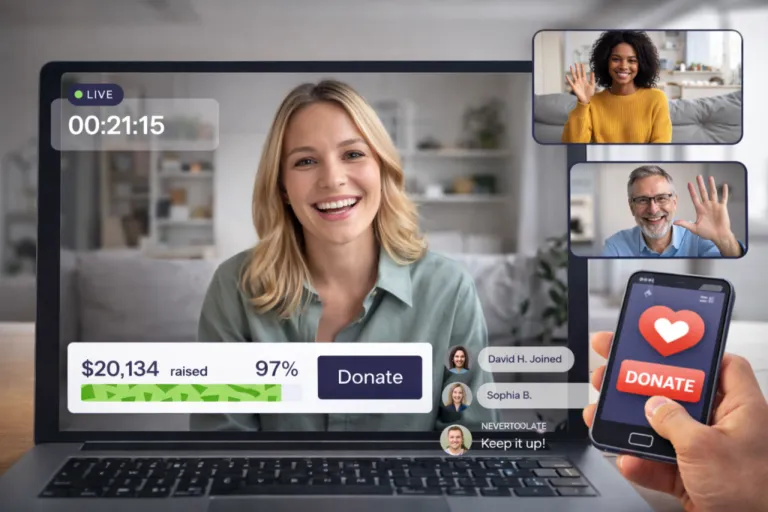
Livestream fundraising moved from an experiment to a working tool very quickly after 2020. Lockdowns pushed charities, creators, and community groups to test live formats out of necessity. What surprised many organizers was how well these streams performed once audiences had a choice again. Live video holds attention in a way static donation pages rarely do. People stay longer, react in real time, and feel part of a shared moment. That sense of presence matters.
Livestream fundraising also taps into behavior that platforms have trained users to follow for years. Viewers already chat, react, and tip during live content. Adding a clear cause turns those habits into donations. Short prompts, visible progress bars, and direct interaction lower hesitation. Many campaigns report higher average session times compared to traditional fundraising pages, along with more spontaneous contributions during peak moments of a stream.
There is no magic in the format itself. Results come from timing, clarity, and trust. A good charity stream makes donating simple, visible, and emotionally connected to what is happening on screen. When those elements line up, live fundraising becomes a practical way to turn attention into real support.
Livestream fundraising works when donating becomes part of the show: viewers can give in one click, see progress update live, and get real-time acknowledgment—turning attention and chat energy into donations.

What Are Charity Streams and How They Actually Work
Charity streams are live online broadcasts designed around one action: donating while the event is happening. Viewers are not passive spectators. They watch, react, chat, and contribute in real time. A charity live stream blends entertainment, communication, and fundraising into one experience, which is why it often feels more engaging than a traditional donation page.
One of the biggest reasons livestream fundraising converts well is simple: removing extra steps during the live moment.
“The Tiltify Fundraising Extension will enable donations to be made to a Tiltify campaign without ever having to leave the broadcast!”
That is exactly the right principle for charity streams. The less friction there is between watching and donating, the easier it is to convert live attention into action.
Source: Tiltify — Best Practices: Twitch Livestream
Most charity streams follow a few clear formats, and each one affects how people give. The most common approaches include:
- Free-to-watch streams where the audience joins without paying and is encouraged to donate throughout the broadcast
- Ticketed livestream events that require a fixed entry fee, often used for concerts, talks, or exclusive shows
- Hybrid streams that stay open to everyone while unlocking special interactions or moments for donors
All of these formats fall under livestream fundraising because donations are directly connected to the live event and its momentum.
Donation collection is built into the viewing experience. Viewers usually give through a visible button, a link pinned in chat, or a QR code displayed on screen. Many streams show live progress bars or counters so people can see the total change instantly. That visibility creates urgency and often leads to multiple donations from the same viewer during one session.
Real-time interaction is what keeps the system working. Hosts respond to chat messages, acknowledge donors by name, and react as goals are reached. This constant feedback loop explains why livestream fundraising often delivers longer viewing sessions and higher engagement than static fundraising pages, using mechanics that stay consistent with how donations are described later in the FAQ.
Charity stream formats: donation flow + engagement levers + what to measure
| Stream format | Donation method that converts best | Engagement lever that drives spikes | Best for | KPI to watch during the stream |
|---|---|---|---|---|
| Free-to-watch | Embedded donate button + pinned link + QR on screen | Milestone unlocks (“at $X we do Y”) | Open community drives, first-time events | Donations per 10 minutes + chat velocity |
| Ticketed / pay-to-access | Paywall checkout + optional “tip/donate” during stream | Premium content + guest access | Concerts, talks, exclusive workshops | Ticket conversion rate + add-on donations |
| Hybrid (free + donor unlocks) | Free entry + donor-only interactions (polls, requests, backstage) | Donation-triggered actions (soundboard, polls, “choose next”) | Long streams, creator-led charity marathons | Repeat donors per session + time-to-next-donation |
| Peer-to-peer team stream | Personal fundraising pages for each host/team | Team leaderboard + friendly competition | Schools, clubs, multi-host collabs | # active fundraisers + avg raised per fundraiser |
| Match hour / sponsor-backed | Simple donate flow with “matched” badge + countdown | Timed match (“next 60 minutes doubled”) | Short, high-intensity pushes | Donations per minute during match window |
Popular Charity Stream Ideas That Keep Viewers Engaged
People donate during live streams for a simple reason: they feel involved. When viewers understand that their actions change what happens on screen, they stop watching passively and start participating. Strong charity stream ideas are built around this sense of control. The stream reacts to the audience, not the other way around. That shift is what turns attention into real support.
Interactive Formats That Drive Donations
Interaction works best when it is obvious and immediate. Donation-triggered actions are a good example. A small amount might trigger a sound, a visual effect, or a quick reaction from the host. Larger donations can unlock polls where viewers decide what happens next. These moments feel personal, even in large streams.
Live shoutouts matter more than they sound. Hearing your name or message read aloud creates a direct link between giving and recognition. On-screen progress bars play a similar role. When viewers see the total move in real time, they understand that their contribution counts right now. These mechanics form the backbone of effective charity stream incentives because they reward participation without turning the stream into a distraction from the cause.
Challenges and Milestones That Work in Real Streams
Challenges give structure to longer broadcasts. Timed segments help reset attention and give people a reason to stay. Endurance streams work when the host sets clear rules and communicates progress honestly. Viewers need to know what they are supporting and how far the goal extends.
Matching donation hours often create sharp spikes in activity. When supporters know their donation will be doubled for a limited period, hesitation drops. Unlockable moments tied to specific amounts also perform well. Instead of vague promises, hosts announce exactly what happens at each milestone. A new guest joins, a challenge starts, or exclusive content appears. These charity stream incentives ideas succeed because the cause-and-effect relationship stays clear.
Technology Behind Charity Streaming and Donation Flow
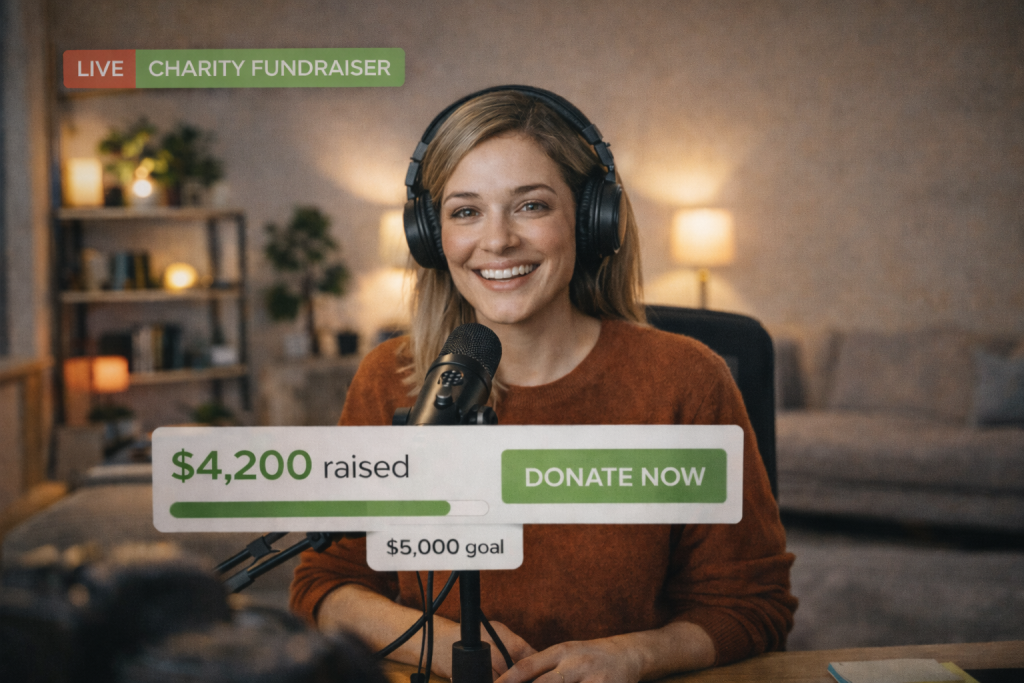
A charity stream only works when the technical side stays invisible to viewers. The moment a donation button lags or audio drops, trust breaks. Charity streaming depends on a tightly connected setup where video, interaction, and payments respond instantly to user actions.
The core stack usually starts with a low-latency video stream delivered through RTMP or WebRTC, depending on scale and interactivity needs. RTMP works well for larger audiences with stable delays. WebRTC is used when real-time interaction matters more than reach. Live chat runs alongside the stream and must support moderation tools such as keyword filtering, message pinning, and donor highlighting. Without moderation, large streams quickly become unreadable.
Payment processing is where many campaigns fail. Donation systems need to support instant confirmation, multiple payment methods, and visible feedback. If a user clicks “donate” and nothing happens for several seconds, they often abandon the action. During livestream fundraising, donation confirmation must return immediately and update the interface in real time.
Audio quality has the biggest impact on retention. A basic condenser microphone and noise suppression matter more than a high-end camera. Viewers tolerate video compression. They leave when speech becomes unclear.
The Technical Side of Donation Momentum
Key technical components that directly affect donations include:
- Low-latency video delivery, keeping host reactions aligned with chat and donation events
- Real-time chat infrastructure, capable of highlighting donor messages and suppressing spam
- Integrated donation logic, handling direct payments, embedded widgets, and recurring contributions
- Live data updates, pushing totals and goal progress instantly during livestream fundraising moments
- Analytics tracking, logging timestamps of donations, peaks, and viewer drop-off
Donation actions usually happen through pinned buttons, embedded forms, or QR codes rendered inside the stream layout. The system must sync these actions with visual updates immediately.
| Stream format | Donation method | Engagement level | Typical use case |
| Free live stream | Embedded donate widget | High | Open charity events |
| Ticketed event | Pay-to-access | Medium | Talks, performances |
| Hybrid stream | Free + donor unlocks | Very high | Long campaigns |
Real Case Studies That Show What Works

When it comes to livestream fundraising, real examples reveal what actually moves donations. The most-quoted success is Z Event 2021, where a group of French streamers raised nearly $12 million for charity over three days. Their approach combined a packed schedule, rotating hosts, visible goals, and well-publicized donation incentives that kept viewers engaged for long periods.
“Together we’ve raised more than $142,000,000 for Children’s Miracle Network Hospitals.” (Extra Life)
Smaller but instructive examples also exist outside massive multi-host events. Alveus Sanctuary used a 21-hour livestream to fund a wildlife sanctuary launch and brought in over $500,000 within a single session. The stream included live auctions and tiered donor perks that gave people something tangible in return for their support.
Another repeated pattern appears with individual creators on platforms like Twitch and Tiltify. Big influencers run annual charity events tied to specific themes, often exceeding six or seven figures in total funds simply by aligning donation goals with transparent progress and consistent interaction.
Across these cases, pacing, clear goals, and direct audience engagement stand out as the elements that keep viewers watching and donating, rather than momentary hype.
How to Do a Charity Stream Step by Step
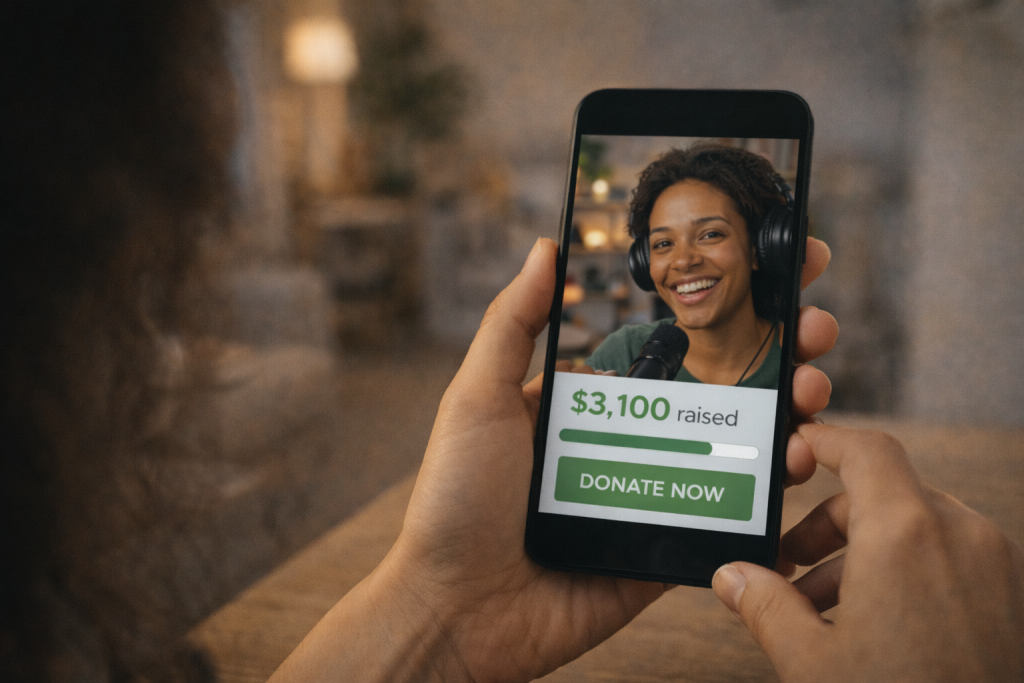
Here’s a numbered list of the essential stages for how to do a charity stream without skipping anything important:
- Clarify your cause and goal — Define who you’re supporting and what the fundraising target is. Clear goals motivate people to give.
- Choose the format — Decide whether the stream is long or short, ticketed or free, or whether elements unlock as donations increase.
- Promote early and honestly — Announce date, time, and purpose across your channels without overpromising.
- Test tech before going live — Check audio, video, encoding bitrate, internet stability, and donation tools beforehand.
- Moderate during the stream — Have someone watch chat, highlight donor activity, and remove spam.
- Use visual goals and incentives — Show live totals, progress bars, and milestones to make impact tangible.
- Acknowledge donors live — Thank donors on-air immediately after they give.
- Post-stream follow-up — Share results, thank participants, and explain next steps.
Keeping these steps tight and consistent helps keep viewers engaged and donations steady throughout the event, reducing confusion and building trust.
Fundraising Through Your Website With Scrile Connect
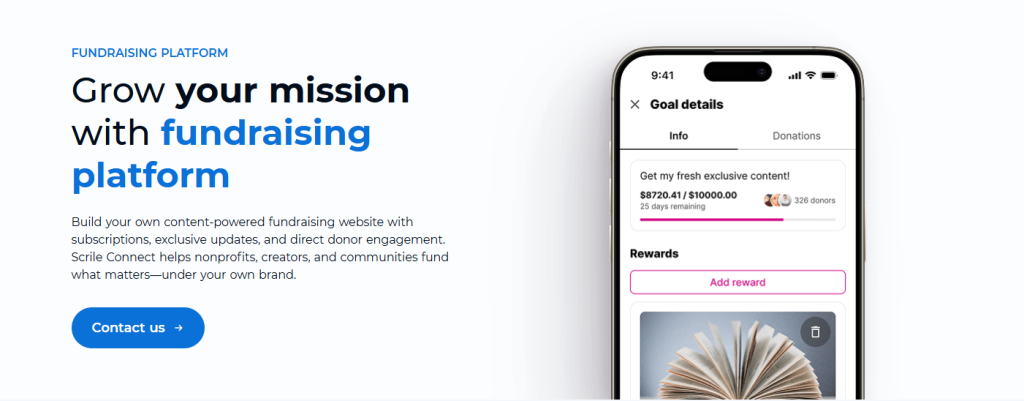
Running livestream fundraising through your own website changes how much control you have over the campaign and its results. Instead of routing supporters through third-party pages, the entire experience stays inside your brand. Scrile Connect works as a custom development service, building fundraising logic directly into your site rather than offering a fixed platform with preset limits.
This approach affects both economics and flexibility. You control donation flows, user data, branding, and payment logic. Fees are predictable. Campaign rules can evolve mid-stream. Features are designed around your goals instead of adapting to someone else’s interface. A livestream becomes part of your digital ecosystem, not a temporary external event.
Scrile Connect solutions typically include:
- custom donation logic tailored to your fundraising model
- branded donation flows that match your website design
- live video integration inside your own pages
- supporter accounts with donation history and preferences
- recurring donations for long-term supporter retention
- analytics tied directly to stream activity and conversion points
- flexible payment options based on geography and audience
Because everything lives on your website, the setup continues to work after one campaign ends. You can reuse the same infrastructure for future streams, events, or memberships. This makes livestream fundraising sustainable rather than one-off. Ownership, adaptability, and long-term value are the real advantages of building instead of renting your fundraising stack.
Conclusion
Livestream fundraising works when viewers focus on the cause, not the tools behind it. Clear goals, visible progress, and honest interaction matter more than production scale. Strong incentives keep attention. Reliable technology keeps trust intact. When those elements align, even small streams can create meaningful results.
If you want to run charity streams through your own website with full control over donations, branding, and data, reach out to the Scrile Connect team to discuss a custom fundraising solution built around your goals.
Quick recap (numbers worth remembering):
- Tiltify reports creator-led fundraising hit $100M+ in 2025, and the Top 30 fundraisers collectively raised $74.2M.
- Extra Life says its community has raised $142,000,000+ to date for Children’s Miracle Network Hospitals.
- Sustainable giving is increasingly recurring-led: monthly giving was 31% of all online revenue in 2024 (M+R Benchmarks).
- Livestream case studies show how incentives work: Maya Higa’s 21-hour stream raised $500,000+ to launch Alveus Sanctuary (frequently cited example of auctions + milestone incentives).
Takeaway: Run the stream like a loop: instant donate flow → visible progress → donor recognition → milestone incentives, and always convert peak attention into monthly supporters for compounding results.
Frequently Asked Questions About Livestream Fundraising
What is livestream fundraising?
Livestream fundraising is a live online event where viewers can donate while the broadcast is happening. Instead of separating content from giving, the stream combines entertainment, communication, and fundraising in one experience so people can watch, react, and support in real time.
How does a charity livestream work?
A charity livestream usually works by combining a live video broadcast with a visible donation path such as an embedded donate button, a pinned link, a QR code, or a platform-native giving feature. The host encourages donations during the event, viewers see progress update live, and donation goals or incentives help keep momentum high.
What makes livestream fundraising effective?
Livestream fundraising works best when the donation flow is simple, the cause is clear, and the audience can see their impact in real time. Visible progress bars, milestone-based incentives, donor recognition, and real-time host reactions all help turn passive viewers into active supporters.
What are the best livestream fundraising ideas?
Strong livestream fundraising ideas usually include milestone unlocks, donation-triggered challenges, live polls, guest appearances, limited-time matching hours, endurance streams, team-based fundraising, and hybrid events that let viewers donate for specific interactions or rewards during the broadcast.
Do viewers donate more when they can give without leaving the stream?
In general, lower-friction donation flows perform better during live events because they reduce hesitation in the moment. When viewers can donate inside the broadcast experience or with one clear action, it becomes easier to convert attention while the emotional peak is still happening.
What tech do you need for a charity stream?
A good charity stream needs reliable video delivery, clear audio, a moderated live chat, a visible donation flow, and real-time feedback such as alerts or progress bars. Audio quality, donation confirmation speed, and moderation usually matter more than expensive production gear.
How long should a charity livestream be?
The ideal length depends on the format, but longer is not always better. The stream should be long enough to build momentum and hit multiple donation moments without exhausting the audience. A shorter, focused event with strong pacing can outperform a long broadcast with weak incentives.
What should you measure during livestream fundraising?
The most useful live metrics usually include donations per minute, total raised, chat velocity, repeat donors, time to next donation, donation conversion during milestone segments, and viewer drop-off. These numbers show not just how much was raised, but when momentum actually happened.
Can livestream fundraising help build recurring donors?
Yes. A livestream can be a strong entry point for recurring support when the organizer gives viewers a clear next step after the event. Instead of ending with a one-time thank-you, the stream can introduce monthly giving tiers, recurring support goals, or post-event follow-up that turns peak engagement into longer-term donor retention.
Can I run livestream fundraising on my own website with Scrile Connect?
Yes. If you want more control over branding, donor data, recurring giving, and the live donation experience, Scrile Connect can be used to build a branded fundraising website with custom donation flows, live video integration, supporter accounts, and reusable fundraising infrastructure.
