
Nonprofit Fundraising Plan: How to Build One
Learn how to build a clear, practical nonprofit fundraising plan that actually works. This guide walks you through setting goals, choosing the right channels, organizing your team, tracking results, and avoiding common mistakes, plus how custom solutions from Scrile Connect can help you design a smarter, more flexible online fundraising system around your nonprofit’s real needs.

Nonprofit Fundraising Plan: How to Build One
A small, mission-driven nonprofit pours its energy into good work but spends every quarter scrambling for donations. Appeals go out late, staff rushes, and results feel unpredictable. A nonprofit fundraising plan changes that dynamic. It replaces panic with clarity, random effort with timing, and scattered asks with focus. This isn’t about adding more paperwork to your plate. It’s about creating a simple framework that helps you decide what to do, when to do it, and why. Digital tools and platforms matter, but they only amplify what you already planned. The real leverage starts with thinking first, then acting deliberately.
A nonprofit fundraising plan is a simple 12-month system that ties your revenue goal to the right audiences, channels, owners, and metrics—so you raise money consistently instead of scrambling quarter to quarter.

Why Nonprofits Get Stuck Without a Plan
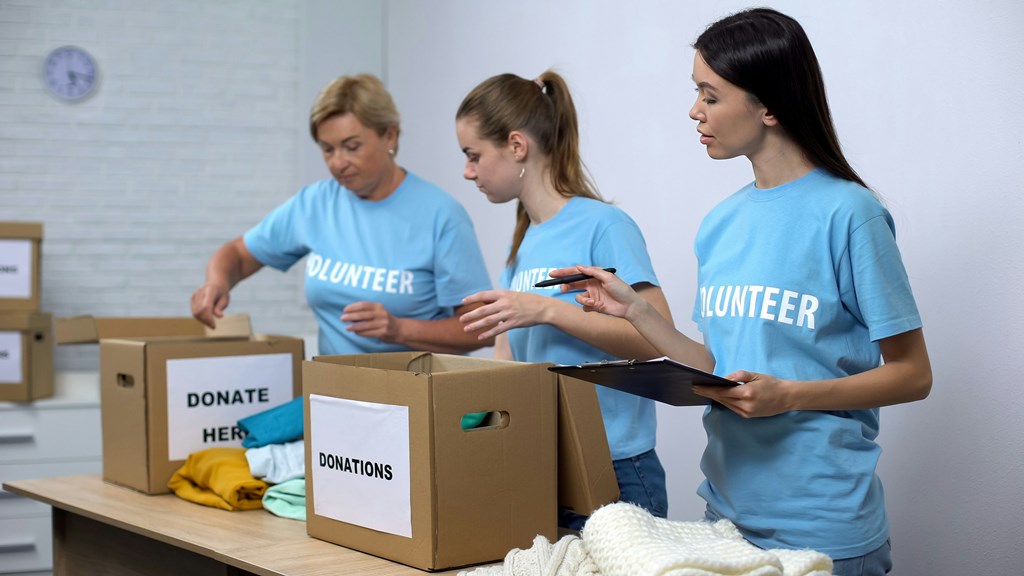
Passion rarely fails; structure usually does. Many nonprofits care deeply and work tirelessly, yet still feel stuck because their fundraising runs on urgency instead of intention. Reactive fundraising looks like scrambling when cash runs low — rushing appeals, improvising events, and chasing every opportunity that appears. Proactive fundraising starts earlier, connects activities to clear goals, and treats fundraising as a steady system rather than a series of emergencies.
“Individuals, bequests, foundations and corporations gave an estimated $592.50 billion to U.S. charities in 2024.” – Giving USA
When there is no nonprofit fundraising plan, the same patterns tend to repeat:
- last-minute campaigns that feel rushed and thin,
- mixed messaging that confuses supporters,
- donor fatigue from too many uncoordinated asks,
- burnout of staff and volunteers who are always in crisis mode.
These consequences reinforce each other. Confused donors give less, stressed teams make mistakes, and the organization ends up spending more energy for weaker results.
The environment around nonprofits has also changed. Online giving has become a major channel, and recurring donations are increasingly common. That shift rewards consistency, clear storytelling, and predictable communication. Organizations that operate only in reactive bursts often miss this opportunity, while those that plan ahead can build steadier relationships and more reliable revenue over time.
What Actually Belongs in a Strategy

A strong strategy is not a glossy document. It is a set of clear choices that align your mission, your people, and your money. When those choices are sharp, everything else becomes easier.
Clear goals and the right donors
Start by being specific about what your fundraising will actually fund. Is it program delivery, salaries, infrastructure, or growth? Vague goals like “raise more” rarely move teams or donors. Instead, translate your mission into concrete outcomes that money will enable.
Set targets that are realistic and measurable. Decide not only how much you need, but by when, and from whom. This is where many organizations overreach or underplan.
Donor segmentation matters as much as the total amount. Small donors often provide stability and community; major donors can unlock transformational gifts; corporate partners bring both funding and credibility. Treating all supporters the same usually weakens your impact.
Thoughtful fundraising strategies for nonprofits connect these pieces so your asks feel intentional rather than random.
Channels that fit your organization
Pick channels that match your capacity and your audience, not just what looks popular. Digital tools — donation pages, email campaigns, social media — work well for scale, while offline methods like events or direct mail deepen relationships.
Balance recurring gifts with one-time contributions. Monthly donors create predictable revenue, while occasional gifts fuel specific campaigns or emergencies.
Community events such as walks, raffles, or small auctions are less about immediate profit and more about building trust and visibility. Done well, they strengthen your broader charity fundraising strategy.
Whatever mix you choose, keep it consistent. A coherent nonprofit fundraising strategy works best when every channel supports the same story and goals. That alignment is the core of a durable nonprofit fundraising plan.
Fundraising approaches vs. what they’re best at (quick planning table)
| Approach | Best for | Primary KPI to track | Tools you need | Main risk | Planning tip |
|---|---|---|---|---|---|
| Recurring giving (monthly) | Stable baseline revenue | Monthly donor retention + churn | Donation form + CRM + renewal comms | Churn from weak onboarding | Add a “welcome + impact” sequence + annual upgrade ask |
| Peer-to-peer | Reach + social proof | # of active fundraisers + avg raised per fundraiser | Shareable pages + templates + coaching | Low participation | Recruit team captains first; launch with a small “founding crew” |
| Matching gifts | Increasing gift impact | Match rate + employer participation | Matching tools + clear instructions | Setup complexity | Make it a timed “match week” with simple messaging |
| Auction / event | Visibility + major donor cultivation | Net profit + cost per dollar raised | Ticketing + sponsor kits + logistics | High effort / low net | Treat it as a relationship play; set a clear net target |
| Text-to-give | Fast, low-friction donations | Conversion rate + avg gift | SMS provider + short landing page | Lower avg gift | Use for emergencies/live moments; follow up to convert to monthly |
| Email fundraising | Owned audience monetization | Revenue per 1,000 emails + list growth | ESP + good donation page | Fatigue / declining performance | Segment hard; send fewer, stronger appeals |
Money, Time, and People

Great ideas fail when budgets and roles are vague. You can have a brilliant nonprofit fundraising plan, but if the money, time, and responsibilities are fuzzy, execution will still break down.
Start with a simple, realistic budget that matches your ambitions. Many nonprofits focus only on program costs and forget the real price of fundraising. At minimum, account for:
- tools and software (CRM, donation forms, analytics),
- marketing and design (emails, ads, visuals),
- events (venue, permits, logistics),
- staff or contractor time.
Next, clarify ownership. Decide who manages incoming donations, who maintains donor data, and who communicates with supporters. When “everyone” is responsible, no one actually is. Clear roles reduce mistakes, speed up responses, and make your team feel less stretched.
Nonprofits also tend to underestimate technology costs. Platforms, integrations, payment fees, and maintenance add up quickly. What looks “cheap” at first can become expensive in time and hidden friction later.
That is why fundraising planning needs to pair ambition with practicality. Align your budget, your people, and your timeline before you launch anything. When these three elements move together, your plan stops being a document and starts working in real life.
Plans That Work — and the Formats That Win

Seeing how plans play out in real life makes the idea of a nonprofit fundraising plan far clearer than any theory.
A small community nonprofit in a mid-sized town built its year around two anchors: steady monthly donors and one signature event in the fall. Instead of chasing every opportunity, it focused on nurturing 300 recurring supporters at modest levels and then poured energy into a well-run annual dinner with a local auction. The recurring gifts covered core costs; the event funded a specific program expansion and doubled as a relationship builder with local businesses.
A digital-first organization took a different path. It prioritized peer-to-peer fundraising through social campaigns, giving supporters simple tools to create personal pages and share stories. Alongside that, it pushed monthly giving as the default option on its donation page. The result was fewer big, chaotic campaigns and more consistent cash flow driven by community advocates rather than staff alone.
A hybrid model blended both worlds. A regional nonprofit hosted two local events a year — a charity walk and a small auction — but paired them with a structured corporate matching gift program. Local companies agreed to match employee donations during a defined window, turning ordinary contributions into much larger totals while deepening corporate relationships.
Successful Fundraising Formats
Across these approaches, certain formats tend to perform especially well when matched to the right audience. Many nonprofits consistently see stronger results from:
- auctions that combine entertainment with competition,
- matching gift drives that double individual contributions,
- text-to-give campaigns for quick, low-friction donations,
- eCard campaigns that spread awareness while raising money,
- volunteer grants that turn hours of service into corporate donations,
- peer-to-peer fundraising that lets supporters raise money on your behalf.
None of these formats succeed automatically. They work best when they fit your supporters’ habits, your team’s capacity, and the goals you set in your plan.
Fundraising Approaches vs Results
The table below gives a quick, practical snapshot you can use when shaping your approach instead of guessing which tactic fits your goals.
| Approach | Best for | Tools | Risk |
| Recurring | Stability | Forms | Churn |
| Auctions | Visibility | Event tools | High effort |
| Peer-to-peer | Growth | Social | Low participation |
| Matching gifts | Larger gifts | Employer programs | Setup complexity |
| Text-to-give | Speed | SMS | Lower gift |
Tracking What Works

A plan without measurement is guesswork, and guesswork is how good intentions quietly waste money.
- Track the right numbers, not just the headline total.
Monitor how much you raise overall, your cost per dollar raised, donor retention, and average gift size, because together these indicators reveal whether your efforts are efficient or simply noisy. - Prefer simple dashboards over massive spreadsheets.
A clear visual overview lets you spot patterns in minutes, while oversized tables of raw data often bury problems until they become expensive to fix. - Build a regular review rhythm.
Hold monthly or quarterly check-ins to compare results against your targets, and treat these meetings as a chance to adjust tactics rather than defend them. - Tie insights back to your overall direction.
Data should strengthen your fundraising strategy for nonprofits, keeping every campaign aligned with your mission and your audience instead of drifting toward vanity metrics.
When you consistently measure, learn, and refine, your nonprofit fundraising plan becomes a living system instead of a static document, and your fundraising grows more predictable without becoming mechanical.
Organize Fundraising on Your Own Platform with Scrile Connect
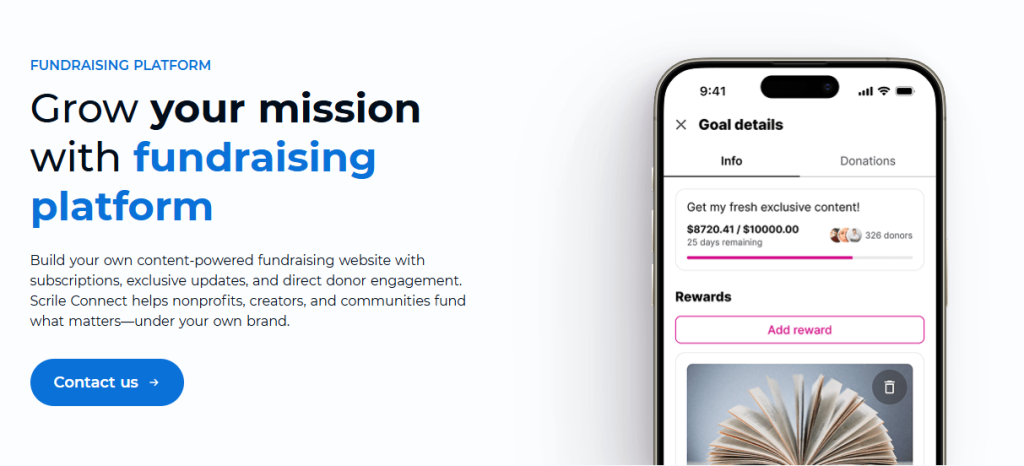
Many nonprofits outgrow off-the-shelf fundraising tools faster than they expect. What begins as convenience often turns into friction: fixed donation tiers, generic checkout pages, and dashboards that don’t match how your team actually works. At that point, you start adapting your strategy to the software instead of letting the software serve your strategy.
Scrile Connect takes a different path. It is not a ready-made platform you simply sign up for. It is a custom development service that builds a fundraising system around your nonprofit’s real workflows, audience, and goals. Instead of forcing you into templates, it lets you define how donations move, how supporters interact with you, and how your team manages campaigns.
This matters because many of the problems nonprofits face — scattered tools, weak analytics, and clunky donor experiences — are design issues, not mission issues. With Scrile Connect, those problems are solved at the system level rather than patched with manual work.
In practical terms, organizations typically use Scrile Connect to build:
- Custom recurring donations and tiered giving that reflect how you actually ask for support.
- A fully branded donor experience that feels like your organization, not a third-party site.
- Built-in analytics that track retention, campaign results, and donor behavior in one place.
- Livestream fundraising or paid updates for highly engaged supporters.
- Admin tools that reduce manual work, so your team spends less time on data entry and more time on relationships.
Because everything is tailored, you can also define your own rules for onboarding, verification, and account management. This reduces friction for donors and confusion for staff. The result is a fundraising setup that grows with you — reliable, flexible, and aligned with how your nonprofit actually operates.
Conclusion
Start with clear goals, choose channels that actually fit your audience, assign ownership for money and data, and measure what happens instead of guessing. Planning beats panic every time — it gives your team confidence and your donors a clearer reason to stay involved. The right systems can amplify all of this by reducing friction, improving analytics, and keeping everything in one place. If you want a fundraising setup built around your nonprofit instead of generic templates, reach out to the Scrile Connect team and discuss a custom solution that matches how you actually work.
Summary (numbers worth remembering):
- $592.50B total charitable giving in the U.S. in 2024 (+6.3% current dollars; +3.3% inflation-adjusted).
- Individuals gave $392.45B in 2024 (largest share of total giving).
- Digital fundraising is steady, not explosive: average nonprofit online revenue was +2% in 2024, driven by monthly giving (+5%), which made up 31% of online revenue.
Takeaway: A plan that prioritizes recurring giving + a few high-fit campaigns (instead of “everything everywhere”) is the most reliable path to predictable revenue.
Related guides
- Best Donation Platforms for Nonprofits in 2026
- What Is a Church Online Platform and How Does It Work?
- 15 Church Website Ideas to Inspire Your Design
- Donation Page Examples to Inspire Your Website
FAQ
What is the best way to raise money for a non-profit?
Set up recurring donations through tools like Donorbox or Givebutter to create steady income, run online auctions to engage supporters, organize community events such as dog walks or raffles to build relationships, and explore corporate matching gifts to increase the impact of individual donations.
What is the most successful type of fundraiser?
Auctions, matching gift drives, text-to-give campaigns, eCard campaigns, volunteer grants, and peer-to-peer fundraising consistently deliver strong results when they match your audience and capacity.
Which fundraising platform is best for nonprofits?
GoFundMe Pro stands out for nonprofits because it offers branded campaigns, intelligent tools, and flexible donation forms in a single, accessible system designed for online fundraising.
Peer-to-peer only worked after we recruited team captains first. Otherwise participation was near zero.
We kept doing events with no net target. When we started tracking cost per dollar raised, we cut two ‘tradition’ events immediately.
Our biggest win was assigning owners per channel. Once ‘someone owns the email calendar,’ chaos disappears.