
Recurring Crypto Payments: Web3 Payment Solutions
Recurring crypto payments are becoming a real alternative to card-based subscriptions. This article explains how automated blockchain billing works, why businesses use it, and what tools power Web3 payment systems. You’ll also learn how Scrile can build a custom crypto billing solution for your website.

recurring crypto payments
People barely notice how many subscriptions run their daily routine anymore. A streaming platform for the commute, a design tool for work, cloud storage, a few creator memberships, maybe a fitness app. Most of it renews in the background. Cards get charged, invoices pile up, and the cycle moves on without much thought. This familiar system is starting to shift as a new option enters the picture. More companies are experimenting with recurring crypto payments, and the idea is moving from niche curiosity to something practical.
Crypto wallets can approve automated transactions, so scheduled billing no longer depends on card networks or banks. A smart contract can handle a monthly charge, and the system runs as long as the user keeps enough balance. No expired cards, no blocked transactions, no regional restrictions. This appeals to businesses that reach global audiences and want fewer interruptions in their subscription flow.
The concept is spreading through platforms that already support automated purchases. Developers see patterns that look familiar but run on different rails. The mechanics are simple once you break them down, and the benefits become clear with real examples. This article explains what recurring crypto payments are, how they work, the Web3 models behind them, and how you can integrate the same capabilities into your own website with a custom solution built by Scrile company.

What Are Recurring Crypto Payments?
Recurring crypto payments are scheduled transfers made in cryptocurrency. A user approves the charge through their wallet once, and that permission allows the system to renew the payment on a set cycle. It works much like the subscriptions people already use for apps or entertainment, only the billing rail changes. A wallet signature replaces the chain of banks and card processors.
Conventional billing fails in familiar ways. A card expires. A bank blocks an international transaction. Some customers do not have access to cards at all. Wallet approval avoids these weak points. After the user grants permission, the system attempts each renewal automatically. It succeeds when the wallet has enough balance and pauses when it doesn’t. Gas fees still matter, and each network has its own tempo, but once configured, the routine stays consistent. That reliability is one reason recurring crypto payments appeal to companies with users spread across countries.
Businesses apply this model in many situations. Software teams renew account access. Creators maintain paid communities. Games update season passes. NFT utilities refresh perks on a monthly cycle. Any product that depends on ongoing access can use this structure.
The process usually follows a simple chain:
- The wallet asks the user to approve recurring charges.
- The user chooses the token and billing interval.
- The system stores that approval for future cycles.
- The contract checks the balance and gas conditions at renewal time.
- If everything aligns, the payment goes through. If not, the system waits instead of failing silently.
Recurring crypto payments rely on these small steps working together, creating a subscription flow that operates without banks or card networks.
One of the clearest signs that recurring crypto payments are becoming practical is that major billing infrastructure now supports them directly:
“Use this guide to set up a subscription that withdraws recurring stablecoin payments from a customer’s crypto wallet.”
That matters because it shows crypto subscriptions are no longer just a Web3 concept. They are becoming part of real billing infrastructure for businesses that want recurring payments without relying only on cards.
Source: Stripe Docs — Set up a subscription with stablecoin payments
A practical way to launch recurring crypto billing
For most businesses, recurring crypto payments are not just about blockchain logic. They also require a reliable payment layer that can handle subscription billing in production.
That is where a solution like Zyrox fits in. Zyrox is a non-custodial crypto payment gateway that sends funds directly to your wallet and supports subscription payments powered by smart contracts. In a practical setup, a business can use a custom product layer built by Scrile and connect it to Zyrox as the recurring crypto payment infrastructure behind the checkout flow.
How Automatic Billing Works on a Blockchain
Smart contracts define the entire routine. They track time, check balances, and trigger payments without involving banks or card processors. This automation removes many friction points that plague traditional subscriptions. Teams building global products often look at recurring crypto payments because the billing engine doesn’t change based on the customer’s country or their card issuer. The rules stay consistent. The schedule stays predictable. The system runs as long as the chain itself continues to operate.
Why Recurring Crypto Payments Matter for Businesses

The subscription economy keeps expanding. Analysts expect the global market to cross 1.5 trillion dollars by 2030, fueled by software bundles, creator memberships, cross-platform gaming passes, and a long list of digital services that rely on predictable monthly revenue. Businesses want payment systems that match this momentum. This is where recurring crypto payments start to fit into real commercial plans instead of staying on the edges of Web3 experiments.
The appeal is practical. Crypto moves across borders without asking banks for permission. A customer in one region can renew their subscription in seconds without currency conversions. Chargebacks disappear because transactions are final. Fees shift from card processors to the chain itself, which often results in lower operating costs. When a company chooses stablecoins like USDT or USDC, the monthly price doesn’t swing. Many companies serving emerging markets look at crypto because large portions of their audience don’t have reliable card access but do have wallets. This is one reason Web3 payment options are appearing in more business conversations.
A few advantages stand out once you examine how businesses actually use subscription billing:
- Reliable global access: a customer only needs a compatible wallet. They don’t need a credit card, a bank account with international clearance, or an address that card processors recognize.
- Fewer failed renewals: wallet-based approvals bypass many predictable issues such as expired cards, fraud filters, and regional transaction blocks. The subscription keeps running as long as the customer maintains balance.
- Predictable revenue: companies using stablecoins know the amount they receive each cycle. It simplifies revenue forecasting and reduces uncertainty across markets.
- Better margins: moving billing logic to on-chain infrastructure often lowers payment overhead. Card networks layer fees and conditions, while blockchain transactions follow transparent rules.
Web3 Payment Infrastructure and Subscription Tools

Automated billing becomes possible in Web3 because smart contracts can execute rules without asking a bank or processor to approve every renewal. Once a user signs a wallet permission, the contract stores that authorization and uses it at each interval. The logic is mechanical: check the balance, confirm network conditions, execute the transaction. This structure is different from traditional billing but grounded in the same goal, which is to create a steady flow of payments that a business can rely on. Many teams exploring recurring crypto payments find themselves drawn to this model because it replaces a fragile chain of third-party approvals with a predictable set of blockchain rules.
A few technologies make this possible. DeFi introduced the idea of automated transactions long before subscriptions entered the conversation. Wallet approvals allowed users to grant recurring permissions in a controlled way. Gas fees forced developers to design smarter cycles, since each renewal has a cost. Cross-chain tooling gave merchants more choices, from low-fee networks to more established chains. These elements form the backbone of modern Web3 payment systems.
To build something businesses can trust, several layers have to work together:
- Wallet approval mechanisms handle the first handshake with the user, and they determine how much freedom the contract has to pull funds in the future.
- Recurring charge logic sets the timing structure, evaluates the user’s balance, and adapts to changing gas prices so renewals don’t fail unexpectedly.
- Off-chain event tracking keeps records of every renewal, which supports analytics, invoices, and customer notifications.
- Merchant dashboards show subscription status in real time and help teams adjust pricing, intervals, and supported tokens.
- Token selection allows companies to support BTC, ETH, USDT, USDC, or other assets, depending on volatility tolerance and user preference.
Where a gateway like Zyrox fits into the recurring billing stack
A real subscription setup usually needs more than smart contracts alone. Businesses still need a checkout layer, payment monitoring, merchant visibility, and recurring billing logic that works consistently over time.
That is where a crypto gateway like Zyrox becomes useful. Zyrox can act as the payment infrastructure layer for recurring crypto payments, helping businesses handle subscriptions, automated billing, and wallet-based checkout without relying on custodial processors. In that model, blockchain logic stays connected to a merchant-friendly operational layer instead of existing as a standalone technical experiment.
What a Real Web3 Subscription Stack Looks Like
A complete stack usually contains smart contracts, payment processors, billing dashboards, and integration layers that connect everything to the company’s website or app. Monitoring tools watch for low balances or interrupted renewals. API routes move data between the chain and the merchant’s internal systems. These parts turn Web3 payments into something companies can operate at scale, and they form the foundation of modern Web3 payment solutions. As more teams explore global subscription models, recurring crypto payments become a practical option rather than a technical experiment.
Limitations, Risks, and Security Factors
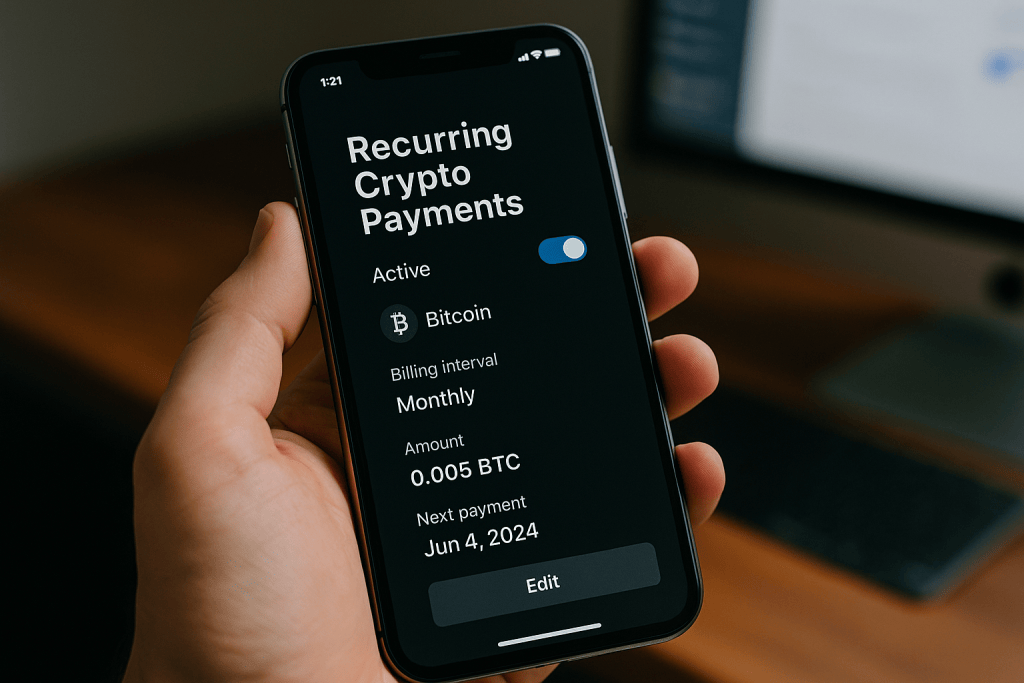
Businesses exploring recurring crypto payments gain more control over global billing, but they also accept a set of limitations that differ from card-based systems. Some come from how blockchains operate, others from how users handle their wallets. Gas fees shift throughout the day, so the real cost of a renewal can change without warning. A wallet might not hold enough tokens at the moment of the charge. Even users who want to stay subscribed can miss a cycle because the balance wasn’t topped up in time.
Smart contracts introduce their own responsibilities. Code needs to be audited, updated, and monitored. A flaw hidden inside a contract can create problems long after the subscription system goes live. User onboarding also demands attention. Many people still feel uneasy when a wallet asks for permission to process automatic payments. Regulations add another layer. Companies that convert crypto revenue into fiat must follow local KYC and AML rules, which can slow the withdrawal process.
Different networks create different challenges. Some chains become slow during high traffic. Some stablecoins carry better liquidity than others. These variables shape how smooth or unpredictable an automated billing cycle becomes.
Key Obstacles in Recurring Crypto Payments:
| Challenge | Cause | Impact |
| Gas Fee Volatility | Network spikes | Higher renewal cost |
| Failed Billing Cycles | Low wallet balance | Missed revenue |
| Smart Contract Issues | Poor audits or outdated code | Security risk |
| Onboarding Difficulty | Limited user knowledge | Lower conversion |
| Regulatory Pressure | KYC/AML on cash-outs | Slower payouts |
| Network Congestion | High on-chain activity | Delayed renewals |
| Stablecoin Liquidity Gaps | Token-specific market differences | Pricing complications |
Scrile Custom Development: Integrating Crypto Billing Into Your Website
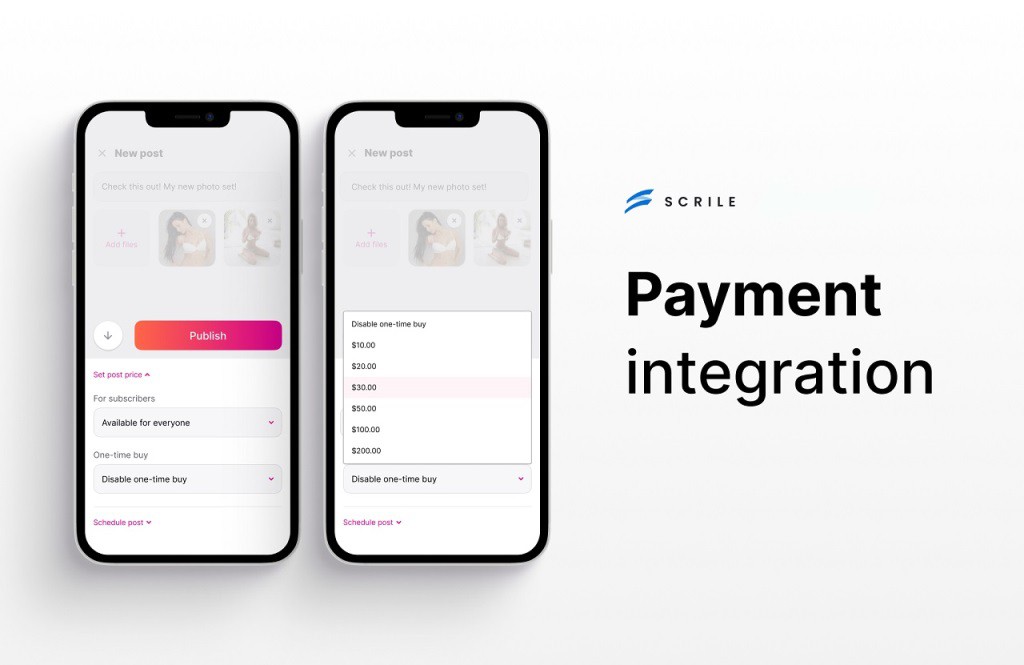
Once a company decides to support recurring crypto payments, the challenge is not only technical. The business needs billing logic, wallet flows, failed-payment handling, renewal tracking, merchant visibility, and a checkout system that users can actually trust.
This is where a two-layer approach makes sense.
Scrile can help businesses design the product side of the system: subscription logic, user access, onboarding, dashboards, notifications, and the custom flows required by a specific website or platform.
Zyrox can serve as the payment layer behind that setup. It is a non-custodial crypto payment gateway built for one-time and recurring payments, with direct-to-wallet settlement and subscription flows powered by smart contracts.
Together, this creates a more practical recurring crypto payment stack:
- Scrile handles the custom business logic and integration layer
- Zyrox handles the recurring crypto payment infrastructure
- the business keeps more control over both user access and revenue flow
This approach is especially useful for subscription platforms, creator businesses, adult services, digital products, SaaS projects, and other companies that want global billing options without relying entirely on traditional card processing.
Conclusion
Recurring crypto payments have moved far beyond theory. They give businesses a way to reach customers without fighting card restrictions or regional barriers. The model supports global access, steady revenue, and fewer renewal failures, and it works well for companies that rely on subscriptions to grow. As more products adopt Web3 tools, automated crypto billing becomes a natural extension of how digital services operate. If your website or app needs a subscription system that works across borders, consider adding a crypto option. Contact Scrile’s team to build a custom version tailored to your rules, your market, and the experience you want your users to have.
In real-world projects, recurring crypto payments usually work best when businesses combine two layers: a custom product experience and a payment infrastructure built for subscription billing. In that setup, Scrile can develop the user-facing logic and platform integration, while Zyrox can power the recurring crypto payment layer itself.
Frequently Asked Questions About Recurring Crypto Payments
What are recurring crypto payments?
Recurring crypto payments are scheduled payments made in cryptocurrency on a fixed cycle, such as weekly, monthly, or annually. They are used for subscription-style billing, memberships, SaaS access, paid communities, and other products that depend on repeat renewals instead of one-time purchases.
How do recurring crypto payments work?
In most setups, the user approves payment permissions through a crypto wallet, selects a token and billing interval, and then the system uses smart contract logic or connected billing infrastructure to process renewals automatically. The payment succeeds when the wallet has enough balance and the network conditions allow the transaction to go through.
Can businesses offer crypto subscriptions?
Yes. Businesses can use recurring crypto payments for subscription billing, digital memberships, creator access, software plans, Web3 products, and other recurring services. This model is especially attractive for global businesses or products serving users who may not rely on traditional card infrastructure.
What are the main benefits of recurring crypto payments?
The main benefits are global reach, fewer card-related failures, support for users without traditional payment access, final settlement without chargebacks, and the ability to use stablecoins for more predictable subscription pricing. For some businesses, this can also improve margins by reducing dependence on traditional payment rails.
Which cryptocurrencies are best for recurring payments?
Stablecoins such as USDT and USDC are usually the most practical choice for recurring payments because they reduce the pricing volatility that comes with assets like BTC or ETH. For subscription businesses, a stable monthly amount is often easier to manage than a token whose value changes sharply from week to week.
What are the risks of recurring crypto payments?
The biggest risks usually include gas fee volatility, missed renewals when wallet balances are too low, smart contract vulnerabilities, more difficult onboarding for non-crypto users, and compliance issues when businesses need to convert crypto revenue into fiat or follow local KYC and AML requirements.
Are recurring crypto payments cheaper than card subscriptions?
They can be, but it depends on the network, the token used, and the business setup. Some businesses save on payment overhead because they avoid card-network fees and chargebacks, but blockchain fees can still rise during congestion. The actual cost advantage depends on how the payment system is designed.
Do recurring crypto payments need smart contracts?
In many cases, yes. Smart contracts or equivalent Web3 billing logic are usually what make automated renewals possible. They help define timing, approvals, renewals, and transaction behavior, although the full business system also needs off-chain tracking, merchant dashboards, and customer-facing flows.
Can recurring crypto payments work across borders?
Yes. That is one of their biggest advantages. Crypto subscription flows can help businesses serve users across regions without relying on card approval rules, bank-based limitations, or local payment infrastructure. This is one reason recurring crypto billing is especially attractive for global digital products.
Can Scrile build a custom recurring crypto billing system for my website?
Yes. If your business needs more than a simple plugin or gateway, Scrile can build a custom crypto subscription system with wallet onboarding, billing logic, admin dashboards, renewal tracking, stablecoin support, and multi-chain setup tailored to your product and business rules.
