
Recurring Income Web Design: Build Sustainable Profits
Build predictable revenue with recurring income web design. Learn how agencies turn web projects into subscriptions, retain clients long term, and scale with custom solutions like Scrile Connect.


recurring income web design
Looking for ways to create recurring income in web design? The most reliable models are monthly maintenance plans, managed hosting, retainers, analytics and optimization packages, and productized subscription offers. The goal is simple: stop relying only on one-off website launches and turn client work into predictable monthly revenue.
Quick Answer: How do web designers build recurring income?
Web designers build recurring income by turning one-off projects into ongoing services. The most common models are monthly maintenance plans, managed hosting, retainers, analytics and optimization packages, and productized subscriptions with clear deliverables. These offers create more predictable revenue, stronger client relationships, and better long-term planning than relying only on new project sales.

What Is Recurring Income and Why It’s Gaining Ground
For years, web design was built around one-off projects. You launched a site, sent the final files, and moved on to the next client. The problem is that this model creates constant pressure to sell again. Once the project ends, the income usually ends with it.
That is why more designers and agencies are shifting toward recurring revenue. Instead of treating a website like a finished object, they treat it like an ongoing business asset that needs support, improvements, updates, and accountability. This is where recurring income web design becomes valuable: it gives clients continuity and gives the agency more predictable revenue.
Recurring Income Explained
Recurring income means getting paid on a predictable schedule for ongoing value. In web design, that value might be maintenance, hosting, improvements, or simply being responsible for keeping the site healthy. The contrast with project fees is stark. A project has a start, an end, and a long sales cycle in between. Recurring work has continuity.
The math is intentionally boring, which is why it works. Ten clients paying $300 per month generate $3,000 in stable revenue. That number doesn’t depend on closing new deals every week. This is how recurring income quietly replaces adrenaline with planning, and why designers who adopt it rarely go back.
Why Businesses Are Choosing Ongoing Services
Clients push this model forward as much as designers do. They want a single point of responsibility instead of juggling vendors and emergencies. Ongoing services usually bundle things clients don’t want to manage themselves, such as:
- managed hosting with someone accountable for uptime and speed, not just a server login
- security updates and monitoring that reduce real business risk
- analytics and reporting that show whether the site is actually performing
This preference mirrors broader buying behavior. Subscription-based services now dominate software spending. According to Zuora’s Subscription Economy Index, subscription businesses have grown revenues several times faster than traditional models over the past decade. That mindset spills into web services too. Recurring web design fits how businesses already think and budget today.
One of the clearest reasons agencies move toward recurring models is simple business stability:
“Recurring revenue, like that from retainer contracts, provides financial stability.”
That is exactly why monthly web design offers matter. They make planning easier, reduce dependence on constant new sales, and help agencies build deeper client relationships over time.
Source: Webflow Blog — Starting an agency that’s built to last
Subscription Models in Web Design That Actually Work

Subscription models work best when they feel concrete. Clients don’t buy “a website per month.” They buy continuity. They want to know that someone is responsible for the site after launch, that changes won’t turn into negotiations, and that problems won’t sit unanswered for weeks. This is where recurring income web design separates itself from classic project work. Instead of selling pages, designers sell ongoing attention, availability, and improvement.
The shift sounds subtle, but it changes how services are framed. A one-off project ends with delivery. A subscription begins with delivery. Everything after that is where the value compounds, both for the client and for the business providing the service.
Tiered Subscription Plans
Tiered plans succeed because they remove ambiguity. Each tier defines what the client can expect and what the designer is not obligated to do. That clarity reduces friction and churn. Well-structured tiers usually include a mix of predictable tasks and clearly capped extras, so work stays profitable over time.
In practice, tiers often differ across several dimensions, not just price:
- the number of content or layout changes allowed per month, written in plain language
- response times for support requests, which matter more to clients than unlimited promises
- access to performance checks, updates, or reporting
- what is explicitly excluded, so “small fixes” don’t quietly grow into redesigns
- upgrade paths, making it easy for clients to move up without renegotiation
When boundaries are visible, clients feel safer committing long term. Designers spend less time defending scope.
Retainers vs Productized Subscriptions
Retainers rely on trust and flexibility. They work well with mature clients who value access and ongoing collaboration. Productized subscriptions lean in the opposite direction. They favor standardization, repeatable processes, and predictable margins. Neither model is inherently better. The right choice depends on scale goals and client type. Many studios blend both, using recurring web design subscriptions as a stable base and retainers for higher-touch partnerships.
Additional Services That Turn Projects Into Monthly Revenue
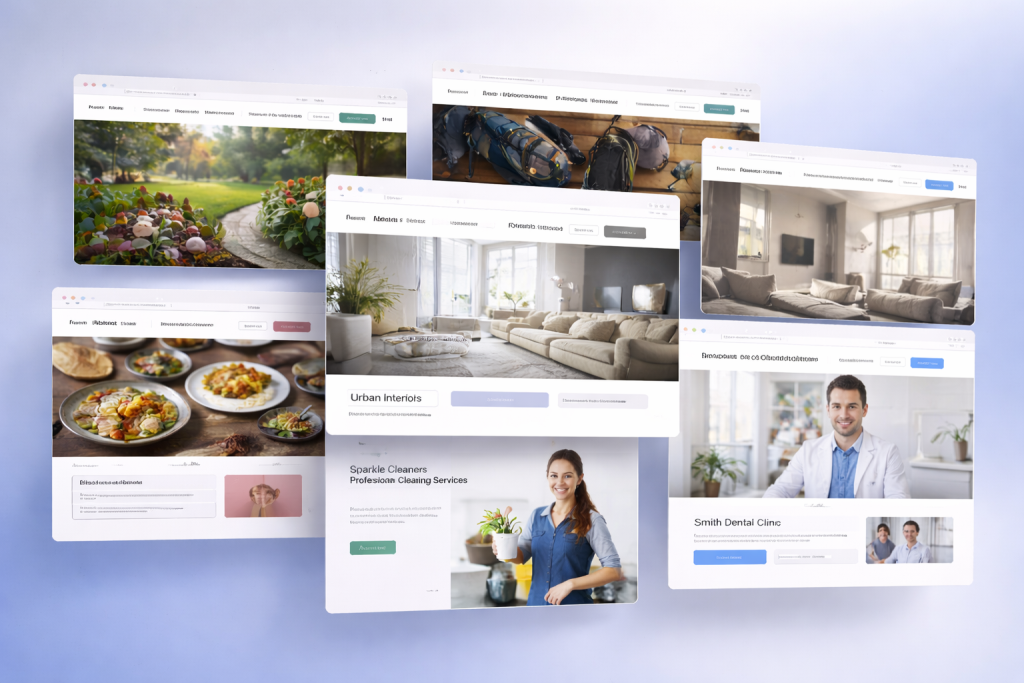
Add-on services sell more easily than redesigns because they solve quieter problems. Clients rarely wake up wanting a new homepage. They do worry about sites breaking, slowing down, or quietly underperforming. When services are framed as protection and improvement rather than “extra work,” the conversation changes. This is where recurring income web design becomes practical, not theoretical. Ongoing services feel like insurance with visible upside.
The key is positioning. These services are not optional polish. They reduce risk, save time, and create accountability after launch. Clients already understand subscriptions in other areas of their business. Web services fit that mental model naturally.
Support, Maintenance, and Security
Monthly support works when it’s specific. Clients paying every month expect their site to be watched, not just touched when something breaks. That expectation usually includes routine updates, backups that actually get tested, and monitoring that catches issues early. Emergency fixes matter too, but the real value is prevention.
What clients typically assume is happening in the background looks like this: software updates applied without downtime, backups stored offsite and restorable, alerts triggered when something fails, and a clear response path when help is needed. When these details are spelled out, monthly fees feel justified rather than abstract.
Hosting and Performance Management
Hosting becomes far more valuable when it’s offered as a managed, branded service. Clients don’t want server access. They want speed, uptime, and someone responsible when things go wrong. Performance management adds a layer most cheap hosts ignore.
Common elements bundled into managed hosting often include server configuration tuned for the site’s workload, performance monitoring with real thresholds, proactive fixes instead of reactive tickets, and a single point of contact. Accountability is what turns hosting into a service clients stay with.
Analytics and Continuous Optimization
Analytics subscriptions stick because they make progress visible. Monthly reports that explain what’s happening, not just numbers, change how clients view their site. Conversion insights, small iteration plans, and follow-up checks turn data into action.
This is where recurring income replaces guesswork. When improvements are measured and explained, clients understand what they’re paying for and why staying subscribed makes sense.
Agency Cases With Recurring Revenue

If you look past marketing blogs and sales pages, the same patterns show up again and again in how agencies actually build recurring revenue. Freelancers and small studios rarely start with grand subscription visions. Most arrive there after hitting the ceiling of project work. What works tends to be boring, repeatable, and tightly connected to real client pain. What fails is overpromising, underpricing, or bundling services clients don’t clearly understand.
One common path starts with maintenance plans becoming the financial backbone. Agencies that succeed here usually serve small and mid-sized businesses that don’t have in-house technical staff. Pricing is simple and transparent, often in the $150–$300 monthly range, covering updates, backups, monitoring, and basic fixes. Over time, this creates a baseline revenue that smooths cash flow and reduces reliance on constant new sales.
Another proven pattern revolves around retainers built around reporting and optimization. Instead of selling “hours,” agencies package analytics, performance tracking, and monthly recommendations. Clients stay because progress is visible and explained in plain language. Retention improves when reports connect site changes to business outcomes, not just traffic numbers.
Across both approaches, a few lessons show up consistently:
- Agencies that document exactly what is included, and what is not, spend less time renegotiating scope and more time delivering value.
- Clients stay longer when they feel someone is actively watching their site, not just reacting when something breaks.
- Predictable pricing builds trust faster than flexible but vague arrangements, especially for non-technical clients.
- Recurring revenue grows steadily when services are positioned as responsibility, not optional extras.
Common Recurring Revenue Models in Web Design
| Model | Client Type | Typical Monthly Fee | Core Value |
| Maintenance Plans | SMBs | $150–$300 | Stability |
| Managed Hosting | E-commerce | $200–$500 | Performance |
| Analytics & CRO | Growing brands | $300–$700 | Measurable improvement |
| Subscription Platforms | Creators | Per user | Scalable income |
How to Price Recurring Web Design for Sustainable Profit
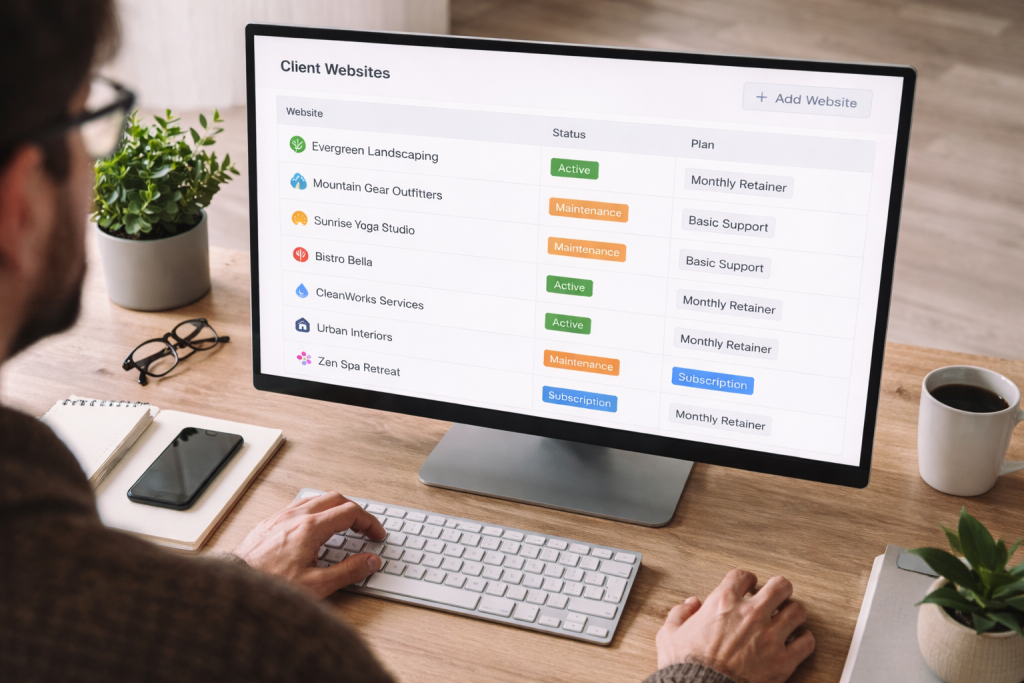
Pricing is where many recurring models quietly fail. Designers copy low monthly numbers to stay competitive, then realize too late that the workload doesn’t shrink with the price. Thin margins leave no room for proper support, which leads to slow responses, frustration, and eventually churn. Underpricing doesn’t just hurt revenue. It damages trust, because services start slipping the moment the work becomes unsustainable.
Recurring pricing works when it’s tied to outcomes instead of effort. Clients don’t care how many hours you spend updating a plugin or reviewing analytics. They care that the site stays online, secure, and effective. When pricing reflects responsibility and results, conversations shift away from micro-management. This is one of the biggest advantages of recurring income web design over hourly work. It replaces time tracking with accountability.
Bundling plays a key role here, but only when done with restraint. Too much flexibility creates confusion. Too many optional add-ons make clients hesitate. Clear bundles that combine maintenance, performance, and basic reporting are easier to understand and easier to sell. At scale, simplicity wins. Designers who embrace this approach tend to protect margins better and build more predictable recurring profit over time.
Build Your Own Subscription Platform With Scrile Connect
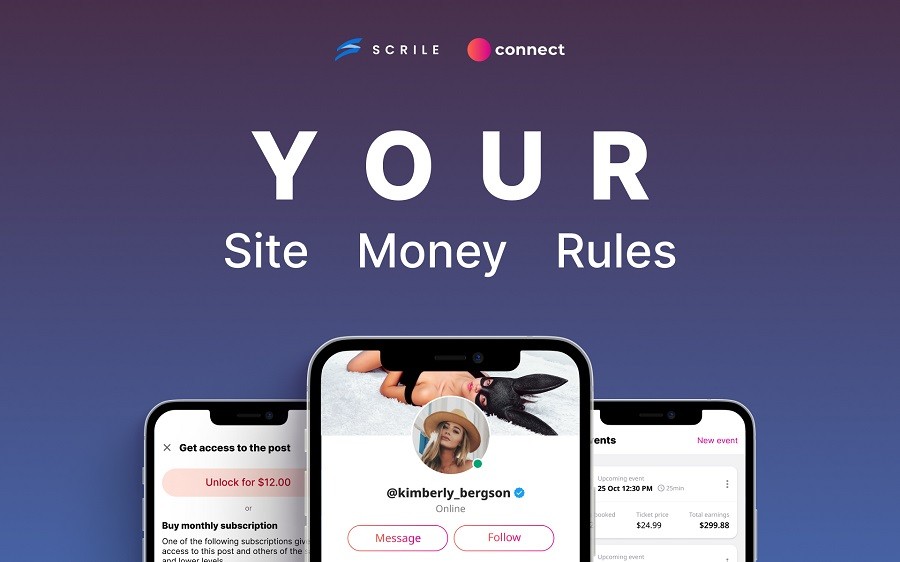
Off-the-shelf tools work fine when web design income comes from isolated projects. Problems start when recurring revenue becomes the core of the business. Standard plugins and hosted platforms impose fixed subscription logic, limited payment flows, and branding constraints that don’t align with how agencies actually sell and manage web services. For web design businesses building long-term income, those limits slow growth fast.
This is where custom development becomes part of the web design offering itself. Scrile Connect is not a platform designers log into. It’s a development service used to build fully branded subscription-based websites and client portals tailored to specific business models. Instead of forcing recurring income web design into predefined templates, the site architecture is built around how designers package services, manage clients, and monetize access over time.
In practice, Scrile Connect allows web designers and studios to build:
- subscription-based websites where design, maintenance, hosting, and updates are bundled into recurring plans
- client dashboards that give ongoing customers visibility into services, usage, and deliverables
- custom access rules for premium content, private areas, or member-only features designed as part of the site itself
- flexible monetization logic that supports retainers, memberships, pay-per-feature access, or hybrid models
- payment and compliance flows integrated directly into the web product, reducing operational risk as client volume grows
This approach suits designers and agencies that treat recurring revenue as a core part of their web design strategy, not an add-on. When the website itself becomes the subscription engine, control over structure, logic, and user experience turns into a competitive advantage. Scrile Connect supports that by helping build web products designed to generate sustainable income over time.st, adapt, and grow alongside the business.
Conclusion
Recurring income web design gives web businesses stability instead of constant resets. Predictable revenue, retained clients, and clear responsibility replace the pressure of endless new projects. Ownership makes this model work long term, because pricing, access, and monetization stay under your control. If subscriptions and recurring revenue matter to your business, reach out to Scrile Connect, and start building a custom subscription platform designed around your goals, not platform limits.
Related guides
- 15 Best Facebook Group Alternatives in 2026
- How to Build a Fanbase from Scratch?
- How to Make Money on OnlyFans? Best Strategies 2026
- How to Sell a Book? Proven Strategies for 2026
Frequently Asked Questions About Recurring Income in Web Design
What is recurring income in web design?
Recurring income in web design means getting paid on a monthly or annual basis for ongoing services instead of relying only on one-time website projects. It usually comes from services like maintenance, hosting, retainers, reporting, optimization, or subscription-based website offers.
How do web designers make recurring income?
Web designers usually make recurring income by offering monthly maintenance plans, managed hosting, retainers, analytics support, SEO updates, conversion optimization, or productized subscription packages. The strongest offers solve ongoing problems instead of selling one-time deliverables.
Is a web design subscription model profitable?
Yes, a web design subscription model can be very profitable when the scope is clearly defined and the delivery process is repeatable. It tends to work best when the agency avoids unlimited requests, sets visible boundaries, and builds pricing around responsibility and outcomes rather than small tasks.
What services are best for monthly recurring revenue in web design?
The most reliable recurring services are website maintenance, managed hosting, security monitoring, backups, content updates, analytics reporting, landing page support, SEO improvements, and conversion optimization. These are easier to resell monthly than full redesigns.
What is the difference between a retainer and a productized subscription?
A retainer usually sells access, flexibility, and guaranteed time. A productized subscription sells a defined monthly package with clear deliverables and limits. Retainers are often better for custom, higher-touch relationships, while productized subscriptions are better for repeatability and scale.
How much should I charge for recurring web design services?
Monthly pricing should depend on the scope of support, the speed of response, the level of responsibility, and the business value you create. A strong recurring offer usually has a clear base package and higher tiers for faster support, more requests, reporting, or optimization work.
Can hosting become a recurring revenue stream for web designers?
Yes. Hosting becomes a strong recurring revenue stream when it is offered as a managed service instead of just server access. Clients care less about the hosting itself and more about uptime, speed, support, and having one person responsible when something goes wrong.
Do clients actually want monthly web design services?
Many clients do, especially if they are not equipped to manage technical updates, performance, analytics, and fixes on their own. Ongoing services are easier to buy when they are framed as continuity, accountability, and protection against avoidable problems.
Is web design still a good business in 2026?
Yes, but the model has evolved. Web design is strongest when it includes recurring services such as support, optimization, content updates, analytics, or managed hosting. Agencies that rely only on one-time builds are more exposed to unstable revenue.
Can I build a subscription-based website business with Scrile Connect?
Yes, if your goal goes beyond maintenance or retainers and includes building a branded subscription website, member portal, paid content platform, or recurring-access product. Scrile Connect is most relevant when recurring revenue comes from access, monetization, and platform logic rather than only from classic website care services.
