
Types of AI Chatbots: From Rules to LLMs
This article breaks down the main types of AI chatbots, from rule-based systems to large language models. It explains how different architectures shape memory, control, and user experience, compares real platforms and use cases, and shows when building a custom chatbot with Scrile AI makes more sense than adapting a ready-made tool.


types of ai chatbots
Most people interact with chatbots daily without noticing how different those systems really are. A support widget answers a question. A conversational app keeps talking. On the surface, the experience feels similar. Underneath, the technology can vary dramatically. That difference is why understanding types of AI chatbots is more important than it sounds.
Chatbot architecture defines what happens after the first few messages. Some systems follow strict rules. Others recognize intent, store context, or generate responses using large language models. These design choices determine how much a chatbot can remember, how natural its tone feels, and how much control a business has over behavior and data. Architecture also affects monetization and scalability. A simple bot is easy to deploy but limited. More advanced systems offer flexibility, at the cost of complexity.
This article breaks down how modern chatbots are built, where different architectures are used, and why those differences matter in practice. It also explains how custom development services like Scrile AI help teams move beyond generic tools and design chatbots that match real product goals, rather than forcing conversations into prebuilt templates.
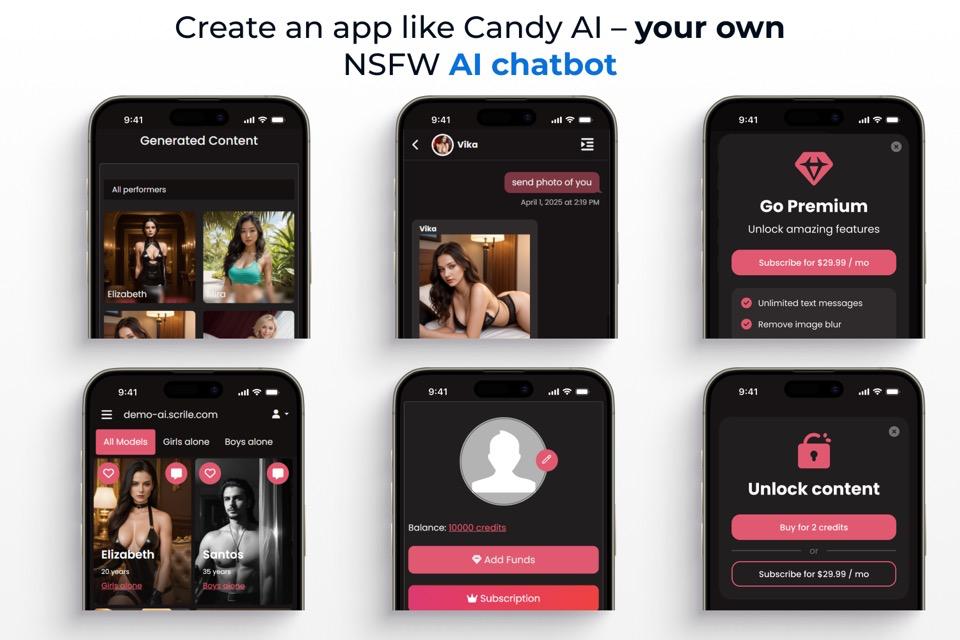
Scripted and Rule-Based Chatbots: Predictable by Design

Rule-based chatbots are built on simple logic. They don’t “understand” language in a human sense. Instead, they follow predefined rules, keywords, or menu paths. Ask the right question in the right format, and you get a useful answer. Step outside that path, and the conversation usually stops or loops back to the start. Menu-driven bots work the same way, just with buttons instead of text.
Despite their limits, these bots are still everywhere because they do one job very well: repeat the same process reliably. You still see them in places where variation is a problem, not a feature:
- Airline booking flows that walk users through dates, destinations, and baggage options
- Bank IVR-style chats used for balance checks, card blocks, or office hours
- Basic website FAQs that answer the same delivery, pricing, or return questions all day
Within the broader types of AI chatbots, this category is the most controlled and the least flexible. That trade-off is intentional. Businesses choose predictability over conversation.
Problems start as soon as users expect more than instructions. Rule-based bots can’t handle open dialogue, tone shifts, or context. They don’t remember what was said earlier, and they can’t adapt when a question is phrased differently. This becomes especially obvious in roleplay or adult chatbots, where users expect personality, continuity, and emotional flow. A scripted response breaks immersion instantly.
NLP Chatbots: Understanding Intent, Not Meaning
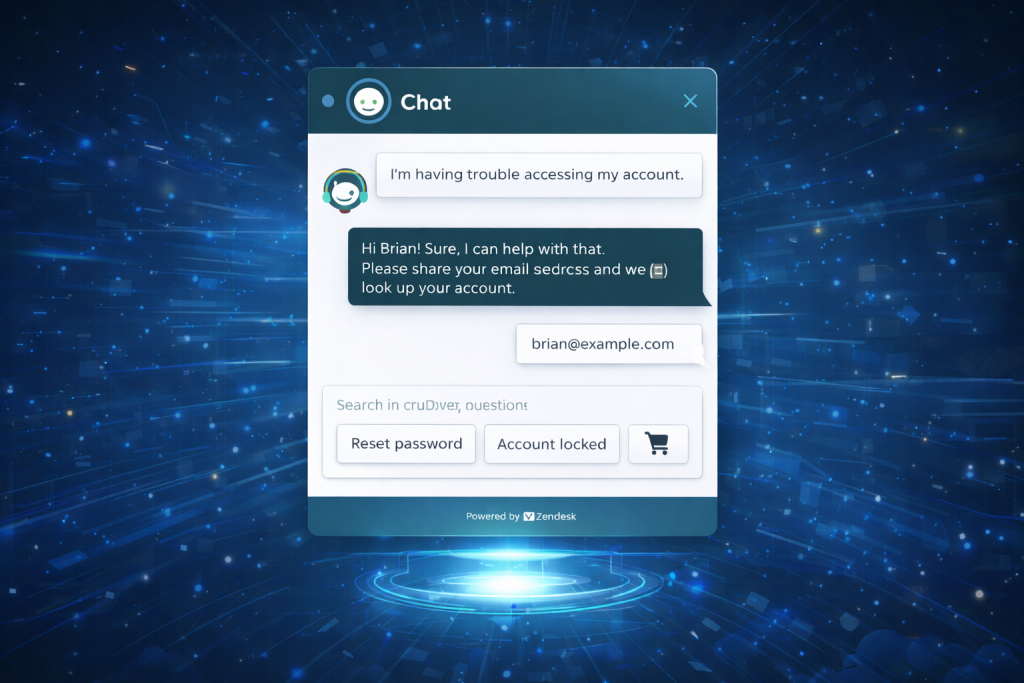
NLP-based chatbots were a big step forward from rigid scripts. Instead of matching exact phrases, they try to understand what a user intends to say. This is where terms like NLP, NLU, and NLG come in. In simple terms, NLP helps the bot process human language, NLU tries to figure out intent and key details, and NLG turns structured data back into readable replies. Together, they allow chatbots to respond even when questions are phrased differently.
This shift improved user experience quickly. Conversations stopped feeling like filling out a form. Users could type naturally and still get relevant answers. That said, these bots still operate on patterns. They recognize intent, not meaning. If a conversation drifts, changes tone, or depends on earlier context, the bot often loses track. It can sound polite and helpful while quietly misunderstanding what the user actually wants.
NLP chatbots became popular in practical, task-focused environments:
- Zendesk bots used for routing tickets and answering support questions
- Intercom automated support handling onboarding and basic troubleshooting
- Early Shopify support bots assisting with orders, shipping, and returns
- Educational assistants answering structured questions or guiding lessons
Some early attempts at persona-based interaction also appeared here. An AI chatbot character might have a friendly name or tone, but the personality rarely held up beyond a few exchanges. Without memory or deeper reasoning, the illusion broke quickly.
NLP bots bridge the gap between rigid rules and more advanced systems. They just aren’t designed for long, evolving conversations where meaning matters more than intent.
Contextual and ML Chatbots: Memory as a Turning Point

Contextual chatbots changed the feel of conversations in a very simple way: they started remembering things. Instead of treating every message as a fresh request, these systems keep short-term context and use it to shape the next reply. That alone makes interactions feel less mechanical.
In broader AI classification, researchers usually talk about four types of AI: reactive, limited-memory, theory-of-mind, and self-aware. Most chatbots only touch the first two. Rule-based and simple NLP bots fall into reactive AI, meaning they respond without memory. Contextual chatbots belong to the limited-memory AI category. They don’t understand users in a human sense, but they can retain recent details like intent, preferences, or earlier answers within a session. That small layer of memory removes a lot of friction.
The other two categories matter mainly as boundaries. Theory-of-mind AI, which would understand emotions, beliefs, and intentions the way humans do, does not exist in production chatbots today. Self-aware AI remains a theoretical concept rather than a real technology. Modern chatbots do not possess awareness or understanding beyond pattern recognition.
Where Contextual Chatbots Work Best
This type of chatbot works best where continuity matters:
- Mental health check-ins benefit from remembering what the user shared earlier. When a bot recalls mood patterns or ongoing concerns, the conversation feels supportive instead of repetitive.
- Coaching tools use memory to track progress. Remembering goals or past feedback allows advice to evolve rather than restart every time.
- Multi-step sales conversations depend on context to feel natural. A chatbot that remembers previous questions or choices avoids pushing users back to square one.
Within the broader types of AI chatbots, contextual systems sit in a middle ground. They feel more responsive than intent-based bots but still have limits. Memory is usually short and narrow, which users notice quickly.
That gap often comes up in the best AI chatbot Reddit discussions, where people compare how long different bots actually remember details before conversations start to flatten out again.
LLM-Based Chatbots: Generative Systems and Their Trade-Offs
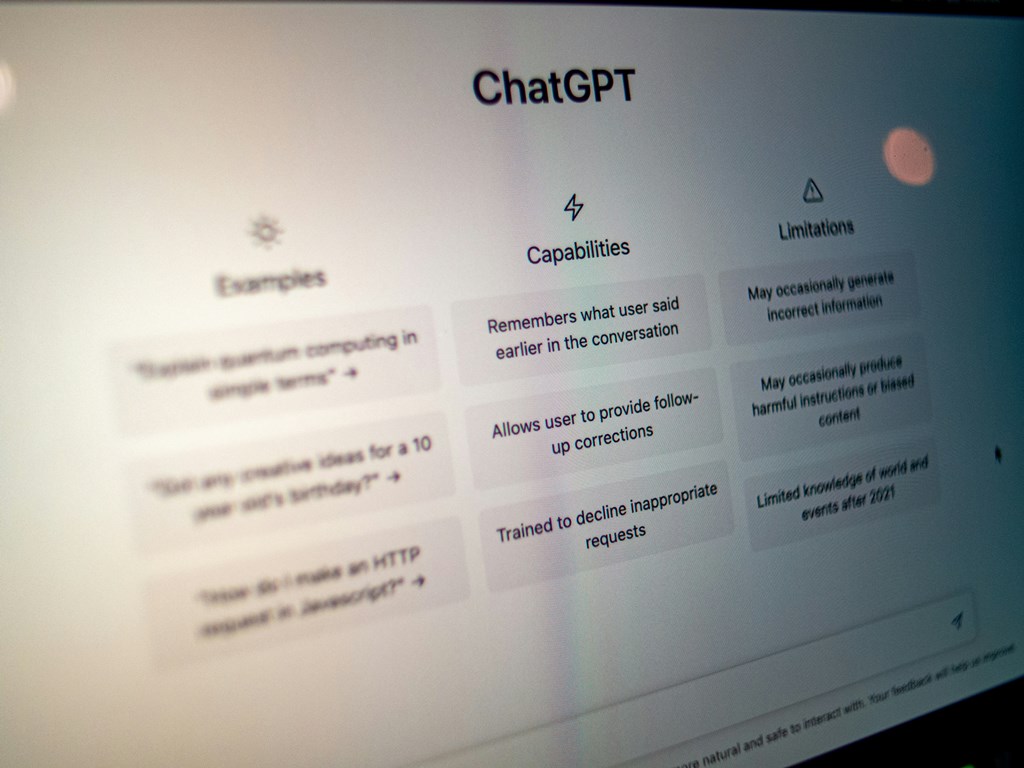
Large language models changed chatbots by removing fixed paths altogether. Instead of selecting replies from a script or intent map, these systems generate responses on the fly. They are trained on massive volumes of human language, which allows them to predict what should come next in a conversation. This is what people usually mean by generative AI. The chatbot is not retrieving a stored answer. It is composing a new one based on patterns learned during training.
This approach unlocked flexibility that earlier systems could not reach. LLM-based chatbots can switch topics smoothly, explain complex ideas, and maintain a tone that feels natural. At the same time, this freedom introduces trade-offs. Because responses are generated dynamically, control becomes harder. Without careful design, the chatbot may drift, hallucinate facts, or respond in ways that do not fit the product’s goals.
You can see these differences clearly in real products:
- ChatGPT is often described as the best AI chatbot for general use because it handles writing, reasoning, and explanation tasks across many domains. Its strength is breadth, not specialization.
- Claude focuses on long-context reasoning and structured writing. It performs well when conversations require memory across lengthy documents or extended discussions.
- Character.AI is widely known as the best AI character chatbot because it centers on persona-driven conversations. Users interact with fictional or themed characters.
- Replika leans into emotional and companion-style interaction. It prioritizes empathy and continuity over factual precision, which shapes how users relate to it.
Many adult chatbots also rely on LLMs to deliver natural dialogue, roleplay, and emotional flow. This is why control becomes critical. When personality, boundaries, and memory are not carefully managed, the same flexibility that makes these bots engaging can also create serious product and moderation challenges.
Hybrid Chatbots: Rules, Memory, and LLMs Together
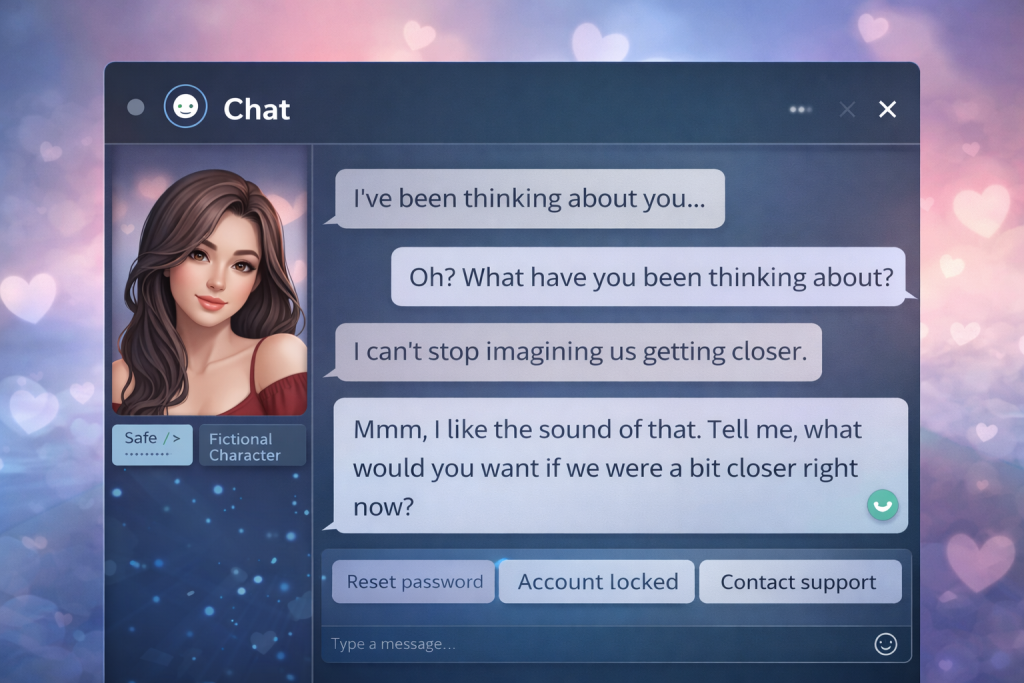
Hybrid chatbots don’t rely on a single technique. They combine rules for control, memory for continuity, and LLMs for flexible language. This lets teams decide where freedom is allowed and where strict logic is required.
Most real products use this setup because extremes rarely work well. Rule-only bots feel rigid. LLM-only bots can be unpredictable. Hybrid systems sit in between, which is why they appear so often across different types of AI chatbots.
Common examples make this clear:
- Banking chatbots lock sensitive actions behind rules, while AI explains products or answers questions naturally.
- Healthcare chatbots allow conversational support but add safety layers that limit medical advice.
- Adult chatbots often mix persona-driven dialogue with moderation logic to keep conversations consistent and within defined boundaries.
Hybrid design is about keeping conversations useful without losing control.
Comparison Table
This snapshot highlights how different chatbot architectures compare in logic, strengths, and real-world use:
| Type | Core Logic | Strength | Weakness | Typical Products |
| Rule-Based | Scripts | Control | No flexibility | FAQ bots |
| NLP | Intent parsing | Better UX | Shallow context | Support bots |
| Contextual | ML + memory | Continuity | Cost | Coaching tools |
| LLM | Generative | Creativity | Control risk | Roleplay bots |
| Hybrid | Combined | Balance | Complexity | Platforms |
Examples of Platforms and Solutions by Chatbot Type
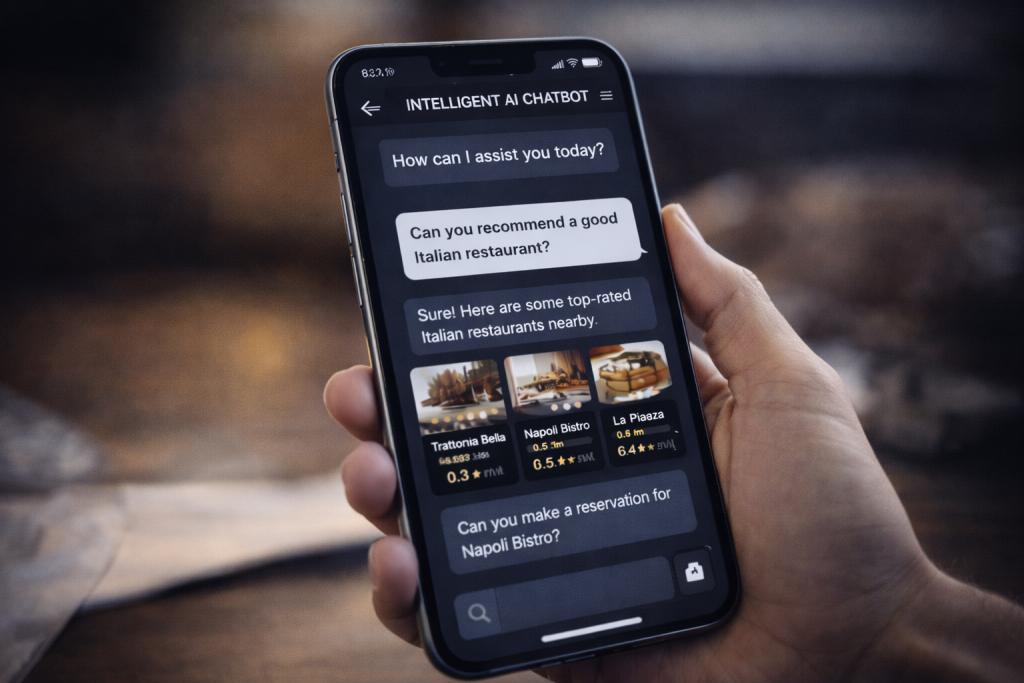
Seeing real products side by side makes the differences between chatbot architectures much clearer. Each category solves a specific problem, and each comes with trade-offs that matter once a chatbot moves beyond testing.
Rule-Based / NLP Platforms
- Drift focuses on sales qualification. Its chatbots guide users through predefined paths, qualifying leads before handing them to human teams.
- Intercom automation combines scripted flows with basic intent detection to handle onboarding and support at scale.
- Tidio targets small businesses, offering simple setup and predictable behavior for customer questions and order updates.
Contextual / ML-Based Solutions
- Ada Health–style triage bots use limited memory to ask follow-up questions and adjust recommendations over a session.
- Duolingo’s conversational practice bots remember recent answers to keep language exercises coherent instead of repetitive.
- CRM-integrated sales assistants track earlier interactions to personalize follow-ups and move leads through longer funnels.
LLM and Character-Based Platforms
- Character.AI centers on fictional personas, letting users interact with themed or story-driven characters.
- Replika emphasizes emotional and companion-style conversations, prioritizing continuity and tone.
- Chai allows users to create and share character bots with varying personalities and constraints.
Adult Chatbot Platforms
- Candy AI–style companions focus on intimate, persona-driven dialogue.
- NSFW roleplay bots built on LLMs rely on generative models to sustain open-ended scenarios.
- Subscription-based adult chat systems monetize access to persistent characters and long conversations.
Market Outlook: Where Chatbots Are Heading
Chatbots are no longer treated as experiments. Many companies now rely on them for everyday tasks. The global chatbot market is estimated at $15–18 billion, and forecasts point to growth above 20% CAGR over the next few years as chat moves deeper into sales, support, education, and internal tools.
Large language models pushed this change forward quickly. Users now expect chatbots to follow context, explain answers, and stay consistent across longer conversations. That shift also revealed weaknesses. Systems without structure can drift, produce unreliable responses, or behave differently from one session to the next. As a result, teams are paying closer attention to how chatbots are built.
This is where different types of AI chatbots start to matter. Simple bots still exist, but they rarely scale well. More advanced designs focus on control, memory limits, and predictable behavior. The emphasis is moving away from novelty and toward systems that can be trusted in real products.
Building Your Own Chatbot with Scrile AI
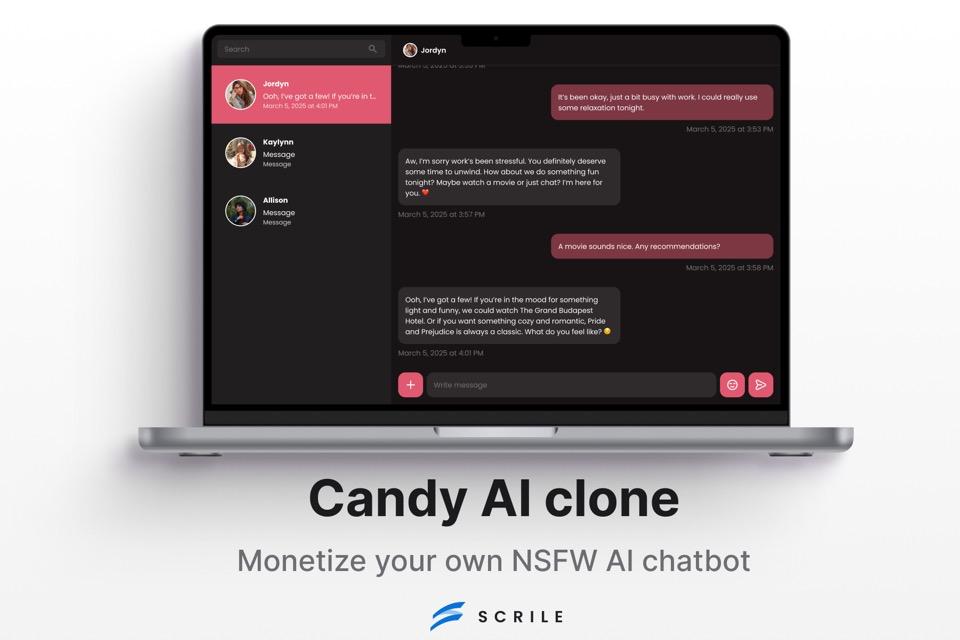
At some point, teams outgrow platforms. What starts as a quick test turns into real usage, real users, and real constraints. That’s when ownership becomes important. Instead of adjusting your product to fit someone else’s rules, the underlying system needs to fit your goals.
This is where Scrile AI steps in. Scrile AI is a custom AI development service, not a ready-made chatbot platform. It focuses on building chatbots from the ground up, with architecture tailored to how the product is meant to work, scale, and earn.
Scrile AI is suited for different chatbot directions:
- Business chatbots — designed around support flows, sales logic, internal tools, and integrations rather than generic answers.
- Character-driven chatbots — where tone, consistency, and personality matter across long conversations. This level of control is critical when aiming for the best AI chatbot for roleplay.
- Adult chatbots — which require clear boundaries, reliable memory behavior, and stable monetization rules from day one.
What custom development really enables is control. You choose the architecture instead of inheriting it. Memory can be short or persistent. Personas can stay rigid or evolve — by design. Monetization, access levels, and analytics are built into the system, not layered on later.
Across different types of AI chatbots, Scrile AI allows teams to build owned systems that can grow, adapt, and stay predictable over time.
Conclusion
Chatbots live or fail based on how they are built, not how impressive they sound in a demo. Architecture defines memory, tone, control, and long-term limits. Choosing a chatbot type is a product decision, not a cosmetic one. Ready-made tools can work for testing, but real products need ownership and flexibility. When conversations matter, building beats adapting. If you’re planning a chatbot designed for real users and real growth, it’s time to contact the Scrile AI team today and start building on your terms.
Related guides
- AI Avatar Generator in 2026: Use Cases & Tips
- AI Character Creator: Build a Persona That Scales in 2026
- How to Promote Your AI Companion Website in 2026
- How Creators Use AI to Sell More Content and Engage Fans
FAQ
How many types of AI chatbots are there?
In practice, chatbots fall into a few core categories. Menu-based and rule-based bots follow fixed paths. NLP chatbots interpret intent from user input. Contextual or ML-based bots add short-term memory to keep conversations connected. The key takeaway is that complexity increases with flexibility and memory.
What type of AI do chatbots use?
Most modern chatbots rely on NLP to process language, NLU to detect intent, and NLG to produce responses. More advanced systems use generative AI powered by large language models trained on vast amounts of text data.
What are the four types of AI?
AI is commonly grouped into reactive systems, limited-memory AI, theory-of-mind AI, and self-aware AI. Today’s chatbots operate mainly within reactive and limited-memory categories.
