
Will AI Replace Software Engineers?
Will AI take over the role of software engineer? AI can automate certain repetitive tasks, but the role of architecture, strategy, and ownership still lies with people and human-based engineers. There is much more to understand about software development than just the current changes and how it has evolved over time.

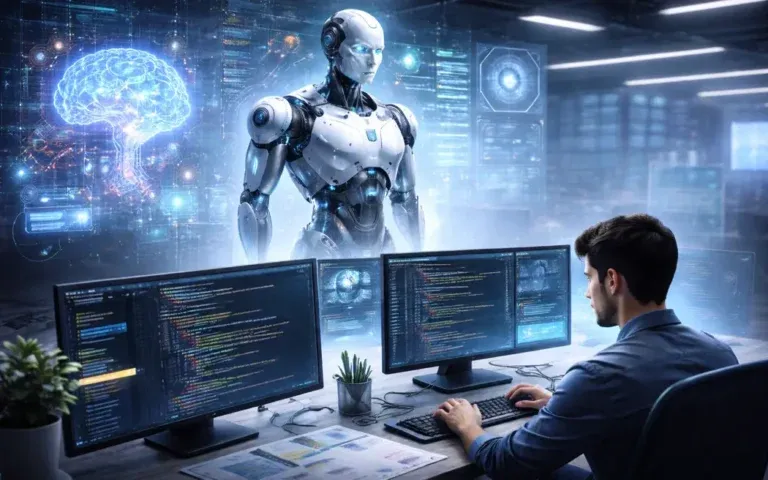
will AI replace software engineers
Will AI Replace Software Engineers, or Are We Asking the Wrong Question?
Let’s address the fear directly: will AI replace software engineers? This is a question being searched for quite a bit right now within the technology sector. And you can see why, because there are many weekly demonstrations showing AI writing complete applications in minutes. Naturally, this leads to the next wave of concern: will AI replace programmers? The short answer is no. But let’s discuss it in detail.
Will AI Replace Programmers in 10 Years?
Though AI tools may seem promising to assist in programming at first glance, there’s more to AI than meets the eye. For example, AI may generate repetitive code to help you generate unit tests or suggest improvements from an architectural perspective. However, to startup or solo founders, these AI tools are perceived as game-changers with tremendous increases in productivity and greatly reduced costs. This shift is all over the news right now. But there is a vast difference between generating code and owning the system.
While AI has an incredible ability to learn trends based on previous experiences, it does not understand the many factors that go into making business decisions based on these patterns or how they will affect a business. AI also never participates in project meetings, nor does it hold any accountability when it disconnects from the database during a production outage at two o’clock in the morning. Additionally, AI is making technical decisions inconsistent with my long-term technical strategy.
When someone asks if there will come a time when AI will replace a software engineer, they are typically referring to coding as the simple act of writing lines of code. As we have seen throughout all of history, coding has always been about solving human problems of a very complex nature while working under some sort of constraint.
In the next section, we will discuss what AI can currently do today and the areas where AI continues to experience challenges.
What AI Can Do Today and Where It Still Falls Short

What AI Does Extremely Well
AI is impressive. But it is not magic. Functional program code can now be generated quickly and easily using AI tools that can create code from plain text quickly. For example, legacy systems can be converted, documentation can be created, and test cases can be created all in just seconds using AI tools.
In addition to increasing the speed of software development, these AI tools enable entrepreneurs to pilot their idea within a week, compared to months for larger organizations. This implies that this will change the way we build software economically.
In conclusion, AI technology accelerates software development time.
“Is AI Stupid?”: Why the Question Isn’t So Silly
Now let’s address a common frustration: Is AI stupid? A lot of times, it rings “true.” AI generates incorrect code with confidence. Hallucinates nonexistent libraries, misunderstands poorly written specifications, and lacks context for your infrastructure, users, or compliance constraints.
AI is statistically predicting the next probable item and does not have true understanding in a human way. It has no understanding of your product vision. AI predicts the next probable result based on statistics for its last response. Therefore, when you use vague prompts, you will likely not get reliable responses. This is also why you typically get better results from an experienced software engineer than you do from a junior engineer, as the experienced engineer is more adept at directing the tool.
Why It’s Still a Powerful Lever
Despite its flaws, AI is a serious force multiplier. It handles repetitive logic, surfaces edge cases, and suggests improvements you might overlook. Used correctly, it boosts productivity without replacing judgment.
The key insight is simple: AI performs tasks. Engineers own outcomes. And that distinction changes everything.
What Does a Coder Do?
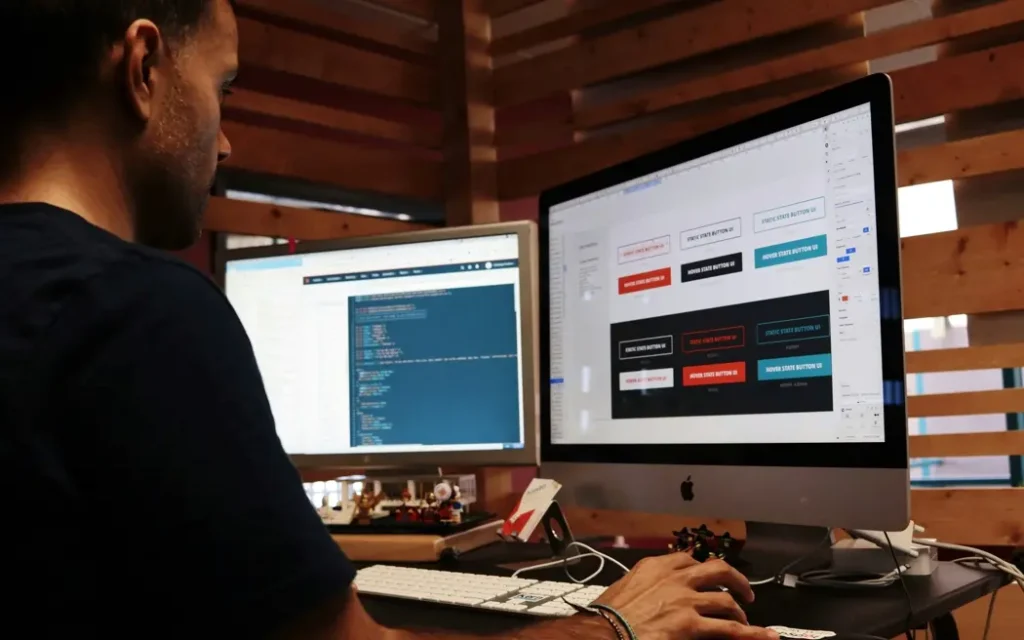
If you reduce software engineering to typing syntax, then yes, AI looks like a replacement threat.
But that view misses the point entirely. So, let’s answer a fundamental question: what does a coder do in real life?
The Real Role of a Coding Engineer
A professional coding engineer doesn’t just translate ideas into Python or JavaScript. They clarify vague requirements; they ask uncomfortable questions; they turn business chaos into structured systems.
To begin with, the requirements will be investigated. What is it we want to solve? Who uses our application? What are common scenarios that will generate high traffic? Next, we make decisions regarding the technical architecture of the application:
- Will we build the application using microservices or a monolith?
- Should we use SQL or NoSQL?
- Do we want to focus on developing for speed or consistency?
Following this is the actual implementation of the application. Although coding will take place, this only makes up a portion of the work completed by the engineers during the implementation phase as they review pull requests, ensure security, maintain scalability, and create deployment strategies. Additionally, prior to creating the application, the engineers need to think about “what ifs.”
Finally, taking responsibility is another key item. Whereas an AI can propose the system architecture for the database, it cannot be responsible for maintaining it during a traffic surge.
What Are Coding Jobs Becoming Today?
The definition of what is coding jobs is already evolving. Integrating APIs, orchestrating cloud services, and collaborating with multiple teams take up a lot of an engineer’s time. Because of this, communication skills are more important than ever, and product thinking is no longer optional.
Many engineers at companies today also use AI-based tools in their normal workflow, which includes validating output from the tools, refining prompts used in the tools, and integrating generated code from the tools into production.
This is not a replacement. It is expansion. The job is moving away from being just syntax-driven to being focused on systems, judgment, and ownership. This will be much more difficult to automate than creating an automated version of the job.
How Much Do Coders Make a Year?

Let’s talk about money. Because behind every “AI will replace developers” headline, there’s a financial anxiety. So, how much do coders make a year today?
In the U.S., junior developers often start between $70,000 and $95,000. Mid-level engineers typically earn $100,000 to $140,000. Senior engineers and specialized experts can exceed $160,000 or much more, especially in AI, security, or distributed systems. That’s not a fragile profession.
Is AI Driving Salaries Down?
Not really. AI is altering job functions from the ground up. Companies are not just looking to pay for someone’s ability to do CRUD operations anymore because they can already use AI to help with that. Instead, they want to pay for an engineer who is capable of designing a scalable system, making value or trade-off decisions, and producing high-quality products in a shorter amount of time.
Essentially, productivity is increasing, and therefore, the standards of everyone will increase as well. Junior-level positions may become more difficult to fill because of the increased automation of routine jobs. However, engineers who know how to architect their systems, utilize DevOps principles, and integrate AI will become much more marketable than before.
The New Competitive Edge
The way we think about software development is changing from “Do you have coding skills?” to “What will you create?” Developers who are able to work successfully with AI tools will generate more speed in their work. They will also be faster in their process of prototyping, debugging, and making decisions rather than worrying about syntax.
Therefore, the “star” developers will be compensated at a higher level compared to the average-performing developers. Thus, even though AI will not change salaries for developers significantly, it will change the disparity between developers who are strategic thinkers and developers who execute simple tasks. This storyline differs greatly in comparison to simple job replacement.
Will AI Replace Programmers in 10 Years or Just Redefine the Role?
Now let’s project forward. The real anxiety hides inside this question: will AI replace programmers in 10 years? Technology has seen tremendous advancements over the last 10 years, especially in the area of generative AI. Generative AI has changed from basic coding scripts to AI co-pilots that many businesses are beginning to use. With such a rapid rate of advancement in this space today, it is reasonable to believe that there will be even greater advancements in the future.
| Scenario | Key changes | Impact and outcome |
| Automation of routine work | Routine coding responsibilities will become less frequent. Boilerplate, API wiring, and standard UI components will be generated automatically. | Entry-level programmers will need to continue to develop their basic skills and supervise the output of AI. The bar will continue to rise as the nature of work may change and evolve rather than just disappearing. |
| AI-augmented senior engineers | AI can be a powerful aid in writing code, optimizing systems, and simulating scenarios. | Senior developers will act as technical directors. Their productivity will increase, their teams may get smaller, but the decisions and accountability will still be done by humans. |
| New AI-driven roles | There are new job roles arising in and around AI systems, automation, and workflow creation. Examples of new job roles include AI developers and automation specialists. | Engineers move to the design, training, integration, and monitoring of AI systems that align with business goals. When AI is created, there will be new types of specialties rather than replacing existing jobs. |
Therefore, instead of asking the question, “Will AI replace software engineers?” You should be asking, “Are programmers going to be able to change fast enough to lead the transformation?”
What Will Really Change: Tasks Will Shift, Not Disappear
Here’s the part that often gets lost in dramatic predictions. AI doesn’t remove responsibility. It redistributes effort. In practice, that means engineers will spend less time writing repetitive logic and more time making decisions. The mechanical part shrinks. The strategic part expands. That shift is already visible.
Task Redistribution Inside Teams
The bulk of traditional coding, simple refactoring, and documentation will eventually become largely automated. Instead of writing each function by hand, engineers will be responsible for monitoring and validating the functions generated by an AI-based system. On the other hand, architecture design, performance optimization, security planning, and system resiliency will continue to require strong human input.
An AI could suggest 5 possible alternatives to a problem. However, when it comes down to the selection of a solution based upon a combination of market positioning, legal liability, budget constraints, and scaling out over time, the decision is incumbent upon humans.
The Rise of AI-Native Products
Another huge change happening now is at the product level; many more businesses are building AI right into their customer-facing tools. Examples of this include internal copilots, AI-based dashboards, and automated support assistants, which are now being seen as standard functionality.
These systems need to be designed by someone, for example, who will be responsible for designing the experience for end users and defining how those experiences generate revenue?
In other words, this wave of new products will be led by engineers that understand both AI capabilities and the business context in which they exist. Therefore, no one is coming to take their jobs. They’re just being pushed higher up and therefore won’t see that as a threat to their own careers. Ambitious developers will see it as an opportunity or leverage. They will realize they can use the tools available today to build a better future for themselves and those around them.
From Developer to AI Product Creator: Turning Skill Into Leverage

Now we get to the interesting part. Instead of asking whether AI will replace you, a smarter question is: how can you use AI to build something of your own?
Many developers underestimate this shift. They focus on employment risk. Meanwhile, the real opportunity sits right in front of them.
Developers as AI Entrepreneurs
If you understand systems, workflows, and user problems, you already have a strong foundation.
You can build:
- A niche AI assistant for lawyers, marketers, or educators.
- An internal AI tool for small businesses.
- A paid knowledge base powered by smart search.
- A training platform that uses AI for personalization.
Instead of fearing that AI will take over your work, it makes more sense to use it to create your own product. For example, an AI assistant for your niche, a training service, or a smart reference book. And this is where infrastructure matters.
In this situation, Scrile AI provides a completed platform that will act as the foundation for developing such services. You will concentrate on devising the logic and designing the end-user experience while leaving the Scrile AI platform the infrastructure management responsibilities, as well as the billing processes. That changes the equation.
You no longer need to spend months building subscription systems, payment integrations, or user dashboards from scratch. You can concentrate on value and differentiation.
In a world where AI accelerates development, speed to market becomes a serious advantage. And that’s how engineers move from being task executors to product owners.
Launch Your AI Idea With Scrile AI

Scrile AI provides assistance to individuals and businesses wanting to develop and launch an AI product quickly.
The main benefits of Scrile AI include:
- A template that provides the majority of your system’s architecture.
- An easy way to manage your subscription and payment systems.
- A mechanism for controlling access to your system for user accounts.
- A method for creating content and managing your audience with ease.
- A fully scalable hosting infrastructure.
All of these components typically require a substantial amount of development time. The platform approach will create substantial reductions in your setup and development costs.
You will not build your own authentication system and billing process but integrate into an existing framework in order to modify it per your product.
Who Benefits From Scrile AI?
- Developers creating very specific niche-based AI tools.
- Consultants who want to turn their expertise into an automated service.
- A community of content creators who want to integrate AI capabilities within their communities.
- An entrepreneur who would like to test the validity of an AI SaaS concept.
The barriers to entry for launching a digital product developed around AI have been diminished significantly.
From a discussion standpoint about AI replacing engineers, this is more about using AI as a component of building a product.
Turn your technical knowledge into a scalable product, not just a job. Launch your AI service with Scrile AI.
FAQ: Will AI Replace Software Engineers?

Can AI replace a software engineer?
There’s no clear answer to if AI can ever fully replace human software engineers, but the short answer is no, not at all. While there are many repetitive coding tasks that can be automated or made easier with an AI’s assistance, the act of designing a system, performing a business analysis, developing an architectural design, and being accountable for the final product are still the responsibility of the engineer. AI can support engineers in their efforts by helping them to achieve a higher level of productivity, rather than ultimately replacing the engineering role.
Will software engineers be replaced by AI by 2030?
AI will likely automate a lot of boring technical tasks by 2030. However, there are still a lot of difficult things to do when it comes to writing software where human input is needed, such as making decisions about how it should be designed, settled, and communicated. Developers will supervise and validate the code created through AI and will be able to concentrate on building the logic of their products, determining how best to improve them, and other things. The bottom line is that AI will change how software is created but will not replace the need for people to create it.
Will AI replace programmers by 2050?
Speculation exists around predictions for 2050. The evolution of technology and capabilities will increase the productivity of AI. Regardless of how automated our systems will be at this point in time, one thing is for sure: humans will still play an important role in overseeing them, since these things won’t likely be completely automatable.
Programming will differ greatly from what we currently see in the future, with AI handling the bulk of the implementation and engineers being relegated to supervising the work being done through design and innovation.
The integration of people and systems will not result in the complete replacement of either. Rather, there will be an ongoing synthesis of human expertise with intelligent systems.

Related guides
