
Best Automated Testing Tools in 2026: Comparison and Use Cases
Compare automated testing tools for web, API, mobile, visual and CI/CD workflows, with practical criteria for choosing the right QA stack in 2026.

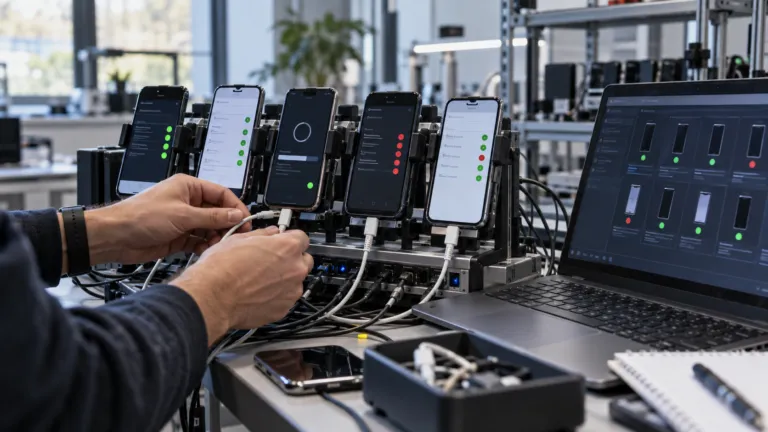
QA engineer connecting devices on an automated software testing bench
Quick answer
The best automated testing tools in 2026 depend on what must be protected. Playwright and Cypress suit modern web journeys; Selenium remains useful for broad browser and language flexibility; Appium covers native mobile applications; Postman and REST Assured address APIs; and visual platforms such as Applitools detect rendering changes. Choose by product risk, stack compatibility, team skills, CI/CD fit, test ownership and exit options—not by a universal ranking.
How to Choose the Best Automated Testing Tools
Choose automation software by matching each material product risk to a test layer your team can operate reliably. Project type, technology stack, budget, engineering capacity and integrations matter more than the number of features on a vendor page.
Start with the failure that costs money. An online platform may need to protect registration, permissions, subscriptions, payouts and content access before it needs exhaustive interface coverage. Map those journeys, identify whether each failure originates in the browser, API, mobile client or external integration, and then evaluate tools against that map. A browser framework cannot prove that a webhook was processed correctly; an API suite cannot detect an unusable checkout layout. This risk-first method also prevents teams from automating hundreds of low-value cases while the payment path still depends on someone clicking through it on Friday afternoon.
| Decision factor | Question to ask | Likely direction |
|---|---|---|
| Application surface | Web, native mobile, API or several? | Use a specialist per critical surface. |
| Team capability | Who will maintain tests after launch? | Prefer familiar languages and debuggers. |
| Release process | Must tests block every deployment? | Require stable CI integration and artifacts. |
| Ownership | Can tests and data be exported? | Avoid an irreversible proprietary format. |
| Budget | What operating cost replaces license cost? | Include maintenance and execution infrastructure. |

Which Tools Fit Regression, API, End-to-End and Mobile Testing?
Use Playwright, Cypress or Selenium for browser automation; Postman, REST Assured or similar code-level clients for APIs; and Appium for native mobile coverage. The right choice depends on the surface under test and who will maintain the suite.
Playwright is a strong default for modern end-to-end web tests because it combines browser control, isolation, tracing and parallel execution in one framework. Cypress offers an approachable developer workflow for browser applications, although teams should validate support for their exact cross-origin and multi-context journeys. Selenium remains valuable when an organization needs broad language choice, established WebDriver infrastructure or compatibility with a mature suite. Appium extends the WebDriver model to native and hybrid mobile applications. For service contracts, Postman helps teams collaborate around requests and collections, while REST Assured suits Java teams that want API checks reviewed and versioned as code.
- Regression: keep durable business assertions in code and reserve full-suite runs for meaningful checkpoints.
- API: test authorization, validation, idempotency and error behavior below the interface.
- End-to-end: cover only journeys whose components must be proven together.
- Mobile: test device-specific permissions, interruptions and platform behavior, not merely responsive web pages.

How Should a Multi-Role Platform Be Tested?
A configurable platform needs tests organized around money, identity and state. Protect monetization, role boundaries, localization, integrations and cross-device continuity before polishing broad cosmetic coverage.
The dangerous defect is rarely a button that looks slightly wrong. It is a creator seeing another creator’s data, a canceled subscriber retaining paid access, a localized price using the wrong currency, or a successful payment failing to unlock content. Model tests as journeys plus state changes: visitor to member, member to subscriber, creator to paid creator, and active subscription to canceled access. Then exercise those transitions through both API and interface layers. Teams building a creator platform MVP should keep this critical matrix deliberately small enough to run on every release while deeper permutations run separately.
Worked example: assume the team identifies 20 critical journeys, 4 user roles and 3 billing states. A naive full matrix contains 240 combinations: 20 × 4 × 3. Do not turn all 240 into end-to-end tests. First eliminate impossible combinations, cover authorization rules mainly at the API layer, and retain browser tests for representative revenue paths. The calculation exposes scope; risk analysis decides coverage.
- Monetization: purchase, renewal, cancellation, refund and entitlement changes.
- Permissions: direct URLs, APIs and administrative actions for every role boundary.
- Localization: currency, dates, translated layouts and fallback behavior.
- Integrations: delayed, duplicated, reordered and rejected external events.
- Devices: session continuity and completion of critical journeys across supported clients.

How Do CI/CD, Team Skills and Budget Change the Decision?
The best test automation software must produce fast, interpretable release evidence inside the delivery pipeline. License cost matters, but maintenance labor, execution infrastructure, flaky failures and delayed deployments usually determine whether the stack survives.
Run a proof of concept against the real application, repository and pipeline. Ask one engineer who did not create the test to diagnose a deliberate failure from the generated trace, screenshot, log or report. Check whether tests can be sharded, retried selectively, tagged by risk and run against disposable environments. Also inspect authentication handling, secrets management, test-data setup and cleanup. A managed testing platform can reduce browser or device infrastructure work; an open framework can provide greater control and portable source code. Neither model is automatically cheaper. The operational bill arrives through different doors.
- Automate one revenue journey, one permission boundary and one integration failure.
- Run them repeatedly in the existing CI/CD system, including concurrent builds.
- Change a selector, API response and test account state; measure diagnosis effort.
- Verify test export, artifact retention, access controls and data handling.
- Record who owns upgrades, flaky-test triage and failed-release decisions.
Tie automation outcomes to creator platform metrics such as successful purchases, activation and retained access, but do not confuse a passing test with a healthy business metric. Tests confirm expected behavior; observability reveals what real users experience.
Consider two teams buying the same managed service. One has a QA engineer who owns test architecture; the other expects product managers to record flows between releases. Identical licensing can produce radically different results because ownership is the missing variable. Low-code recording may accelerate initial coverage, yet complex state setup can still require engineering. Conversely, an open-source runner has no license fee but is not free to operate. Name the maintainer, triage routine and pipeline budget before procurement, or the suite will become an expensive warning system that everyone learns to ignore.

Where Do AI-Assisted Testing Tools Actually Help?
AI is most useful for bounded work: drafting tests, suggesting edge cases, grouping failures, identifying visual differences and repairing low-risk selectors. It should accelerate judgment, not become the authority on whether a release is safe.
Evaluate an AI feature by the artifact it leaves behind. Generated tests should be readable, reviewable and preferably exportable in the framework your team already uses. Failure summaries should link to the underlying evidence rather than replace it. Self-healing selectors need an audit trail because a test that silently follows the wrong element is worse than a test that fails loudly. Visual comparison can reduce manual review, but dynamic content, personalization and localization require carefully defined regions and tolerances. For sensitive products, establish what source code, screenshots, prompts and user data leave your environment before enabling any assistant.
| AI-assisted task | Potential value | Required control |
|---|---|---|
| Test drafting | Faster first version | Human review of assertions |
| Failure clustering | Less repetitive triage | Links to raw artifacts |
| Selector repair | Lower routine maintenance | Logged changes and confidence limits |
| Visual review | Prioritized differences | Approved baselines and exclusions |
| Edge-case suggestions | Broader exploration | Risk owner selects what matters |
The same governance principle applies to automated content creation: generated output needs ownership, review criteria and a clear route back to its inputs. In testing, attractive prose about a failure is not evidence that the diagnosis is correct.

How Do You Assemble the Right Testing Stack?
Build the stack from the lowest reliable layer upward: unit and component checks, API contracts, a narrow set of end-to-end journeys, specialist mobile or visual coverage where justified, and exploratory testing for ambiguity. Every layer needs an owner and a removal condition.
Begin with the release gate, not a shopping list. Fast deterministic checks should reject obvious defects first; API tests should validate business rules and permissions; browser or mobile tests should prove only the critical assembled journeys. Add visual testing when presentation itself carries material risk, and managed device coverage when supported hardware cannot be represented locally. Document which suite answers which release question. If two tools detect the same failures at similar cost, remove one. If a proprietary service disappears, the team should know which test assets, data and reports remain portable.
- List the five failures that would stop a release or damage trust.
- Assign each failure to the lowest test layer that can detect it reliably.
- Select one primary framework aligned with the application language and team skills.
- Add specialist services only for uncovered browser, device, visual or reporting risks.
- Review failures quarterly and retire tests that no longer support a decision.
Once the basic stack of best automated testing tools is established, the logical next step can be a proprietary AI layer: an assistant that drafts tests, analyzes results and helps the QA team. Instead of building the surrounding AI product experience from scratch, Scrile AI – AI Companion Platform can support a branded assistant with AI chat, generated content, subscriptions and paid access, launched as an internal service or a separate client product.

Add an Owned AI Layer to Your QA Operation
A dependable testing stack creates structured evidence: tests, failures, artifacts and operating rules. If your next product decision is to wrap that expertise in a branded conversational experience, Scrile AI supports AI chat, character experiences, generated content, paid access and subscriptions.
Use it to launch an AI companion or character product with customized branding and workflows. Repository access, CI integration and QA governance still require project-specific implementation, but the commercial platform layer does not have to begin as a blank page.
Frequently asked questions
What are the best automated testing tools in 2026?
Playwright, Cypress and Selenium are leading choices for web automation; Appium serves native mobile testing; Postman and REST Assured cover APIs; and visual-testing services add interface comparison. The best combination depends on product risk, stack and maintainers.
Is Playwright better than Selenium?
Playwright is often a simpler default for modern web applications, with integrated tracing and browser-context features. Selenium may fit organizations that need broader language flexibility, existing WebDriver infrastructure or continuity with mature suites.
Should a team choose Cypress or Playwright?
Choose through a proof of concept using your hardest real journeys. Compare browser coverage, debugging, multi-page behavior, pipeline execution and team familiarity rather than relying on a generic ranking.
Which tool is best for API test automation?
Postman suits collaborative request collections and accessible workflows. REST Assured fits Java teams that want API tests maintained as code. Other language-native clients may be better when they reduce dependencies and match the application repository.
Can one tool automate every type of software testing?
No single tool provides equally strong web, API, native mobile, visual, performance and exploratory coverage. A small layered stack is usually more maintainable than forcing every risk into one interface.
Are AI testing tools ready to approve releases autonomously?
AI can draft tests, summarize failures and assist maintenance, but accountable people should retain release authority. Generated assertions, repaired selectors and diagnoses require reviewable evidence and audit trails.
How should startups budget for test automation?
Budget for maintenance labor, CI execution, environments, test data, devices, reporting and failure triage as well as licenses. Start with revenue and permission risks, then expand where incidents or release friction justify the cost.
What should be automated first in a subscription platform?
Automate registration, authentication, purchase, renewal, cancellation, entitlement changes and role boundaries first. Cover business rules at the API layer and retain a small number of end-to-end checks for complete customer journeys.
